SCOTUS Roundtable: Shadow Dockets, Parental Rights and the Power of Justice Amy Coney Barrett
8.5.2025
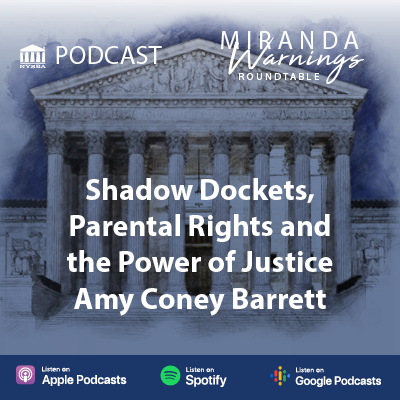
This week’s Miranda Warnings podcast features U.S. Supreme Court rulings ranging from the reach of executive power to the influence parents hold in determining school curriculum.
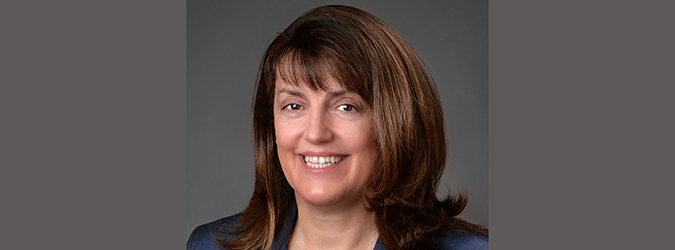
The podcast brings together Albany Law School professor Vin Bonventre and political strategist Liz Benjamin. NYSBA past president and general counsel David Miranda moderates it.
The U.S. Supreme Court issued more than a hundred decisions this past term on an emergency basis, which means there were no arguments held. Bonventre noted that in most of those cases, colloquially referred to as the shadow docket, the justices were divided.
“None of the administrations prior to this had 113 cases in one year, not even close,” he said.
Bonventre previously highlighted the court’s 6-3 split. Now, he contends the court’s nine justices are splintered into a 3-3-3 court.
“You’ve got Roberts, Kavanaugh and Barrett, those are the deciding votes. They are in the majority, most often, by far,” he said. “The other two groups are Justices Jackson, Kagan and Sotomayor on the left and Justices Thomas, Alito and Gorsuch on the right. Ketanji Brown Jackson, Sonia Sotomayor are in the majority the least, as are Thomas and Alito,” Bonventre added.
The panel then discussed the case of Trump v Casa, which addressed the authority of judges to issue universal injunctions to block the enforcement of a government policy nationwide. Three District Court judges blocked enforcement of Executive Order 14160, which redefines the government’s understanding of the citizenship clause of the 14th amendment to the Constitution.
The court ruled in a 6-3 decision to limit the use of universal injunctions. The panelists recognized the increasing influence of Justice Amy Coney Barrett who wrote the majority opinion in the case and the strong public reaction to the ruling from those on both sides of the political spectrum.
“Amy Coney Barrett made it absolutely clear that this case was not about the merits of birthright citizenship. It’s purely do we allow one trial court judge to issue an order that holds up an entire branch of government,” Bonventre said.
“She is clearly doing what she thinks is the right thing to do, which makes others angry,” added Benjamin.
Lastly, the panel tackled the issue of the First Amendment’s free exercise clause in the Mahmoud v Taylor case in which parents wanted to remove their children from instruction involving LGBTQ+ themed storybooks.
“The overriding legal issue is whether states can permit or prohibit this [exclusion of students],” said Miranda.
“The parental choice case is really about something entirely different than whether or not you have to have your kid sit in a reading circle with a book on an issue you don’t like,” countered Benjamin. “The problem is the separation of church and state and the chilling effect on education with far reaching implications.”
Bonventre offered a different perspective, saying that conservative students in his classes are often afraid to speak up.
“That is a real failing of higher education, that people who have dissident views don’t feel safe to express them,” said Benjamin.
You can listen to the full conversation below on our YouTube channel or your favorite podcast platform.