



Labor Employment Section Logo 50 Years

WHO WE ARE

The Labor and Employment Law Section brings together members from across the spectrum of labor and employment law, including representatives of labor organizations, management and individuals; neutrals; academics; and government representatives. We invite everyone with an interest in workplace improvement and development to join our Section, benefit from our experience and expertise, and enjoy our camaraderie. Section membership is open to all regular, associate and law student members of the New York State Bar Association.

Labor and Employment Law Section Mission Statement
To examine the possibilities of improvement and reform in labor and employment law through legislation; to disseminate information and exchange ideas relating to the development and practice of labor and employment law, both substantive and procedural; and to further the education of the Bar and the public in labor and employment law.

MEMBER BENEFITS 

Members of the Labor & Employment Law Section have exclusive access to the following benefits:

  • Continuing Legal courses/content – learn from NYS legal leaders – Free and exclusive to members only 
  • Up-to-date information on recent impactful legal developments. Check our blog and follow us on LinkedIn
  • Networking opportunities
  • Opportunities to write and/or present as a subject matter expert
  • Opportunity to participate in any of the Section’s standing Committees.

SECTION CONTENT – For Members Only

  • Access to online case research through Loislaw, a searchable directory of members,
  • The Section’s newsletter, Labor and Employment Law Journal,
  • Materials and presentations from recent CLE programs.

The Labor and Employment Law Section has been in the forefront of introducing, monitoring and evaluating legal developments at both federal and New York State levels. Section members include neutrals, management, and labor and employee attorneys. (Labor and Employment Law Section – New York State Bar Association (nysba.org))

CONTACT US

To learn more about this Section, please contact Lori Randle
lrandle@nysba.org
(518) 487-5582

Please do not contact the Section liaison with a request for legal advice or an attorney referral. You can instead visit our ‘Public Resources’ or ‘Lawyer Referral Service’ page for this type of request.

Iyana Titus

Iyana Titus


Assistant Commissioner for Diversity, Equity, Inclusion & Belonging, NYC Parks & Recreation

Iyana Titus serves as Assistant Commissioner for Diversity, Equity, Inclusion & Belonging at NYC Parks, where she leads the development and implementation of the agency’s diversity, equity, inclusion, and belonging strategies, policies, and practices. In this role, she oversees EEO investigations and helps ensure compliance with federal, state, and local anti-discrimination laws, among many other employment-related responsibilities. Throughout her career, she has primarily practiced in government settings, serving in various in-house legal and leadership capacities. Her innovative work contributed to NYC Parks receiving a 2019 Innovation Award from the New York City Department of Citywide Administrative Services.

In addition to her leadership role at NYC Parks, Ms. Titus serves as a neutral in employment discrimination matters. She is a member of the mediation panel for the U.S. District Court for the Southern District of New York and serves as a pro bono advocate with the Mediation Advocacy Program for the Eastern District of New York.

Driven by her passion for alternative dispute resolution, Ms. Titus established NYC Parks’ first Alternative Dispute Resolution Program, which includes mediation services for workplace disputes. She also launched the agency’s Restorative Practices Program, centered on the use of community-building circles to strengthen workplace relationships and foster belonging. Most recently, she authored the article,

“Using Restorative Practices to Create Restorative Park Systems,” published in Parks & Recreation magazine by the National Recreation and Park Association.

Ms. Titus has also served as an adjunct professor at Borough of Manhattan Community College, where she taught Human Resources Management. She frequently serves as a guest lecturer and trainer on topics including mediation, diversity and inclusion, restorative justice, and workplace conflict resolution.

She earned a Bachelor of Arts degree from Emory University, a Juris Doctor from Loyola Law School, and a Master’s degree in Comparative Labour and Organization Studies from the University of Amsterdam, where she wrote her thesis on diversity management within the Dutch police force.

During her term, Ms. Titus hopes to strengthen community within the Section while cultivating and empowering the next generation of leaders.

Outside of her professional endeavors, Ms. Titus serves as a deacon at her church and enjoys running and traveling. She lives in Harlem with her husband.

Online Community

Labor & Employment Law Section Publications

Newly released issues are restricted to Section & Committee Members only for the first 90 days, after which they become available to all members.

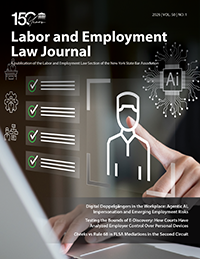
A person touches a digital screen showing employment icons, text, and an AI symbol. The cover reads Labor and Employment Law Journal with article topics listed below. A 150th-anniversary logo is in the top left corner.

Labor and Employment Law Journal

The Labor and Employment Law Journal features peer-written substantive articles relating to the practice of labor and employment law on various topics including ERISA, ADR, discrimination, social media and workplace issues. Also included are regular columns on labor matters and ethics, and updates on Section activities. The Labor and Employment Law Journal is published by the Labor and Employment Law Section and distributed to Section Members free of charge.

The Labor and Employment Law Journal is published as a benefit for members of the Labor and Employment Law Section and is copyrighted by the New York State Bar Association.

The Labor and Employment Law Journal encourages article submissions on topics of interest to members of the Section. Writing an article for a NYSBA Section publication is a great way to get your name out in the legal community and advertise your knowledge. Our authors are respected state-wide for their legal expertise and have written articles in such areas as ERISA, ADR, discrimination, and workplace issues.

Image Placeholder

Article Library

Looking for specific articles from our issues? Explore our library of individual articles, available from current and past editions.

View article library

Author Guidelines

NYSBA has created comprehensive author guidelines, with information regarding our reprint policy, style guidelines, and obtaining MCLE Author Credits.

Bylaws of the Labor and Employment Law Section

Approved on November 14, 2022 and amended on September 18, 2022

View the Bylaws

In Accordance to Article IV, Section 1 of the By-Laws, here is the nominating report for the June 1, 2024 to May 21, 2025 term. The nominations have been voted on and approved at the Business portion of the Labor and Employment Section’s Annual Meeting on January 18, 2024, immediately before the Labor and Employment Law Section’s Annual Meeting CLE Program.

Meeting Papers and Materials


Americans with Disabilities Act Amendments Act
The Americans with Disabilities Act Amendments Act (ADAAA) – By Simeon Goldman, Esq., September 2011 (pdf)

Collective Bargaining— Public Sector
Government Consolidations and the Taylor Law: Cooperate, Litigate, or Legislate? – By Matthew Bergeron, Esq., January 2013 (pdf)
Government Mergers and Consolidations – By Terry O’Neil, Esq., January 2013 (pdf)

Disability Law
Disability Rights Law for Labor & Employment Attorneys in New York – By Mark Leeds, Esq., July 2017 
Learning When and How to Accommodate Learning Disabilities in the Workplace
 – By Loren Gesinsky, Esq., September 2012 (pdf)

Ethics
Emergency Ethics: To Disclose or Not to Disclose, That Is the Question – By Laura Harshbarger, Esq., September 2012 (pdf)
The Beginning and the End — Scope and Termination [of Representation] – By Daniel Wirtz, Esq., September 2011 (pdf)
Ethical Issues in Terminating a Client — Lawyer Relationship
 – By John Gaal, Esq., Cara Greene, Esq., and Laura Harshbarger, Esq., January 2011 (pdf)
Contingency Retainers and Multiple Parties: Problems and Pitfalls
 – By Mariann Meier Wang, Esq., September 2011 (pdf)”(Includes Sample Retainer Documents)

Genetic Discrimination
A Primer on Title II of the Genetic Information Nondiscrimination Act of 2008 (“GINA”) and Its Implementing Regulations – By Heather Giambra, Esq., September 2011 (pdf)

Joint Employment and Co-Employment
Who’s the Boss? Co-, Joint and Other Complicated Private and Public Sector Employment Relationships – By Rachel Bien, Esq. and Rich Zuckerman, Esq., September 2012 (pdf)

Immigration
Immigration Basics for Expats and Secondees – By Marcela Bermudez, Esq., January 2013 (pdf)

International
Structuring Expatriate Postings – By Renata Neeser, Esq., January 2013 (pdf)

National Labor Relations Act
Recent Acting General Counsel Initiatives and Current Issues Before the NLRB – By Karen Fernbach, Esq., and James Paulsen, Esq., September 2012 (pdf)
Specialty Healthcare: The NLRB’s Answer to Organized Labor’s Struggle for New Members – By Peter Conrad, Esq., September 2012 (pdf)
The NLRB and Social Media: BFF? – By Barnett Horowitz, September 2012 (pdf)

NY Court of Appeals
Summary of 2014 Labor and Employment Law Decisions from the Court of Appeals, by Philip Maier, Esq.
Summary of 2013 Labor and Employment Decisions from the Court of Appeals, by Philip Maier, Esq., and Kasey Baker, Esq.

Public Sector — Speech and Discipline Issues
The Fall Out from Garcetti: How Has the Decision Affected Public Employee Discipline? – By Beth Bourassa, Esq., September 2012 (pdf)
Taylor Law Speech Issues
 – By John Crotty, Esq., September 2012 (pdf)

Trade Secrets, Non-Compete Provisions, and Employee Duty of Loyalty
Theft of a Trade Secret Is Now a Federal Crime – By Ethan Brecher, Esq., May 2007 (pdf)
Representing the Departing Employee and Recent Decisions of Interest
 – By Arnold Pedowitz, Esq., September 2012 (pdf)
Restrictive Covenants: Limits and Enforcement – By Sheryl Galler, Esq., March 2013 (pdf)

Wage and Hour
Recent Developments Impacting New York Wage and Hour Practitioners – By Wendy Butler, Esq., January 2013 (pdf)

Whistleblowing
Whistleblower Protection – By Beth Bourassa, Esq., September 2012 (pdf)
Whistleblower Claims Under the Dodd-Frank Wall Street Reform and Consumer Protection Act: The New Landscape – By Jill Rosenberg, Esq. and Renee Phillips, Esq., September 2011 (pdf)

Awards

To recognize excellence among law school students writing in the area of labor and employment law; and to cultivate the relationship between the Section and future labor and employment practitioners.

The purpose of the awards is to enable New York State Law Schools to recognize excellence among their law students in the area of labor and employment law and to cultivate the relationship between the Labor and Employment Law Section and future labor and employment practitioners.

Diversity Fellowship Program

APPLICATION DEADLINE: NOVEMBER 30, 2026

Purpose:  The Labor and Employment Section’s (Section) Diversity Fellowship seeks to attract emerging leaders and increase the diversity – including, but not limited to, racial, ethnic, sexual orientation, gender identity, disability, cultural and practice area – of its membership.  The Fellowship’s financial support is intended to encourage the Fellow’s attendance at meetings and further participation in the Section.   A Fellowship grant may include payment of NYSBA and Labor and Employment Law Section dues for two years, Labor and Employment Law Section Fall CLE Meeting and Annual CLE Meeting registration fees, lodging and travel expenses for attendance at Section Meetings (provided the Fellow’s employer does not have ethics regulations prohibiting such reimbursements.)

Qualification criteria:  Attorney who practices Labor and/or Employment law who has demonstrated a commitment to leadership within the bar.

Recommendations:  To ensure that the Fellows are interested in making a meaningful contribution the Section, each candidate must submit one (1) recommendation from an employer, professor, or any other professional reference.

Essay:   An application for a Fellowship must include an essay up to 500 words describing the applicant’s interest in the Labor and Employment Law Section and how the Section may benefit from the applicant’s participation in the Section.

Memberships:  Please tell us about your involvement with bar associations, professional organizations, and whether you have received any recognition’s or awards.

Resume:  Please provide a current resume or CV.

Mentoring:  Each fellow will be paired with a member of the Executive Committee (EC) who will be in attendance at the Fall and Winter meetings.  The EC member will contact the fellow, at a minimum, once per quarter to discuss leadership opportunities within the Section (e.g., speaking opportunities at meetings; writing for the Journal; participating on the EC committee, etc.), the leadership structure of the Section and NYSBA, and any other issues that are important for encouraging the fellow’s future (and increased) participation in the Section.

Lawyers should address Applications or Fellowship inquiries to Labor & Employment Law Section Liaison, Lori Randle at lrandle@nysba.org

Mentorship Program

About the Program

The Labor and Employment Law Section (“LELS”) Mentoring Program is designed to support the professional growth of law students, emerging attorneys, early-career practitioners and others who have an interest in practicing in the multi-faceted field of labor and employment law.  Whether you are interested in management-side employee-side, union, agency/regulatory, or mediation/arbitration/neutral practice, the Program fosters meaningful, sustained mentorship relationships within our legal community.

Through careful mentor-mentee matching, helpful guidance, and ongoing engagement opportunities, the Program aims to:

  • Cultivate supportive professional relationships within the labor and employment legal community.
  • Educate new practitioners about the scope and significance of this field of law.
  • Provide career development, networking, and leadership opportunities.
  • Strengthen pathways for attorneys to develop a meaningful practice.

Whether you are seeking mentorship or looking to give back as a mentor, this Program offers a structured and rewarding way to build connections and uplift the next generation of labor and employment legal professionals.

Program Structure

The 2026 mentoring cycle runs from November 2026 through June 2027 and includes:

Meetings

Mentors and mentees are expected to meet for at least 30 minutes every other month, either virtually or in person, but participants may meet more frequently if they so wish. Meetings can focus on career guidance, skill development, practice insights, or other professional goals identified by the mentee.

Virtual Kickoff Reception

Participants will be invited to an orientation event in late 2026, where mentor-mentee pairs will be introduced, review expectations, and begin planning their goals for the cycle.

In-Person Networking Reception

Participants will be invited to an in-person networking reception in January 2027, which will take place in conjunction with the Annual Meeting.  At the reception, mentors and mentees can meet in person, connect with other participants and network with other bar association members.

NYSBA Events

Participants are encouraged to attend LELS programming throughout the year, including networking events and the NYSBA Annual Meeting in January 2027.

Check-In & Evaluation

The Program includes a brief mid-year check-in and a final evaluation on the efficacy of the Program with the LELS Mentoring Program admin team to help measure the Program’s impact and identify areas for improvement for future cycles. Evaluation forms will be provided to participants.  Participants will be evaluating the program itself, not their mentors/mentees.

Who Should Apply?

Mentees

Law students, recent graduates, and attorneys in their first 1–5 years of practice who are seeking professional guidance, networking, and community support, as well as more experienced attorneys who have recently begun practicing labor and employment law or are switching to a new area within the field.

Mentors

Experienced attorneys willing to share insight, support the next generation of labor and employment attorneys, and commit to consistent engagement throughout the Program cycle.

Both mentors and mentees must be members of NYSBA.

How Matching Works

Applicants are matched based on:

  • Practice area or career interests
  • Professional goals identified by mentees
  • Mentor experience
  • Preferences regarding communication and meeting format
  • Optional demographic or background considerations shared by participants

Every effort is made to create meaningful, compatible pairings that support individual and professional development.

How to Participate

Interested participants will complete a brief survey that helps us determine fit, goals, and preferences for the upcoming cycle.

Apply here:

Mentor Application (pdf)

Mentee Application (pdf)

Commitment Expectations

Participants agree to:

  • Meet at least every other month for the duration of the cycle
  • Make their best efforts to coordinate with their mentor/mentee and attend the virtual kickoff event or the in-person networking event to be held in NYC
  • Communicate proactively about scheduling
  • Maintain professionalism and confidentiality
  • Participate in mid-year and final surveys

Questions?

For additional information, please contact:  Lori Randle, Section Liaison, lrandle@nysba.org

Mission Statement

Through the Mentoring Program, the New York State Bar Association’s Labor and Employment Law Section (“LELS”) seeks to foster the professional development of law students and new lawyers and assist them in navigating the unique issues they might encounter during law school and the beginning of their legal careers. The Mentoring Program aims to reinforce a sense of community among members of the LELS while enhancing the skills and career prospects of participants.

MENTEE INFORMATION

Mentee Roles

The Mentoring Program will provide a mentor for support and to assist in achieving academic, professional, and personal goals. Mentees should expect to play one or more of the following roles:

  1. Team Player
  • Identify and share your needs/concerns with your mentor.
  • Be receptive to feedback.
  1. Planner
  • Set realistic goals with your mentor.
  • Contribute to solving problems.
  1. Communicator
  • Communicate clearly and effectively.
  • Don’t be afraid to ask questions!
  • Listen and be respectful.

Mentee Responsibilities

Below are general guidelines for students/newly admitted attorneys participating in the Mentoring Program as a mentee:

  1. Respect
  • Respect your mentor’s time as if it were your own.
  • Respond to your mentor’s emails or calls in a timely fashion.
  • Do not miss a scheduled appointment with your mentor (see No-Show Policy below).
  • Do not share any of your mentor’s personal feelings or ideas with a third party without their express consent.
  1. Communicate
  • Communicate your needs and limits early.
  • Discuss you preferred method of communication, the best days to be reached and your time constraints.
  1. Professionalism
  • A professional relationship should always be maintained.
  1. Self-Evaluate
  • Be committed to self-development and growth.
  1. Feedback
  • Take the time to thank your mentor when they’ve helped you solve a problem or achieve a goal.

Mentee Expectations

The LELS expects all mentees to be professional and committed to the program. Besides the Responsibilities mentioned above, the LELS expects that you will make every effort to manage your schedule accordingly and notify your mentor immediately of any changes that will affect your in-person meetings or other expectations that you have set with your mentor.

No-Show Policy: The LELS team have a strict “no-show” policy which does not permit mentees to cancel or reschedule a previously scheduled appointment with mentors more than three times in one year. If you cancel or reschedule an appointment with your mentor more than three times, you will no longer be permitted to participate in the program.

Terminating Mentor Relationship: If at any time you feel you cannot work with your mentor, please contact the LELS admin team at lrandle@nysba.org.  You will receive help to resolve the issue or to be reassigned if necessary.  If at any time you no longer wish to participate in the mentoring program, please contact the LELS admin team as soon as possible.

MENTOR INFORMATION

Mentor Roles

A Mentor should act as a professional resource to their mentee and assist the mentee in achieving their communicated goals. Your role will differ depending on the needs of your mentee. Sometimes you will be performing one role; other times, you may be performing several. Below are general roles that a mentor may assume.

  1. A Guide
  • Help your mentee navigate the transition from undergraduate student or working professional to role of law student/new attorney.
  • Provide information on the dynamics of a law firm, in-house law department, public interest organization, government agency or judicial clerkship experience.
  • Feel free to share any tips for developing and maintaining a professional demeanor and reputation.
  • Everybody makes mistakes, share yours!
  1. A Motivator
  • Encourage your mentee to identify and take concrete steps toward achieving their goals. • Focus on what your mentee is doing successfully and relate this positive feedback to your mentee.
  1. A Coach
  • Encourage positive behavior with positive feedback.
  • Discourage negative behavior with constructive feedback.
  1. An Advisor
  • Set goals that are reachable, specific, clear and have a reasonable time frame for being achieved.
  • Keep goals flexible and modify when necessary.
  • Direct your mentee to career resources that they may require.
  1. A Role Model
  • Project high standards of professionalism and a positive attitude. (Remember, mentees are likely to imitate their mentors.)
  • Provide an opportunity for your mentee to learn positive attributes of an experienced lawyer.

Mentor Responsibilities

A mentor’s responsibilities, like their roles, will vary depending on your mentee, however, the following guidelines are universal:

  1. Respect
  • Don’t share a mentee’s personal feelings or ideas with a third party without express consent from your mentee.
  • Respect your mentee’s time as if it were your own.
  1. Communicate
  • Discuss, early on, your preferred method of communication, the best days/times to be contacted, and your time constraints.
  • Set boundaries from the beginning.
  • Invite your mentee to discuss any concerns.
  • Recognize your mentee when they achieve a milestone.
  1. Professionalism
  • Carefully consider whether to encourage a friendship.
  • Work through a conflict with care and respect. Contact LELS at lrandle@nysba.org immediately if a perceived problem arises.


Mentor Expectations

We expect that all mentors will be committed to the program. We understand, however, that conflicts may arise. If at any time you feel that you cannot work with your mentee, please contact LELS at lrandle@nysba.org. The LELS will work to resolve the issue or reassign mentees if necessary. If at any time you no longer wish to participate in the program, please contact LELS Mentoring Program admin team as soon as possible.

Suggested Activities:

Not sure where to begin with your mentee? Here are a few possible activities to suggest to them:

  • Meet for lunch, coffee, or dinner.
  • Attend your mentee’s moot court arguments.
  • Review your mentee’s resume and provide feedback.
  • Help them practice their interviewing skills.
  • Take them to NYSBA events and help them build their professional network.

Mentoring Program Guidelines (pdf)

Mentoring Program Full Brochure (pdf)


Program Archives

So You Want to be a Labor and Employment Lawyer? What This Attorney Does

Recorded June 13, 2024

20190921_204200
IMG_5471
Plenary two Public Sector 3

Contact Us

"*" indicates required fields

Name * Required
CLE_AGuidetoDIversityandInclusion_675
gradient circle (purple) gradient circle (green)

Connect with Labor & Employment Law Section

  • LinkedIn