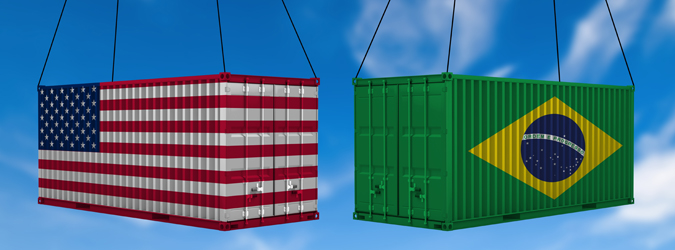
American Tariffs on Brazilian Goods
8.15.2025

Recently imposed tariffs on Brazilian goods are creating uncertainty for companies in both Brazil and the United States. Increases on the cost of exporting goods has left industries scrambling.
The New York State Bar Association hosted a seminar discussing the rapidly changing landscape of trade and commerce and how companies and governments are responding.
The speakers were:
- Vinicius Aquini, co-chair of the New York State Bar Association, International Section Brazil Chapter.
- Robert Leo, partner at Meeks, Sheppard, Leo & Pillsbury in New York, and co-chair of the New York State Bar Association International Section Trade Committee.
- Renato Faria, partner at Martins Villac Advogados in São Paulo, Brazil.
- Marcus Giraldes, director head of Global Treasury at Iochpe-Maxion S.A. in São Paulo.
- Helen Naves, founding partner at HNaves Advogados in São Paulo, and vice-chair of the New York State Bar Association International Section.
Under the direction of President Donald Trump, the American government has implemented a 50% tariff on Brazilian products. There are a few exceptions for certain materials, such as orange juice, civil aircraft and iron ore.
“The president cited ongoing trade deficits as an emergency to the U.S. economy and did impose tariffs on that basis,” said Leo. “With regards to Brazil, there is no trade deficit with the United States. In fact, the U.S. has a $7.5 billion trade surplus with Brazil. The president also cited the Brazilian government’s treatment of former President Jair Bolsonaro as a reason for the imposition of these tariffs.”
A lawsuit challenging the reasoning for these tariffs is proceeding through federal courts. In particular, the lawsuit is arguing that the International Emergency Economic Powers Act of 1977 was improperly used to put in these tariffs.
The panelists advised that companies may also argue in court that they cannot fulfill their contractional obligations due to the tariffs and should be released. “Usually one party has the economic power over the other party,” said Leo. “So they either put in a one-sided impracticably clause or they don’t put it in at all. There are a lot of lawyers and there are lot of courts in the United States disputing these, and not just with regards to tariffs – but the disputes are going to increase because of the tariffs.”
In the meantime, companies in both the U.S. and Brazil are struggling to keep businesses profitable and products affordable.
“We are in an uncertain moment,” said Giraldes. “It’s not in the best moment to invest in the United States when you have big volatility in the decisions – in the scenario between Brazil and the United States.”
Very recently, the Brazilian government released an aid package for companies affected by tariffs, extending a line of credit for the most-affected companies, and incentives for Brazilians to buy locally produced goods that otherwise would have been exported to the U.S.
The speakers emphasized that this is an ongoing issue, and any number of government actions or court decisions could change it.
“We will continue to study this topic,” said Naves. “And to develop ideas and suggestions that can help our members.”
This program was sponsored by the New York State Bar Association’s International Section and its Brazil Chapter. View the full seminar here.