Prioritizing Support for Public Service Attorneys
8.21.2025

Attorneys in the public sector face stressors that lawyers in private practice do not. A recent program, “Prioritizing Support for Public Service Attorneys,” addressed funding and staffing changes and other issues that affect government employees.
“Federal employees are facing unprecedented challenges, and our mental health and well-being as attorneys is a top priority,” said Amy Kendall, chair of the Environmental and Energy Law Section, which sponsored the webinar. “We are here to impart knowledge and tools for you to weather the storms that we are facing right now.”
The program was co-sponsored by the Committee on Attorney Well-Being and led by Jennifer Clayton, program manager of NYSBA’s Attorney Well-Being Program. Clayton is a licensed social worker and coordinates several attorney well-being programs at the association.
She explained how attorneys in the public sphere focus on mission-driven work with victims of crime or trauma or on an issue that ignites their passion. Such dedication can lead to compassion fatigue, vicarious trauma and burnout.
Clayton shared how compassion fatigue affected her in a previous job working with victims of trauma.
“I was not losing empathy for my clients, but in my personal life, I was losing empathy for anyone that complained about their job,” she said. “I no longer cared about the problems going on in the lives of my friends.”
When you add the stress of budget cuts or policy changes that threaten career security, Clayton says the stress can become overwhelming. Lawyers are good at compartmentalization and often respond to stress by working harder with more time away from family and friends.
“Putting all of your energy into your occupation will create bigger problems in other areas,” she said. “You are saying ‘my work is more important than my social, physical or emotional health.’”
Clayton gives the example of an attorney seeking help with stomach pain and physicians can’t find a medical cause. “The pain and discomfort you are experiencing is valid. It’s not in your head; it can be the physical impact of stress.”
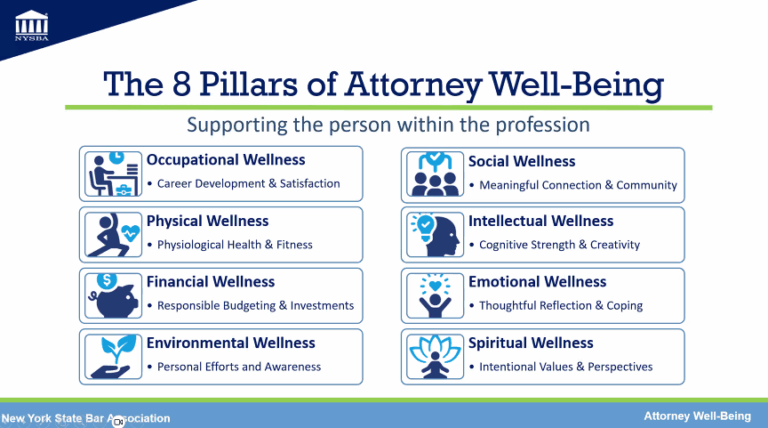
The Eight Pillars
The “Eight Pillars of Wellness” refers to eight areas that contribute to well-being.
“The eight pillars are a framework to help you feel well when you have that tunnel vision,” Clayton adds. “The pillars are a starting point to help you identify what needs your attention.”
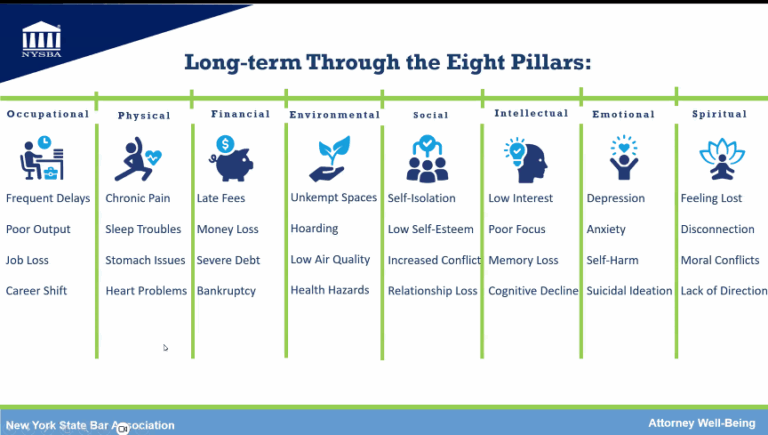
Long periods of stress or avoidance in certain areas of life can lead to changes in physical and mental health, job performance and finances as shown in the graphic below.
Clayton outlines how to reduce stress by setting specific, measurable and attainable goals. Setting a short-term goal for work and a different goal for physical or social well-being is one way to go about it. For instance, to accomplish the goal of being more present with family on weekends, a lawyer might want to read fewer work emails on weekends. Creating a boundary between work and home life is the act of protecting one or more of the Eight Pillars.
“I am building on my social wellness by spending time with my family,” she says. “I am protecting my emotional wellness by separating myself a little bit from the work I’ve been doing.”
Other examples of how to integrate wellness in a legal career include using a mindfulness activity like meditation or journaling, seeking out peer support and using paid leave or vacation time.
The Attorney Well Being program offers many programs in these areas. Kendall closed the program by encouraging those attending to seek out the resources available at the New York State Bar Association.
“Please reach out to me or to the Lawyer Assistance Program if you need help. There are a lot of value in these support programs,” she said.