Protecting the Habitats of Endangered Wildlife
9.30.2025
A federal law to protect the habitats of endangered species is at risk, but New York State has its own laws to lessen the impact on local animals.
The New York State Bar Association recently hosted a Continuing Legal Education course explaining the Trump administration’s proposed changes to regulations that implement the Endangered Species Act and how New York State’s Environmental Conservation Law can help protect animal habitats. The Center for Biological Diversity’s Director of Litigation Eric Glitzenstein and Senior Advocate Tara Zuardo were the speakers.
“Right now, we’re dealing with a federal administration that is arguably dismantling our environmental protection laws and regulations at a rapid pace,” said Zuardo. “And that includes how the federal Endangered Species Act is implemented to protect wildlife.”

The Endangered Species Act states that it is illegal to “take” any endangered or threatened species. The law elaborates that “take” is defined as “harm” to an animal. Furthermore, “harm” includes any act that would modify or degrade the habitat of an endangered species, or impede essential behaviors like breeding, feeding, or sheltering.
The Trump administration seeks to remove the word “harm” from the law, effectively taking away protections for the habitats of endangered species.
“There is literally no replacement definition,” Glitzenstein said of the Trump administration’s proposal.
Although the change has not been finalized, a pending case in Florida, Bear Warriors United Inc v. Alexis Lambert, could be the first to bear the full impact. The Florida Department of Environmental Preservation authorized sewage hookups that diminished the food supplies for manatees. It was decided that Florida had violated the “harm” prohibition of the Endangered Species Act.
“Not surprisingly, the state of Florida had pointed to the pending recission of the regulation,” said Glitzenstein. “And said ‘this is probably going to happen, and when it does, you’re going to be operating under a different regulatory regime.’”
Endangered Species Protections in New York State
New York State is one of the few states with its own version of Endangered Species Act regulations, which includes listing endangered and threatened species to protect their habitats. The state’s Department of Environmental Conservation also puts together a state wildlife action plan to identify threats to endangered species and how to protect them. The plan is updated every 10 years with input from the public. Currently, the plan lists 570 species of greatest conservation need, as well as 270 plant species at risk.
“I don’t want to underscore how important it is that New York provides its own protections for species that are imperiled within its borders,” said Zuardo. “And not just those that are federally listed, but those that may be in trouble only within its borders – and that it protects habitats as well. This is more than what most states are doing, and it could very well be the saving grace for a number of species that become extirpated elsewhere, outside of the state.”
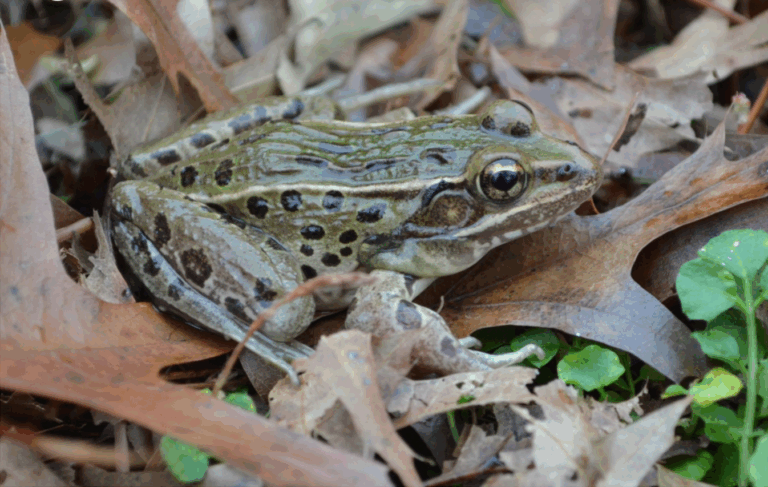
For example, New York State recently added the Atlantic Coast leopard frog, which lives in freshwater wetlands around New York City, to its endangered species list.
“Less than 1% of the quarter-million acres of freshwater wetlands that once blanketed New York City still exist,” said Zuardo. “So as a result, the frogs rely on a good amount of private property, and how those private property holders treat them and the land that they rely on. State conservation officials have to work to reach agreements with site owners to preserve a portion of the marsh that they rely on, while allowing development to proceed on the other portions of the marsh.”
The program was sponsored by the New York State Bar Association’s Committee on Animals and the Law.