150 Years: Leading the Legal Profession in New York State
3.4.2026
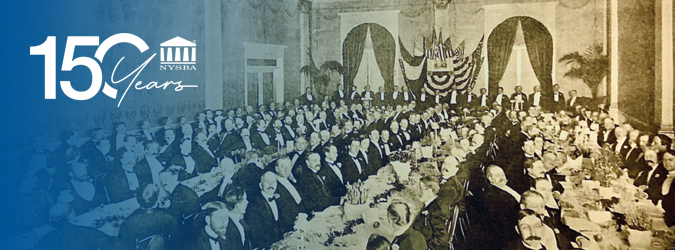
As we celebrate the New York State Bar Association’s 150th anniversary, we reflect on the issues the association addressed in its formative years and find many of those same challenges continue today. The matters of association membership, dues structure and whether to prioritize issues purely related to the practice of law and our courts, or broader social policy issues, remain constant. Today, NYSBA is the largest and most influential voluntary state bar association in the country. With members in every state and territory and 2,500 members in 100 countries worldwide, NYSBA is the most recognized and respected bar association in the world.[1]
A Bar Is Born
The formation of the New York State Bar Association in 1876 was part of a trend toward organized bar associations, nestled between the formation of the Association of the Bar of the City of New York (1870) and the American Bar Association (1878).[2]
The state bar’s creation was inspired by the Association of the Bar of the City of New York, which in 1876 surveyed lawyers throughout New York State to gauge support for a statewide bar association. There was virtual unanimity of those responding that a state bar was needed.[3]
The city bar held an organizing convention in Albany that met in the Assembly Chamber of the Old Capitol on Nov. 21, 1876.[4] Elliot Shepard of Manhattan called the meeting to order and moved that William C. Ruger of Syracuse, the first president of the Onondaga County Bar Association, founded the previous year, serve as chair.[5] There were 91 delegates in attendance, including representatives from all eight of the state’s judicial districts.[6] The delegates represented a broad array of politics, geography, and influence, and were described by The New York Times as representing “to an unusual degree, the learning and culture of the Bar of the State.”[7]
At the 1876 convention, a committee was formed to draft the bylaws of the new statewide association. The bylaws have been subject to many changes over these 150 years, but the initial mandate “to cultivate the science of jurisprudence; to promote reform in the law; to facilitate the administration of justice; to elevate the standard of integrity, honor and courtesy in the legal profession” remains today.
Upon approval of the bylaws, the newly formed Executive Committee took steps to incorporate, which took place on May 2, 1877, by act of the Legislature.[8]
Among the initial issues the new association addressed were membership dues and whether the association should focus on issues specific to attorneys and the practice of law or consider broader social and public policy issues.
These issues still resonate today. In 2024, the association launched a new subscription membership model with a dues structure that includes section membership, all-inclusive access to continuing legal education courses and programming, and full access to the association’s ample publications and legal forms.[9]
Debate regarding the appropriateness of association policy beyond strictly “lawyer” issues has been present since the beginning. In its first year, the association had the Committee on Prizes, which gave its highest award to Walter Howe for his essay “Legal Relations of Capital and Labor.” This topic was controversial, coming at a time of politicized labor disputes in our nation, and the association was criticized by some who cautioned the association to “confine itself strictly to its legitimate object of reforming abuses, and elevating the professional standard, and refrain from interfering in matters foreign to them. If it will do this, it will be eminently successful; if not, dissension will be engendered, and it will likely fail.”[10]
Throughout its 150 years, the association has led on issues of importance beyond those directly impacting lawyers and the legal profession, harnessing the expertise of attorney members to provide thoughtful, well-researched, balanced, educational reports on issues that impact the public at large. Our reports examined such topics as international affairs[11], gun violence[12], preventing wrongful convictions and solitary confinement, marriage equality, the creation of Prisoners’ Legal Services, the benefits of mandatory vaccines[13], artificial intelligence[14], and many others. The debate over the extent of the association’s purview continues today.
Early Years
In its first decades, the association continued to balance addressing issues of specific concern to the legal profession and the courts with using its expertise and prestige to influence change nationally and internationally.
An early struggle among the bar was a movement toward codification of civil laws. Many lawyers were convinced that the common law, slowly developed over time by the courts, was best. Such a system also provided older, long-practicing lawyers with greater influence. They believed their advantage would be diluted if codification made the law more accessible.[15]
The state bar’s Committee on Law Reform called the question of adopting a civil code and code of evidence among the most important legal questions facing the state.[16] The committee’s chair, David Dudley Field, contended that the law should be accessible, able to be found and written in one place, alleviating the need for lawyers and judges to search through volumes to find citations. The city bar opposed codification. Its leader called it “systems of despotic nations, a violation of natural law.[17]” Such parochial opposition slowed, but did not prevent, the proliferation of statutes and consolidated laws by the turn of the century.
The association opposed the continuation of diploma privilege, which allowed law school graduates to practice without taking a formal bar examination. In 1894, the association endorsed the concept of a uniform bar examination throughout the state, as opposed to separate exams in each judicial district. The association led the call for a statewide registry of lawyers by a central authority that became law in 1898.[18]
In 1909, NYSBA adopted the Canons of Ethics and called upon the newly formed Board of Law Examiners to test applicants concerning ethics, all measures that remain in practice today.
Today, the association continues its call for a vigorous New York-centric portion of the bar examination. When New York changed its licensing examination to the Uniform Bar Examination in 2017, it eliminated the full day New York examination, and replaced it with a shorter, online, open book, multiple-choice test of New York law. As New York State moves to what is known as the NextGen Exam, the state bar renews its call for a vigorous multi-hour essay test on New York law.[19]
The association’s early leadership included many statewide and national leaders, including U.S. Presidents Grover Cleveland and Chester A. Arthur; Chauncey M. DePew, a U.S. senator from New York and president of the New York Central Railroad; and David B. Hill, the state bar’s president from 1885 to 1887, who also served as New York’s governor.[20]
It is no surprise that such luminaries would find a role for the association in shaping world events. In 1897, a dispute between Great Britain and Venezuela over a boundary in British Guiana brought the two nations – and possibly the United States – to the brink of war. Concerned that similar conflicts could continue to draw the nation into international crises, NYSBA, through the leadership of DePew, appointed a committee that recommended the creation of an international court of arbitration to peacefully resolve such matters. In a matter of weeks, the association produced a report and proposal for a permanent international tribunal of judges from nine nations. NYSBA leaders presented their proposal to the former association vice president and then-U.S. President Grover Cleveland at the White House.[21] President Cleveland embraced the plan, which led to a permanent International Court of Arbitration in The Hague.
The association continues its influence in international arbitration with its 2011 task force report recommending that a permanent facility was needed to maintain New York’s status as a leading world venue for international arbitration.[22] The report’s recommendations and NYSBA’s support were instrumental in the creation of the New York International Arbitration Center, which opened in Manhattan in 2013.
Membership
In its first year, the association gathered 356 members with dues of $5. Membership more than doubled over the next 15 years to 800 by 1892. By 1930, membership increased to almost 5,000.[23] At its 100-year anniversary in 1976, membership was 26,000.[24] Membership continued to increase parallel to the increase in attorneys licensed in New York State, topping 70,000 members in 2001 and peaking at around 75,000 members.[25]
After a decade of gradual, yearly declines, membership is currently around 55,000 members, making NYSBA the largest voluntary state bar association in the nation. Recognizing this gradual decline, in 2024 the House of Delegates approved a proposal from the Membership Committee to change association membership dues to be all-inclusive – free membership in two substantive sections, access to almost all of the association’s 400-plus yearly continuing legal education programs, and all of its digital content at no additional cost.[26] The new “subscription membership” model began in the fall of 2024 and is already showing a path to stabilization of membership and anticipated membership increases in the years ahead.
Famous Firsts
Although women had been permitted to practice law in New York since 1876, it wasn’t until 1901 that NYSBA became the first major bar association to have a woman member: Kate K. Crennell of Rochester, admitted to the bar in 1897.[27]
In 1987, Maryann Saccomando Freedman of Buffalo took office as NYSBA’s first woman president.[28] In 2018, NYSBA created its Women in Law Section, which had previously been a committee. WILS has been active in preparing reports, creating association policy, and is one of the association’s fastest growing sections.[29]
The association’s first Black member, Thomas B. Dyett, joined in 1927. Dyett, a native of the Caribbean island of Montserrat and a graduate of Howard University School of Law, was an assistant district attorney in Manhattan, and was later director of the New York County Lawyers Association.[30]
In 1993, the association elected its first Black president, Archibald R. Murray of New York City, who was attorney in chief of the Legal Aid Society of New York.[31]
There have been several NYSBA presidents who also served as American Bar Association presidents. Two first served as ABA presidents, then NYSBA presidents. Joseph H. Choate served as ABA president from 1898 to 1899 and later as NYSBA president from 1906 to 1907. Alton B. Parker served as ABA president from 1906 to 1907 and later as NYSBA president from 1913 to 1914.
Elihu Root of New York City was NYSBA president from 1910 to 1911 and ABA president from 1915 to 1916. Root also served as a U.S. senator from 1909 to 1915 and as secretary of state under Presidents William McKinley and Theodore Roosevelt.[32]
After serving as New York’s governor, associate justice (and later chief justice) of the U.S. Supreme Court, and running for U.S. president in 1916, Charles Evans Hughes was NYSBA’s president from 1917 to 1918 and ABA president from 1925 to 1926.[33]
Orison S. Marden, NYSBA president from 1964 to 1965, also served as president of the New York City Bar Association in addition to the American Bar Association (1966-67).[34]
Lawrence E. Walsh, NYSBA president from 1966 to 1967, was a former federal judge and future ABA president (1975-76). Walsh was later appointed as the independent counsel for the Iran-Contra investigation during the Reagan administration, issuing its final report and findings in 1993.[35]
Robert MacCrate served as NYSBA president from 1972 to 1973 and later as ABA president (1987-88). He led the NYSBA Special Committee on the Law Governing Firm Structure and Operation, which in 2000 issued its Report on Multidisciplinary Practice (also known as the MacCrate Report). The report opposed non-lawyer ownership of law firms, which remains the policy of the association.[36]
House of Delegates
Prior to 1972, the association’s governing and policymaking body was the Executive Committee, sometimes called the Administrative Committee.[37] The old Executive Committee numbered between 65 and 75 members and, according to NYSBA president Henry J. Smith (1977-78), was considered “an elite, interesting, comfortable group to belong to.”[38]
Following the recommendation of the Committee on the Constitution and By-Laws, the House of Delegates was created as the association’s governing and policymaking body. The new House of Delegates would be significantly larger than the Executive Committee.[39] Importantly, the new House of Delegates would include representation selected by bar associations from counties throughout the state proportional to the number of association members in each jurisdiction. Although the proposal passed, there was opposition on the theory that the larger body would be too unwieldly and some delegates representing other bar associations “might often be at cross-purposes with our enlightened view.”[40]
However, even those that initially opposed the change found the new House of Delegates brought the association to a heightened and more inclusive level. The new delegates were found to be “obviously proud to represent their bar associations” and to have their local bars participate in the work of NYSBA.[41] In 1977, then-President Smith declared “the aura of a House of Delegates meeting is, almost palpably, that the entire bar of the state of New York is represented there.”[42]
Since that time the House of Delegates has expanded to include 12 diversity seat delegates and two out-of-state delegates.[43]
Lawyers Litigating
As an association of lawyers, NYSBA has commenced litigation sparingly and only when there was a clear path to remedy substantial injustice. The decision to litigate is made by the association’s Executive Committee.
The association commenced its first lawsuit in 1997 seeking to declare unconstitutional a federal act that criminalized advising elderly clients on how to lawfully dispose of assets to qualify for Medicaid.[44] The association challenged the act as violative of the First and Fifth Amendments to the Constitution. The U.S. District Court for the Northern District of New York granted NYSBA’s motion for preliminary injunction, and that decision was not appealed by the government.[45]
In 2002, the association filed a complaint against the Federal Trade Commission challenging application of the privacy provision of the Gramm-Leach-Bliley Act, intended to regulate access to consumers’ personal information.[46] The association challenged the application of privacy provisions to attorneys upon the grounds that Congress never intended to cover lawyers under the law and the regulations of attorney-client confidences are reserved to the states under the 10th Amendment. Following the granting of the association’s motion for summary judgment, the FTC appealed, and the appeal was consolidated with a similar case brought by the ABA. The U.S. Court of Appeals for the District of Columbia affirmed, holding the FTC’s attempt to regulate the practice of law fell outside its statutory authority.[47]
As early as 1932, the association advocated for publicly funded defenders for those unable to pay for counsel. In 2022, the association commenced a lawsuit to increase the rate of pay for assigned counsel in criminal and family courts throughout New York State.[48] NYSBA’s statewide lawsuit followed the granting of preliminary injunction in a lawsuit filed by the New York County Lawyers Association and nine other metropolitan bars that granted an increase to assigned counsel rates, known as 18-B lawyers, in New York City.[49]
Following the lawsuits and NYSBA’s legislative advocacy, New York State in its 2023 budget increased the rates for assigned counsel throughout the state for the first time in almost 20 years.
Home of the Bar
Shortly after its incorporation by act of the Legislature in 1877, the association was provided with its first home at New York State’s Old Capitol on State Street. In 1883, after the completion of the current “new” Capitol, the Legislature provided the association with space there, where it remained for the next 45 years.[50] A mural that includes the current Capitol while it was under construction is in the Peck Room of the association’s current home, an homage to Albany’s history when the association was formed.
In 1928, the association expanded and moved to 112 State Street, where it remained until 1933 when it moved to the 15th floor of Albany’s newest office tower at 90 State Street, known as the National Savings Bank building.[51]
Twenty years later, in 1953, the association moved into the first building it owned, at 99 Washington Avenue. The building was purchased in 1951 in large part due to a $300,000 bequest from member William Nelson Cromwell. One of the bar luminaries, Cromwell continues to be recognized for his contributions with the Bar Center’s Cromwell Room.[52]
In 1969, the bar association purchased its current home, now known as One Elk. It initially consisted of four adjoining townhouses at numbers 1, 2, 3, and 4 Elk Street. The Bar Center’s namesake building number 1 could not be saved and now serves as green space. After historic preservation efforts were made to keep the buildings’ 19th century façades, the architect James Stewart Polshek melded the old buildings with a modern, brutalist design, sufficient to house the association’s more than 90 employees and its over 250-member governing body, the House of Delegates, which meets in Albany three times a year and once in New York City.[53]
The Bar Center is nestled perfectly between the New York Court of Appeals and the Capitol. The One Elk Street buildings are recognized for their creative integration of historic preservation with modern design. One Elk creatively combines a new building with 19th century townhouses to form a single, functional complex.[54] This unique combination of historic architecture and award-winning contemporary design led former design critic Ada Louise Huxtable of The New York Times to call the building “one of the neatest architectural achievements in the century … it is a sophisticated triumph in the most delicate, complex and poorly understood art of the environment: urban design.”[55] In the words of Past President Scott M. Karson (2020-21), “When One Elk is full for a House of Delegates meeting or reception, it has an energy that is electric and alive. Walking through its halls during moments of quiet contemplation, one can feel the comforting weight of its history and be inspired by the greatness of those who have passed through its doors. The building has become a proud symbol of the greatness of our association.”[56]
A few years after its dedication on Sept. 24, 1971, the association expanded to add buildings at 5 and 6 Elk Street. One Elk underwent a substantial expansion in 1990 and less glamorous renovations in 2024.
The association continues to take great pride in preserving the historic nature of the property, which was the home of four New York governors – William Marcy (1832-34), Washington Hunt (1850-52), Horatio Seymour (1852-54), and Enos T, Throop (1930-31). In addition, during his time as a state Senator, Franklin Delano Roosevelt was a resident (1911-13).[57]
The Past Is Prologue
In 1877, as John K. Porter assumed office as the first president of the newly created New York State Bar Association, he held out hope that “this association may endure, and that it may exercise a collective and permanent influence.”[58] Today, the association has done both – and far more – and maintains a strong presence in the legal and civic life of New York State.
Over its 150-year history, NYSBA has frequently adapted to meet the needs of its members, the legal profession, and the public. Time and again, it expanded operations and broadened its outlook, as dictated by the needs of the day. In the past, change meant expanding the association’s brick-and-mortar presence either through relocation of its headquarters or overhauling its facilities space. Major moves and ambitious renovations of the Bar Center on Elk Street signaled new beginnings and an expansion of the association’s role as the leader for lawyers across the state and around the world.[59]
NYSBA’s influence has been collective and permanent, as President Porter had hoped, not only in New York State but around the world. Our membership rolls have included U.S. presidents, New York governors, chief justices of the U.S. Supreme Court, chief judges of the U.S. Court of Appeals for the Second Circuit and chief judges of the New York Court of Appeals. From the UK-Venezuela border dispute to NYSBA’s outpouring of support after 9/11, our history is rich and remains faithful to its motto: “Do the Public Good.”
NYSBA remains a prominent voice providing analysis on the issues of the day, on the debates, the decisions, the actions of government, and the evolution of the law and our system of justice. Our trailblazing nature was evident at our inception, when the very legislation creating our association also removed the barriers to women practicing law in the state. It was the beginning of a progressive tradition that continues to this day. Then, as now, NYSBA remains a positive force helping to shape a more just society.[60]
David P. Miranda is general counsel of the New York State Bar Association. He was president of NYSBA from 2015 to 2016. He also hosts the podcast MIRANDA Warnings.
Endnotes:
[1] MCI Group, Report for New York State Bar Association – Developing Membership Growth and Engagement Strategy (Nov. 2018). On file.
[2] The American Bar Association was formed in Saratoga, N.Y. in 1878. See also David Miranda, The Birth of the New York State Bar Association (with Hank Greenberg), Miranda Warnings NYSBA Podcast, Nov. 1, 2022, https://www.youtube.com/watch?v=Uxvk_GfV65s; Henry M. Greenberg, The Birth of the New York State Bar Association, 94(3) New York State Bar Association Journal (hereinafter N.Y. St. B.J.) 9 (May-June 2022).
[3] Deborah S. Gardner and Christine G. McKay, Of Practical Benefit: New York State Bar Association, 1876–2001, at 9 (2003) (hereinafter Of Practical Benefit).
[4] Francis Bergan, History of the New York State Bar Association – A Century of Achievement (hereinafter A Century of Achievement),48(7) N.Y. St. B.J., 514, 516
(Nov. 1976).
[5] Ruger would later serve as NYSBA’s fourth president (1883) and Chief Judge of the Court of Appeals (1883–1892). Shepard would serve as NYSBA’s fifth president (1884).
[6] Of Practical Benefit, supra note 3.
[7] Id.
[8] Of Practical Benefit, supra note 3, at 10; 1877 N.Y. Laws, ch. 210.
[9] New York State Bar Association (hereinafter N.Y. St. Bar Ass’n), Report and Recommendations of the New York State Bar Association Committee on Membership (January 2024), https://nysba.org/wp-content/uploads/2022/03/NYSBA_Comm-on-Membership_New-Membership-Model_January-Report-w-Cover_FINAL-VERSION.pdf.
[10] Greenberg, supra note 2, at 15, citing 1 New York State Bar Association, Reports 2 (1878), note 14 at 82–83.
[11] N.Y. St. Bar Ass’n, Final Report of the New York State Bar Association’s Task Force on New York Law in International Matters (June 25, 2011), https://nysba.org/wp-content/uploads/2020/02/Task-Force-on-New-York-Law-in-International-Matters.pdf; N.Y. St. Bar Ass’n, New York State Bar Association Ethics Best Practice Guidelines for Latin America and the Caribbean (April 2018), https://nysba.org/wp-content/uploads/2020/02/FINAL-Latin_American_Council_Ethics_Best_Practice_Guidelines-1.pdf; N.Y. St. Bar Ass’n, Resolution of the International Section (Nov. 2022),
https://nysba.org/wp-content/uploads/2022/11/new-business-resolution-of-International-Section-Ukraine.pdf.
[12] N.Y. St. Bar Ass’n, Report of the New York State Bar Association Task Force on Mass Shootings and Assault Weapons (Nov. 2020), https://nysba.org/wp-content/uploads/2020/02/Final-Report-11.5.2020-Task-Force-on-Mass-Shootings-and-Assault-Weapons-With-cover-FINAL-HOD-approval-and-staff-memos-deleted.pdf.
[13] N.Y. St. Bar Ass’n, Report of the New York State Bar Association Emergency Task Force on Mandatory Vaccination and Safeguarding the Public’s Health (Aug. 2021), https://nysba.org/wp-content/uploads/2021/08/EC-Approved-Final-Report-on-Emergency-Task-Force-on-Mandatory-Vaccination-and-Safeguarding-the-Publics-Health.-with-appendix-a.pdf.
[14] N.Y. St. Bar Ass’n, Report and Recommendations of the New York State Bar Association Task Force on Artificial Intelligence (April 2024), https://nysba.org/wp-content/uploads/2022/03/2024-April-Report-and-Recommendations-of-the-Task-Force-on-Artificial-Intelligence.pdf.
[15] A Century of Achievement, supra note 4, at 516; Of Practical Benefit, supra note 3, at 18.
[16] Id.
[17] Of Practical Benefit, supra note 3, at 17-18.
[18] Of Practical Benefit, supra note 3, at 22.
[19] Domenick Napoletano, Time for Change: Future Attorneys in New York Need a Rigorous Exam To Be Better Prepared (President’s Message), 97(2) N.Y. St. B.J. 12, 13 (Spring 2025).
[20] Of Practical Benefit, supra note 3, at 19.
[21] Henry M. Greenberg, NYSBA’s Noblest Act: Preventing War and Establishing a World Court, 95(2) N.Y. St. B.J. 9-13 (March/April 2023). See also David Miranda, History of NYSBA: Our Noblest Act: Preventing War and Establishing a World Court with Hank Greenberg, Miranda Warnings NYSBA Podcast, March 7, 2023, https://podcasts.apple.com/us/podcast/history-of-nysba-our-noblest-act-preventing-war/id1395349801?i=1000603016069.
[22] Final Report of the New York State Bar Association’s Task Force on New York Law in International Matters, supra note 11.
[23] Of Practical Benefit, supra note 3, at 37.
[24] Joseph H. Murphy, A Page of History (The President’s Page), 48(2) N.Y. St. B.J. 83 (Feb. 1976).
[25] Paul Michael Hassett, Ave atque Vale (President’s Message), 73(4) N.Y. St. B.J. 26 (May 2001).
[26] Report and Recommendations of the New York State Bar Association Committee on Membership, supra note 9.
[27] Of Practical Benefit, supra note 3, at 15; A Century of Achievement, supra note 4, at 528.
[28] Jennifer Andrus, NYSBA Trailblazer Maryann Saccomando Freedman Speaks Out, NYSBA News Center (Dec. 5, 2022), https://nysba.org/nysba-trailblazer-maryann-saccomando-freedman-speaks-out; David Miranda, NYSBA Trailblazer: Maryann Saccomando Freedman, Miranda Warnings NYSBA Podcast, Dec. 5, 2022, https://www.youtube.com/watch?v=kvQD_4jwUAY.
[29] For more information on the Women in Law Section’s impact on the legal profession, see Susan Harper’s story on page 30.
[30] Of Practical Benefit, supra note 3, at 38.
[31] A Century of Achievement, supra note 4, at 523; Of Practical Benefit, supra note 3, at 134-35.
[32] A Century of Achievement, supra note 4, at 524; Of Practical Benefit, supra note 3, at 42-44.
[33] Of Practical Benefit, supra note 3, at 34.
[34] Of Practical Benefit, supra note 3, at 111.
[35] Of Practical Benefit, supra note 3, at 114.
[36] N.Y. St. Bar Ass’n, Report of the New York State Bar Association Special Committee on the Law Governing Firm Structure and Operation (April 2000), https://nysba.org/wp-content/uploads/2020/01/MACRATEREPORTAccessible.pdf.
[37] Henry J. Smith, The President’s Page, 49(7) N.Y. St. B.J. 547-48 (Nov. 1977).
[38] Id. at 548.
[39] Currently, the House of Delegates has between 250 and 270 members.
[40] Smith, supra note 37, at 548.
[41] Id.
[42] Smith, supra note 37, at 586.
[43] These delegates are appointed by the president and confirmed by the Executive Committee. Currently, the out of state delegates are from England and Brazil, emblematic of the association’s international reach.
[44] Robert Pear, Repeal Urged for Law on Giving Away Assets To Get Medicaid, New York Times (Feb. 18, 1997).
[45] N.Y. St. Bar Ass’n v. Reno, 999 F. Supp. 710 (N.D.N.Y. 1998).
[46] N.Y. St. Bar Ass’n v. FTC, 276 F. Supp. 2d 110 (D.D.C. 2003).
[47] ABA v. FTC, 430 F.3d 457 (D.C. Cir. 2005).
[48] N.Y. St. Bar Ass’n v. State of New York (Sup. Ct. N. Y. Co. 2022); Susan DeSantis, New York State Bar Association Commences Lawsuit To Raise 18-B Rates, NYSBA News Center (Nov. 30, 2022), https://nysba.org/new-york-state-bar-association-sues-to-ensure-people-who-cannot-afford-counsel-have-constitutionally-mandated-representation/.
[49] New York County Lawyers Ass’n v. State of New York, 2022 N.Y. Slip Op. 32476(U) (Sup. Ct., N.Y. Co. 2022).
[50] Of Practical Benefit, supra note 3, at 10.
[51] Of Practical Benefit, supra note 3, at 56.
[52] Of Practical Benefit, supra note 3, at 96.
[53] Of Practical Benefit, supra note 3, at 127-28.
[54] Scott M. Karson, A Vision for the Future, 93(3) N.Y. St. B.J. 9-10 (May-June 2021).
[55] See N.Y. St. Bar Ass’n – Rededication, Nov. 10, 1990, at 6 (commemorative booklet). See also Ada Huxtable, Goodbye History, Hello Hamburger: An Anthology of Architectural Delights and Disasters (1986).
[56] Karson, supra note 54, at 9-10.
[57] Of Practical Benefit, supra note 3, at 127.
[58] N.Y. St. Bar Ass’n, NYSBA History Book (2024). nysba.org/wp-content/uploads/2025/07/NYSBA-History-Book-2024_rev20250708.pdf.
[59] Karson, supra note 54, at 8.
[60] N.Y. St. Bar Ass’n, supra note 57; N.Y. St. Bar Ass’n, The Bylaws of the New York State Bar Association, as Amended at the Annual Meeting of the New York State Bar Association Jan. 19, 2024, https://nysba.org/wp-content/uploads/2024/02/Bylaws-January-2024-rev.-mmw-2.6.24.pdf.