150 Years of Leadership: How NYSBA Helped Shape the Legal Profession
2.25.2026
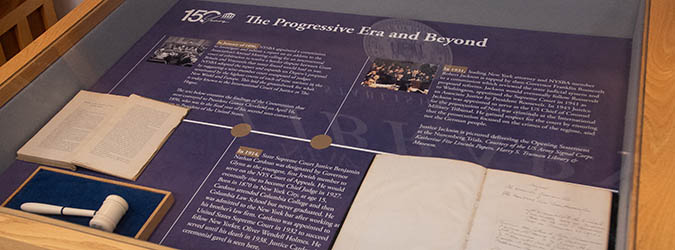
Late-night meetings in an Albany boarding house. Shaping global justice and reform across generations. Such are the stories that are born of the New York State Bar Association’s 150-year history and reflect a continuous commitment to elevating the profession and protecting the rule of law. A new display in the New York State Museum and Library highlights this history.
The Founding Era: Elevating the Professional Standard
On November 21, 1876, in the Assembly Chamber of the old Capitol in Albany, the New York State Bar Association was born. That evening, members drafted a constitution and bylaws and established annual dues of $5. The enabling legislation not only created the association — it also removed barriers to women practicing law in New York, marking an early commitment to inclusion and professional reform.
Artifacts from this era reflect both the rigor and evolution of legal practice in the 19th century. A handwritten ledger records the minutes of the Executive Committee’s first meeting, held the following day at Congress Hall. A well-worn 1878 diary shows the daily transactions of a practicing lawyer. A pocket edition of The Code (1869) captures the transformative procedural reforms that unified legal and equitable remedies under a single system — laying the foundation for later Civil Procedure Rules and Laws. They also serve as a tangible reminder of an age before the arrival of unprecedented human knowledge in the palm of your hand. Much of the practice was hands on and required travel and expertise that had to be compact enough to fit in a pocket, as demonstrated by the “Excelsior Diary”- marked with important practical information as well as the dates of sittings of district courts.
The Progressive Era and Beyond: Expanding Justice
By the late 19th century, NYSBA’s influence extended beyond state borders.
In 1896, the association appointed a commission to study a proposal for an international court of arbitration to resolve a dangerous border dispute between Great Britain and Venezuela. The report, conveyed to President Grover Cleveland, expanded the concept into a nine-member international tribunal — a framework that anticipated what would later become the International Court of Justice at The Hague.
The early 20th century brought towering jurists connected to NYSBA’s legacy.
In 1914, Benjamin Nathan Cardozo — later chief judge of the New York Court of Appeals and a United States Supreme Court justice — emerged as one of the most influential legal thinkers of his generation. His ceremonial gavel, featured in the exhibit, symbolizes a jurisprudence that blended pragmatism, moral reasoning, and doctrinal precision.
In 1931, Robert H. Jackson, a NYSBA member, began a path that would lead him to the U.S. Supreme Court and ultimately to Nuremberg, where he served as Chief U.S. Prosecutor of Nazi war criminals. His insistence that the prosecution focus on the crimes of an authoritarian regime — not the German people — helped establish enduring norms of international criminal accountability.
A Collective and Permanent Influence
Throughout its history, NYSBA has taken seriously its responsibility to confront emerging challenges in the profession and society.
In 1909, President Adelbert Moot urged the association to take principled positions on controversial issues. That call helped define NYSBA’s institutional identity as an organization willing to investigate, analyze, and lead.
A 1948 report on the unauthorized practice of law illustrates mid-century efforts to protect the public and safeguard professional standards. In April 2024, NYSBA’s Task Force on Artificial Intelligence revisited that same issue in the context of rapidly evolving AI technologies — demonstrating the continuity of the association’s mission across radically different eras.
NYSBA also played a pivotal role in advancing civil rights in New York. Through its House of Delegates, the association formally supported extending civil marriage to same-sex couples, grounding its position in constitutional analysis and equal protection principles. By framing marriage equality as a matter of legal consistency and civil rights, NYSBA helped normalize reform within the legal community and among lawmakers. A ceremonial pen certificate commemorating the signing of the Marriage Equality Act stands as testament to that advocacy.
The association’s physical home reflects its values as well. In the late 1960s, rather than demolish historic townhouses at 1 Elk St. NYSBA preserved their 19th-century facades while creating a modern headquarters within — including the former residence of Franklin D. Roosevelt during his time as a state senator. The building itself embodies the association’s philosophy: respect tradition but adapt to serve contemporary needs.
150 Years Forward
From professionalizing legal education to shaping international justice, from defending civil rights to confronting the implications of artificial intelligence, the New York State Bar Association has exercised a collective and lasting influence on the law.
The exhibit marking NYSBA’s 150th anniversary is not merely a retrospective. It is a reminder that the association’s history is defined by engagement — by lawyers willing to strengthen institutions, elevate standards, and safeguard justice for the public good.
Copy Direct Link
Source Copy Link