Attorney Professionalism Forum: A Yankee Lawyer in Albany’s Courts: How the Law and NYSBA Have Flourished Over the Years
6.17.2026
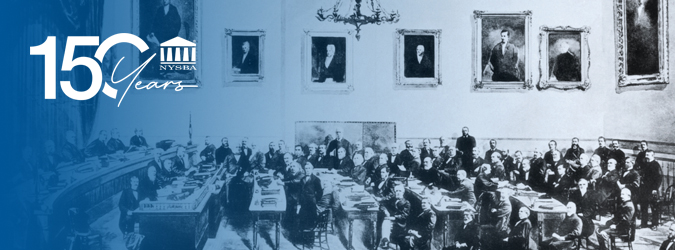
For this article, in which we celebrate NYSBA’s 150th Anniversary, the authors take on the question of what has evolved in the area of professionalism and ethics over the last 150 years.
To the Forum:
I have found myself in a strange and amazing predicament. Let me explain. I am an American. I was born and reared in Albany, in the State of New York – anyway, just over the river, in the country. So, I am a Yankee of the Yankees – and practical; yes, and nearly barren of sentiment. My father was a blacksmith, my uncle was a horse doctor, and I was both, at first. Then I went over to Albany and studied law under Amos Dean, and after a few years’ practice joined, at the time, the fledging New York State Bar Association in 1876. Although a fine lawyer, I was raised rough, and a man like that is a man who is full of fight – which goes without saying. During an argument conducted with crowbars with a fellow attorney we used to call Hercules, I was laid out with a crusher alongside the head that made everything crack. Then the world went out in darkness, and I didn’t feel anything more, and didn’t know anything at all – at least for a while.

When I came to again, I was sitting under a maple tree, on the grass, in a most familiar place to me on the corner of Eagle and Pine Streets. Not entirely familiar, for although there was the gleaming white marble Court of Appeals right in my line of sight, next door was another building, a courthouse, of which I have never known. There were wheeled carriages of the kind I have never seen, not a horse or draught animal around, and two very smartly attired officials, both in a dark suit of clothing, each with a shiny badge, a small caliber sidearm neatly holstered, and finely polished black boots.
“Are you OK, buddy?” said the fellow.
“Are you hurt, sir?” added the madam.
Well, after gathering my composure and figuring that these officials were checking on my well-being, I thanked them for their concern and got myself up to figure out what was what.
I made myself across the street and into the familiar courthouse, and although it was the building I knew, nothing was familiar to me. There were women judges and lawyers, and all of every race. I took the decision to explore what I now knew to be the “new” courthouse next door. I watched a trial and, while familiar in some respects, the lawyers behaved in a most cordial and polite way, with the judge setting them straight if they were otherwise. I heard the judge admonish one and remind him of the Standards of Civility – what are they? I saw lawyers examining a witness with no officer present. And yet, while advocating for their clients, they displayed a fine degree of cordiality and respect for each other. Even so, things did flare, and one reminded the other of the Rules of Professional Conduct. Are there such rules? In another room I saw lawyers debating before a judge through a most peculiar picture frame on her bench. What kind of magic was that?
By now, I had realized that by some strange action I had been projected into the future. As a member of the highest esteem in the New York State Bar Association, I found my way to our library and found you through the Journal. From the date on the masthead, I, quite perplexed, know that the year 2026 is soon to be here.
Since you seem to be an expert in most things related to the practice, while I work to understand my unique predicament, would you be so kind as to provide me with a brief primer on my observations to help bring me up to speed on our practice over the last 150 years?
Sincerely yours,
Josiah Perplexatus[1]
Dear Josiah:
We welcome you to the 21st century. The year 2026 promises to be a great year and you are just in time to join in the once-in-a-lifetime, yearlong, and avidly anticipated festivities in which lawyers from Montauk to Buffalo will celebrate with effusive joy the 150th anniversary of our noble and revered New York State Bar Association.
Much indeed has changed since your time – more than can be recounted to you in these pages. Still, much has remained the same. We do indeed still have a Court of Appeals, and New York, unquestionably, has not lost its place as the most important state in the nation. Why, since Samuel Tilden,[2] we have had a New York citizen come in first or second place for the presidency 19 times (10 times winning), plus twice ascended from the vice presidency. Now the congress of the entire world resides in Manhattan, the tallest buildings are still in Manhattan, and New York still retains its old charms. New York has continued to play host to immigrants from all over the world. We have lawyers of all races and creeds practicing law in New York. What you missed, but might have foreseen, was the growth of women in the profession, and not in small numbers.[3],[4] While there is much work to be done, we are happy to report that the professions of lawyer and judge are truly diverse.
But much has changed in our profession. The screen that you saw is indeed, in brief, a form of magic. It works upon the principle of electricity, which is nowadays called “technology.” For present purposes, the only thing that you must understand about technology is that you should never try to file a sheet of paper with a court. You must file it only through the “technology.” Think of it as a telephone that transmits pictures. All you have to do is watch an episode of “Star Trek” and you will get the idea.
As for the Albany County Courthouse, it is indeed true that the courthouse that you saw is new. It was built in the 1910s to house the Albany County Supreme Court, which moved thither from – well, you had better tell us. 100 State Street? But not enough has changed in the past 150 years to make this topic interesting.
Now then to your point about civility. You have noticed how kind, cordial, civil, and polite lawyers are to each other nowadays, and not only in the Court of Appeals, but in other appellate courts and in trial court as well, which counts for much more. You have noticed how civil the judges are as well, and how a regime of Standards of Civility and Rules of Professional Conduct governs even in the absence of any judge or bailiff. You have asked what these are. Our profession was perhaps not always so nice and ethical as it is today, as you know. But if we are to bring you up to speed, we had better start in the past: what you knew, and what you missed.
The professional quality of lawyers is controlled by the rules regarding admission and discipline. The rules on admission to the bar have changed considerably over the centuries. In the 1600s and 1700s in England, barristers were admitted into the profession by organizations called Inns of Court, something akin to bar associations, without the input of courts. After the American Revolution, in New York lawyers were admitted to practice instead by the courts, with the role of bar organizations deemphasized.[5] Especially in the earlier years of our country, admission came after having read law in a law office, not by going to law school. Disbarment occurred only by action initiated by a court. There were practically no regular bodies that specifically oversaw the conduct of lawyers and judges. A person could provide evidence to a court of a lawyer’s wrongdoing, but only the court could decide to open a disciplinary proceeding against a lawyer.[6],[7] Though this system produced many very fine lawyers, it inherently lacked oversight of lawyers’ professionalism. As U.S. Supreme Court Justice Samuel Miller said in a speech to NYSBA in 1882:
The Inns of Court have no existence in this country. They have the supervision of members of the bar; they discipline them and punish them. We have no such institution as that in this country. Here, when a man is once admitted to the bar, there is no control over him except such as the court desires to exercise, and that is only brought into operation in cases of criminality.[8]
A Mr. Delafield spoke the following words to NYSBA in 1882, summarizing the problem of lack of oversight:
The sufferer generally hesitates about making complaint; the Court reluctantly gives an order to show cause; generally, there is no prosecuting attorney; if there is such a prosecutor, he often represents someone who has a personal grievance and is not impartial; there are no funds to pay counsel, and no funds to pay referees. The Courts are embarrassed when charges of this kind are brought before them, because they have no means of investigating themselves, and they do not know upon whom to call or who will defray the expenses of an investigation; and the result is, that none but the most flagrant cases are investigated at all; and I think it is the experience of the judges in all the departments, that there are lawyers at the Bar against whom complaints are made which should be investigated, but they have no power to investigate. The duty of prosecuting questions of this kind, it seems to me, should be assumed by this Association.[9]
These problems were well known in 1876 and led to NYSBA’s creation on Nov. 21, 1876. It was modeled after several local New York bar associations and other similar associations for other professions. The Medical Society of the State of New York had been formed in 1806,[10],[11] to aid in execution of legislation keeping “ignorant and unskilful Persons” out of “the Practice of Physick and Surgery.”[12],[13],[14] The New York State Bar Association allowed lawyers, by organizing into a single mass, to influence the state government’s legislation of the legal profession, and to weigh in on the admission and disbarment of lawyers in order to exclude persons of low quality from the legal profession. NYSBA utilized its legislative influence for ethical ends, for example, to seek legislation to “suppress” the “monstrous evil” of the “outrageous frauds practiced by a class of lawyers in this State, who make a specialty in procuring divorces.”[15],The original constitution of the association provided for a Committee on Grievances, the purpose of which was to allow members to assert wrongdoing against other members.[16] Evicting a member from the association did not prevent the evictee from practicing law in court,[17] but the Committee on Grievances could also request disbarment to the court when merited, “purifying the profession of unworthy members who are a disgrace to it.”[18] By the end of the 1800s, the Committee on Grievances had a solidified role in helping courts decide whether to initiate disciplinary proceedings against attorneys, as a perusal of its annual reports shows, through members’ advancing sufferers’ grievances against other members.[19]
At that time, ethical principles existed, of course, in the legal profession, and were taught in law schools. But there was lacking a short, pithy compendium of these principles, and there were concerns that the waves of new lawyers entering the profession were not sufficiently familiar with the traditional proper conduct. If the Committee on Grievances and the courts were to truly hold lawyers to account for non-criminal offenses against professionalism, they would need to use an objective and universal set of rules that all lawyers were expected to know. As such, in 1909, the New York State Bar Association, through its Committee on Legal Ethics,[20] adopted the Canons of Ethics,[21] a slightly altered version of the American Bar Association’s 1908 Canons of Professional Ethics, and not long afterwards distributed these Canons of Ethics to all newly admitted lawyers.[22] The association also recommended to the Court of Appeals that all new lawyers be required to submit themselves to these canons, for admission to the bar.[23]
The Canons of Ethics were used for many decades but were repeatedly criticized for being too vague and aspirational in their language.[24] For example, New York’s Canon 14, entitled “Suing a Client for a Fee,” said:
Controversies with clients concerning compensation are to be avoided by the lawyer so far as shall be compatible with his self-respect and with his right to receive reasonable recompense for his services; and lawsuits with clients should be resorted to only to prevent injustice, imposition or fraud.
To overcome this vagueness, in 1970, the Canons of Ethics were replaced by the Code of Professional Responsibility, which contained more specific rules for conduct subject to discipline, and segregated aspirational language out to its own sections. In 2009, the code was replaced by the Rules of Professional Conduct, which retained the code’s disciplinary rules largely unchanged, but reorganized them, included official commentary, and dropped aspirational material. For example: “Where applicable, a lawyer shall resolve fee disputes by arbitration at the election of the client pursuant to a fee arbitration program established by the Chief Administrator of the Courts and approved by the Administrative Board of the Courts.”[25]
Today, all lawyers in New York are subject to these disciplinary rules, which are required to be taught in law schools, and lawyers must pass a test on these rules (the Multistate Professional Responsibility Examination) in order to be admitted.[26] The rules govern a lawyer’s interactions with his or her client, with a tribunal, with other lawyers, and with the public. Though no rule (and no canon) specifically bars a lawyer’s engaging in physical violence against another lawyer, Rule 8.4(b) provides that “A lawyer or law firm shall not … engage in illegal conduct that adversely reflects on the lawyer’s honesty, trustworthiness or fitness as a lawyer,” and Comment 2 to this rule states that such illegal conduct includes “violence.”[27]
Instead of retaining aspirational language in the Rules of Professional Conduct, in 1997, at the urging of NYSBA’s Commercial and Federal Litigation Section, the New York State court system adopted and made effective in 1998 a set of Standards of Civility applied to lawyers, judges, and court personnel,[28] which are not enforced through disciplinary proceedings, but which are expected to be obeyed as part of the decorum of the legal profession. For example, “Upon request coupled with the simple representation by counsel that more time is required, the first request for an extension to respond to pleadings ordinarily should be granted as a matter of courtesy,”[29] and “papers should not be served in a manner designed to take advantage of an opponent’s known absence from the office.”[30] As for arguments conducted with crowbars, the standards say that:
Lawyers can disagree without being disagreeable. Effective representation does not require antagonistic or acrimonious behavior. Whether orally or in writing, lawyers should avoid vulgar language, disparaging personal remarks or acrimony toward other counsel, parties or witnesses.[31]
It is probably true that the written standards are less familiar to lawyers than are the Rules of Professional Conduct, because they are not formally taught,[32] but they are uniformly intuitive, and express principles that no doubt were widely followed in the 1800s.
The codification of the rules of professionalism has not been limited to the rules for attorneys. There are notable differences between the behavior of judges in the 1800s and now. For one thing, judges were less restrained then in some ways: it was vastly more common in those days for former or even current judges to run for legislative or executive political office. We remember the presidential aspirations of former Judge Stephen Douglas, and of Chief Justice Salmon Chase, Associate Justice Stephen Field, and, in the 1900s in New York, Chief Judge Alton Parker. For another thing, we remember how in the 1800s, New York judges associated with Tammany Hall sometimes were found to have violated ethical principles or committed crimes, as, for example, in the case of Judge Albert Cardozo, who resigned from the bench in 1872 after having been accused of gross corruption. Such corruption was an impetus for the formation of the bar association of New York City in 1870, and the investigation into the wrongdoing of Cardozo and other like figures was some of the earliest work of that association.[33] Albert’s son Benjamin eventually made the name Cardozo shine in the judicial universe, but that, as they say, is another story!
Going back to physical violence, Josiah, you may remember David S. Terry, chief justice of the California Supreme Court, who used to carry around with him a Bowie knife, and how he resigned from that court in 1859[34] in order to duel and kill a United States senator from his own state (not even the first time he had tried to kill someone in his four years on the court), after which he fought for the Confederate States of America. After returning to the profession of an attorney, in 1889 he assaulted Justice Field and was shot dead by Field’s federally employed bodyguard David Neagle, whom the state of California tried to prosecute for Terry’s murder. The question of whether a state could so prosecute a federal employee went up to the U.S. Supreme Court itself, which, in a 6-2 decision, held for Neagle. (Field abstained.) This is the sort of personality that simply does not exist and cannot arise in today’s judiciary.[35]
Judges today are more restrained for several reasons, but one reason in New York is that the state has codified rules governing judicial conduct. In 1909, at the same time that the New York State Bar Association adopted the Canons of Ethics for lawyers, it also adopted Canons of Judicial Ethics for judges, which predated the American Bar Association’s analogous judicial canons.[36] New York’s rules for judges evolved similarly to New York’s rules for lawyers. Today, the Rules of Professional Conduct have a judicial analogue in New York’s Rules Governing Judicial Conduct,[37] besides New York’s Code of Judicial Conduct,[38] which are tested in a multistate form on New York’s Multistate Professional Responsibility Examination. These rules essentially require judges to strictly maintain impartiality and the appearance of impartiality in cases before them. The rules extensively and specifically govern judges extrajudicial activities, including their ability to even privately support political organizations, such as making a campaign contribution to a political candidate.[39] Now, judges are required to be polite to lawyers, and to maintain politeness between lawyers – no fisticuffs.[40] Today, no judges in New York want to be publicly perceived as carrying a knife or a gun under their robes, and only one Yankee judge is still known to wield even a bat.
In sum, though in earlier centuries the members of our profession had the instinct to act properly, perhaps obviating the need for a formal written code,[41] the practice of ethics has still been bolstered in visible ways by the codification of professional ethical rules, and their being taught to law students and being submitted to by newly admitted lawyers, and their being enforced by courts with the assistance of the highly active roles of the ethics committees of the modern New York State Bar Association and the attorney grievance committees now administered by the Appellate Division.[42] Now, lawyers intuitively follow these rules, and behave cordially to one another, in the total absence of judge or bailiff. At long last, the standards of professionalism have developed to the point where if you want a physical altercation with another member of the legal profession, the only sure way of finding one is to start it yourself. That may have been true 150 years ago, but we like to think that doing so is at least less common today.
Sincerely,
The Forum, by:
Vincent J. Syracuse, (syracuse@thsh.com)
Jean-Claude Mazzola, (jeanclaude@mazzolalindstrom.com)
Adam Wiener, (adam@mazzolalindstrom.com)
QUESTION FOR THE NEXT FORUM
To the Forum:
I am a recently admitted New York lawyer. I was involved in a case in which parties were disputing over ownership of a historical artifact from a foreign country that had mysteriously disappeared from a museum. I was taking a remote online deposition of an opposing witness, a curator of the museum in which the artifact was last known to have been situated. He was represented by counsel. The witness’s counsel was in the room with him but was off camera; only the witness was on camera. The witness was in a foreign country, and English was not his first language. He spoke English well enough that a translator was not used, but I could tell that he was uncomfortable speaking English. His counsel spoke fluent English. I began the questioning with elementary questions about the witness’s name, location, background, and so on, questions that did not directly pertain to the dispute in the case. From a very early time in the questioning, the witness began to do something curious: After I would ask him a question, he would remain silent for a short term staring in the general direction of the camera, then he would answer, and then would clearly stare to his side, in the direction in which I knew his counsel to be. I was not sure what to make of this. I had heard in my learning experience that it was illegal for counsel to coach his client witness during deposition, but I had never seen it done before, and so did not know quite what it looked like in practice. I was willing to chalk the oddity up to the witness’s lack of proficiency in English. But then when I got into my questions pertaining to the substance of the dispute, and the disappearance of the artifact, the peculiarities escalated. The witness started to take noticeably longer to answer my questions, and, upon finishing his answers, immediately turned to stare in his counsel’s direction. A handful of times he stared toward his counsel before or during his answer. Much worse, his counsel started to aggressively interfere in his answering. I would ask an appropriate and relevant question about the witness’s knowledge of the museum’s treatment of the artifact, and before the witness could answer, his lawyer would jump in, object that his client had no way of knowing the answer, and instruct his client either not to answer, or to answer with “I don’t know.” This happened multiple times, with varying reasons given for the objection: that his client was too high up to know the specific details of the artifact’s treatment by other employees, or that his client had not been at the museum long enough to know. There were even a few times where the witness, after beginning an evasive answer to a question, would stumble over his English and pause, and then his lawyer would jump in and make the same objection, explaining that his client’s hesitation in answering was due to lack of personal knowledge, and he would then direct his client not to answer further.
Opposing counsel also made a slew of objections based on lack of foundation and the form of my questioning. At first, I tried to reformulate my questions to somehow satisfy opposing counsel, but as he kept objecting, I got tougher and told the witness that I demanded that he answer my question as asked. Opposing counsel objected again, and the witness told me that he would not answer on advice of his counsel, parroting his counsel’s reason: lack of personal knowledge, or lack of foundation, or bad form. There was even an instance where, after a break in which the witness’s camera and microphone were off, the witness came back and immediately gave an unprompted short speech about how he was not going to answer questions about how museum employees other than himself treated the artifact.
The result of the deposition was that the witness dodged many important substantive questions that he simply refused to answer. I knew that I could, if necessary, take the case to the judge and use the judge’s authority to compel the witness to answer. But what troubled me was the matter of whether and to what extent the witness’s counsel had improperly coached him. When the witness was staring to the side, or while his camera was off during break, was opposing counsel signaling to him as to how to answer? Was there any way for me to prove it? And considering that the witness repeated his counsel’s objections to me, were those objections meritorious, or were they just subtle means of suggesting an answer to the witness? What tricks should I be on the lookout for in the future?
Sincerely,
Ept
Vincent J. Syracuse is a founding partner of Tannenbaum Helpern’s litigation and dispute resolution practice and has 50 years of experience in litigation. He received NYSBA’s Sanford D. Levy Professional Ethics Award and has chaired NYSBA’s program on ethics and civility for over 20 years. He co-chairs the Ethics Committee of the Commercial and Federal Litigation Section. He has been a co-author of the Attorney Professionalism Forum since 2012, which was published in a collection in 2021.
Jean-Claude Mazzola is founding partner of Mazzola Lindstrom LLP with over 25 years of experience as a commercial litigator. He is chair of NYSBA’s Committee on Attorney Professionalism.
Adam Wiener is an associate attorney at Mazzola Lindstrom LLP, where he focuses on contract law, bankruptcy, real estate finance, defamation, and constitutional law.
Endnotes:
[1] With help from Mark Twain’s “A Connecticut Yankee in King Arthur’s Court” (1889).
[2] Tilden served as N.Y. governor from 1875 to 1877.
[3] New York Women’s Bar Association, History. https://www.nywba.org/history2/.
[4] The Critic: A Weekly Review of Literature and the Arts. XV (New Series), April 18, 1891, The Critic Company, at 217 (1891), https://www.google.com/books/edition/Critic_and_Literary_World/psNZAAAAYAAJ.
[5] For an excellent historical overview of this, see In the Matter of the Application of Henry W. Cooper, 22 N.Y. 67 (1860), https://www.courtlistener.com/opinion/3607567/in-the-matter-of-the-application-of-henry-w-cooper.
[6] See Matter of Brewster, 12 Hun 109 (Gen. T., 1877).
[7] See, e.g, Matter of Loew, 50 How. Pr. 373 (Gen T., 1875) (lawyer disbarred who framed opposing counsel for lawyer’s own mistake).
[8] New York State Bar Association, Reports: Proceedings of Sixth Annual Meeting of the Association, Held at the City of Albany, on the 19th and 20th Days of Sept., 1882. VI, The Argus Company, at 84 (1883), https://www.google.com/books/edition/Reports/tE4dAQAAMAAJ.
[9] Id. at 90.
[10] Laws of the State of New York. V, Websters and Skinner, at l14 (1809), https://www.google.com/books/edition/Laws_of_the_State_of_New_York/1WM4AAAAIAAJ.
[11] James J. Walsh, History of the Medical Society of the State of New York, at 3 (1907), https://ia904503.us.archive.org/16/items/historyofmedical00wals/historyofmedical00wals.pdf.
[12] Commissioners of Statutory Revision, The Colonial Laws of New York from the Year 1664 to the Revolution. IV, James B. Lyon, at 455 (1894), https://www.google.com/books/edition/The_Colonial_Laws_of_New_York_from_the_Y/_ng0AQAAMAAJ.
[13] It was not until 1882 that the Medical Society created a code of ethics for itself. The choice to do so was controversial, and the code of ethics produced was short. See Austin Flint, Medical Ethics and Etiquette, D. Appleton and Company, at 90 (1893), https://www.google.com/books/edition/Medical_ethics_and_etiquette/mvyGtbrwpZoC.
[14] And see The Medical Gazette: A Weekly Journal of Medicine, Surgery and the Collateral Sciences. IX, April 22, 1882, at 181 (Edward J. Bermingham, ed., 1882), https://www.google.com/books/edition/The_Medical_Gazette/b4CBwzRmKEwC.
[15] For example, a “so-called lawyer[’s]” falsely advertising that he could obtain a divorce quietly. Proceedings of the New York State Bar Association Held at the City of Albany, January 18-19, 1898. Vol. 21, 251-252 (1898), https://www.google.com/books/edition/Proceedings_of_the_New_York_State_Bar_As/-U8dAQAAMAAJ.
15 See also The Albany Law Journal: A Weekly Record of the Law and Lawyers. XXXVII, Weed, Parsons and Company, at 103 (1888), https://www.google.com/books/edition/The_Albany_Law_Journal/KfBnbJTbN2QC.
[16] Proceedings of the Convention Called for the Purpose of Organizing The New York State Bar Association, Held at the Capitol, in the City of Albany, November 21, 1876. Weed, Parsons and Company, at 29 (1877), https://www.google.com/books/edition/Proceedings_of_the_Convention_Called_for/wvLFAAAAIAAJ.
[17] New York County Lawyers’ Association Ethics Institute, New York Rules of Professional Conduct: Spring 2011, Oxford University Press, Inc., at xlviii (2011), https://www.google.com/books/edition/The_New_York_Rules_of_Professional_Condu/NvNQEAAAQBAJ.
[18] New York State Bar Association, Reports: Proceedings of the Twelfth Annual Meeting of the Association, Held at the City of Albany, Tuesday and Wednesday, 15th and 16th January, 1889. 12, Weed, Parsons and Company, at 62 (1889), https://www.google.com/books/edition/Proceedings_of_the_New_York_State_Bar_As/d2dMAAAAYAAJ.
[19] See, e.g., id. at 76.
[20] See New York State Bar Association: Proceedings of the Thirty-Second Annual Meeting Held at Buffalo January 19, 28-29, 1909. The Argus Company, at 114 (1909), https://www.google.com/books/edition/Proceedings_of_the_Annual_Meeting_of_the/WmlMAAAAYAAJ.
[21] Franklin M. Danaher, Bar Examinations (New York) and Courses of Law Study. J.B. Lyon Company, at 429 (4th ed. 1909), https://www.google.com/books/edition/Bar_Examinations_New_York_and_Courses_of/MCUuAAAAYAAJ.
[22] Marcus T. Hun, General Rules of Practice of the Courts of Record of the State of New York with Annotations, Notes, and References. Matthew Bender & Co., at 26 (10th ed. 1910), https://www.google.com/books/edition/General_Rules_of_Practice_of_the_Courts/CrEwAQAAMAAJ.
[23] The Green Bag: An Entertaining Magazine for Lawyers. XXI, The Riverdale Press, at 274 (Arthur W. Spencer, ed., 1909), https://www.google.com/books/edition/The_Green_Bag/xxCSAAAAIAAJ.
[24] John C. Coffee, Jr., Gatekeepers: The Professions and Corporate Governance. Oxford University Press Inc., at 201 (2006), https://www.google.com/books/edition/Gatekeepers/V3nUmwKaetgC.
[25] N.Y. R.P.C. 1.5(f).
[26] N.Y.C.R.R. Tit. 22 § 520.9. https://www.nycourts.gov/ctapps/520rules10.htm.
[27] NYSBA NY Rules of Professional Conduct (2025). New York State Bar Association, at 254, 256 (2025), https://nycourts.gov/ad3/agc/rules/22NYCRR-Part-1200.pdf.
[28] Standards of Civility. New York State Unified Court System (Oct. 1997), https://www.nycourts.gov/LegacyPDFS/IP/jipl/pdf/standardsofcivility.pdf.
[29] N.Y. Standards of Civility, Lawyers’ Duties to Other Lawyers, Litigants and Witnesses, III.B.
[30] N.Y. Standards of Civility, Lawyers’ Duties to Other Lawyers, Litigants and Witnesses, V.A.
[31] N.Y. Standards of Civility, Lawyers’ Duties to Other Lawyers, Litigants and Witnesses, I.B.
[32] See N.Y. Standards of Civility, Lawyers’ Duties to Other Lawyers, Litigants and Witnesses, X: “lawyers should bring the New York State Standards of Civility to the attention of other lawyers when appropriate.”
[33] Charges of the Bar Association of New York against Hon. George G. Barnard and Hon. Albert Cardozo, Justices of the Supreme Court, and Hon. John H. McCunn, A Justice of the Superior Court of the City of New York. Vol. 1, John Polhemus, at iii (1872), https://www.google.com/books/edition/Charges_of_the_Bar_Association_of_New_Yo/3qY4AAAAIAAJ.
[34] Cecilia Rasmussen, The Many (Mis)Adventures of Chief Justice David Terry. California Supreme Court Historical Society Newsletter, at 9, 13 (2004). https://www.cschs.org/wp-content/uploads/2017/04/2004-Newsletter-Spring-Justice-Terry.pdf.
[35] In re Neagle, 135 U.S. 1 (1890). For a sympathetic anti-Field biography of Terry commissioned by his family, see Alexander E. Wagstaff, Life of David S. Terry: Presenting an Authentic, Impartial and Vivid History of His Eventful Life and Tragic Death. Continental Publishing Company (1892), https://www.google.com/books/edition/Life_of_David_S_Terry/oUlCnY1SDZwC.
[36] New York State Bar Association’s House of Delegates, Proposed Rules of Judicial Conduct. New York State Bar Association (1 May 2011), https://nysba.org/wp-content/uploads/2020/02/Final-Rules-of-Judicial-Conduct-adopted-April-2-20112.pdf.
[37] N.Y.C.R.R. Tit. 22 § 100. https://ww2.nycourts.gov/rules/chiefadmin/100.shtml.
[38] New York State Bar Association, Code of Judicial Conduct. https://nysba.org/wp-content/uploads/2020/02/CJC-1.pdf.
[39] N.Y. R.J.C. Section 100.5(A)(1)(h).
[40] N.Y. R.J.C. Section 100.3(B)(3).
[41] But see the excellent comedic work: Michael Ream (alias Valmaer), Lawyer’s Code of Ethics: A Satire. The F. H. Thomas Law Book Co. (1887), https://www.google.com/books/edition/Lawyer_s_Code_of_Ethics/C6gzAQAAMAAJ.
[42] Attorney Grievance Committee, Supreme Court, Appellate Division, First Judicial Department, 2024 Annual Report. (2025), https://www.nycourts.gov/courts/ad1/Committees&Programs/DDC/AnnualReport2024.pdf.
Copy Direct Link
Source Copy Link