How To Correctly Complete a Death Certificate in New York: A Guide for Trusts and Estates Attorneys
9.18.2026
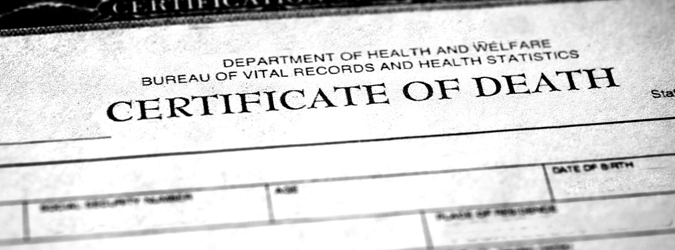

A client calls to tell you that a family member or friend has just died or is expected to die shortly. One of the best things you can do for that client is help ensure that the information reported on the decedent’s death certificate is accurate. A single reported error can delay receipt of life insurance benefits, bank accounts with beneficiary designations, social security payments and administration of the decedent’s estate. Even if your client is not the informant, meaning the person who provides the decedent’s information, your guidance can help ensure that the death certificate is accurately reported the first time.
What Informants Should Know Before Speaking With the Funeral Director
The funeral director bears legal responsibility for completing and filing the death certificate within 72 hours of death.[1] The informant provides personal information such as date of birth, place of birth, domicile, social security number, decedent’s marital status, mother’s maiden name, father’s name and educational level. The funeral director enters this information onto a draft death certificate and presents it to the informant for review prior to filing.[2] That review is the informant’s last opportunity to correct any errors on the death certificate before a formal correction process is needed.

The Social Security Number (SSN). The SSN is among the most important information on the death certificate, and most likely to be entered incorrectly. Before meeting with the funeral director, the informant should verify the SSN on the decedent’s social security card, SS award statement or tax return to ensure that the informant is providing the correct number SSN.[3] The correct SSN is needed to obtain an estate tax identification number (EIN) to open an estate account, claim benefits under life insurance policies, and authorize financial institutions to pay out accounts with beneficiary designations. Although the funeral director must make at least one attempt to verify the SSN through the Electronic Death Registration System (EDRS) before filing,[4] mistakes happen, and a single transposed number can delay administering a decedent’s estate.
Parent Names. It is easy to provide the wrong version of the right information. For the father, the certificate requires his complete legal name – first, middle and last – without abbreviations and with any applicable suffix (e.g., Jr., Sr., III). For the mother, the death certificate requires her name prior to her first marriage, that is, her maiden name. If the name of either parent is unknown – as can happen with adoption or estrangement – the correct entry is “Unknown.” A blank field is an incomplete record that will require correction.
Usual Residence. Usual residence, or domicile, is vital because it determines which county’s Surrogate’s Court has jurisdiction over the decedent’s estate. Under New York law, domicile is “a fixed, permanent and principal home to which a person wherever temporarily located always intends to return.”[5] However, informants often assume that if the decedent died in a nursing home, long-term care facility or hospital, that this is the decedent’s usual residence to report on the death certificate. This is incorrect. When a decedent was placed in a nursing facility due to incapacity, the usual residence (domicile) remains the pre-facility address even if that residence has been sold prior to death.[6] Otherwise, the address to include is the decedent’s last residence.
AKAs. Advise your client to review the decedent’s assets – deeds, shares of stocks and cooperative apartments, bank accounts, brokerage statements, insurance policies – and confirm that every name under which the decedent held property is listed on the certificate as an alias. Likewise include all AKAs on the caption for any probate or administration proceeding so that financial institutions holding the assets will acknowledge ownership by the estate as conferred in the court decree.
The funeral director will also need the decedent’s full legal name and any prior surname; date and place of birth; highest level of education; usual occupation and industry;[7] race and Hispanic origin as self-identified; veteran status, if applicable; and marital status at death and, if survived by a spouse, that spouse’s name before their first marriage. However, if the informant (who also has to provide their own name, relationship to the decedent and address) claims to be the decedent’s spouse but is in fact a prior spouse or divorced, only the informant or a Supreme Court order, not a Surrogate’s Court’s order, can compel a change to the certificate. Similarly, if the informant claims to be the decedent’s executor or distributee, but is not, similar problems arise in administering the decedent’s estate.
When a New Client Comes to You After the Death
Compare the SSN to a tax return or social security card. Confirm the parent names, the spelling of the decedent’s legal name, date of birth, decedent’s address and the informant’s relationship to the decedent. If there is an error, it is better to discover it now rather than weeks later when a bank or insurer refuses to pay out a claim or a Surrogate’s Court requires that an informant who is neither an executor nor distributee must be cited. If the informant resides in the State of New York, they will need to be personally served with the citation.
Correcting Errors After Filing
Once the certificate is registered, it becomes an official record, and correcting it requires documentation, fees and time – typically around 12 weeks plus two additional weeks for mailing.[8]
If the error involves the cause, manner or place of death – information entered by the physician or facility – a 12-month window applies during which the certifier can submit the correction electronically through the E.D.R.S. After twelve months, a written acknowledgment from the certifier and supporting medical records are required.[9] If your client identifies such an error, they should contact the funeral director or the facility promptly.
For errors in personal information – a misspelled name, incorrect date of birth, wrong SSN or wrong parent name – the correction must be initiated by an entitled party: the decedent’s spouse or domestic partner; a child, parent or sibling; the informant listed on the certificate; or a court-appointed fiduciary or estate beneficiary.[10] Where your client was the informant, they can submit the correction themselves. Where someone else served as informant and introduced the error, your client will need to qualify as an entitled party or obtain authorization from one.
Personal information corrections require completing Form DOH-299 with original supporting documentation. In the city of New York, applications go to the New York City Department of Health and Mental Hygiene Corrections Unit and outside the city, these go to the local registrar of vital statistics where the death occurred.[11] In the city of New York, the application fee is $40 (non-refundable), each corrected certified copy costs $15 and mailed applications must be notarized.[12] Supporting documents – a birth certificate, marriage certificate, court order or a letter from the funeral home acknowledging the error – must be original certified copies; photocopies are generally not accepted.
Certified Copies
Each institution, such as the bank, insurer, pension administrator or Surrogate’s Court, will require a certified copy of the death certificate. As a rule of thumb, a client needs one certified copy of the death certificate for each financial institution that holds the decedent’s assets and one for the Surrogate’s Court for probate assets. The funeral director can order copies on behalf of eligible family members for up to one year after the date of death.[13] Afterward, copies must be requested directly from the issuing authority: the New York City Department of Health and Mental Hygiene at $15 per copy through VitalChek for deaths in the five boroughs, or the New York State Department of Health’s Vital Records Center at $30 per copy for deaths elsewhere in the state.[14] Access is restricted to entitled parties; an attorney may request copies on behalf of an entitled party with proper written authorization.
List for Informants/Clients
- Social security card or confirm the SSN from a tax return. Do not rely on memory.
- Decedent’s full legal name, including any prior surname from before a first marriage.
- All known aliases including those recorded with financial institutions (AKA).
- Date, city and state (or country) of birth.
- Last known domicile (the permanent address prior to admission to hospital or nursing facility), including zip code.
- Father’s full legal name (first, middle, last, suffix if any).
- Mother’s full maiden name.
- Marital status at time of death; if survived by a spouse, that spouse’s full name before their first marriage.
- Highest level of education completed.
- Usual occupation and type of industry.
- Race and Hispanic origin as the decedent self-identified.
- Veteran status; if applicable, branch of service and discharge date.
- Name, relationship, and address of the informant (the person providing these facts).
- Decide how many certified copies you will need depending on the number of financial institutions holding the decedent’s assets and if there are probate assets requiring a Surrogate’s Court proceeding.
Review Check List for Attorneys
- Confirm the SSN on the draft matches the confirmed number exactly – digit by digit.
- Confirm the mother’s name is her maiden name, not a married surname.
- Confirm all names are spelled correctly and in full – no abbreviations.
- Confirm the date and place of birth are accurate.
- Confirm no field has been left blank (unknown information should read “Unknown,” not blank).
- Order certified copies through the funeral director – up to one year from the date of death.
- Confirm the relationship of the informant to the decedent – again, if the informant claims to be the decedent’s spouse but is in fact a prior spouse or divorced, only the informant or a Supreme Court order (not a Surrogate’s Court’s order) can compel the Office of Vital Record to make a change to the certificate.
- Similarly, if the informant claims to be the decedent’s executor or distributee, but is not, similar problems arise in administering the decedent’s estate.
This article appears in the Trusts and Estates Law Journal, a publication of the Trusts and Estates Law Section. For more information, please visit nysba.org/trusts.
Toma Ito-Chihaia is a 2026 graduate of Columbia University and serves as a law clerk at the Law Office of Miriam Davidson.
Miriam Davidson has practiced law for 36 years, concentrating exclusively in the areas of Trusts and Estates, Probate and Estate Administration, Elder Law, Special Needs Planning, Medicaid Planning, and Guardianships for Disabled Adults. For more information about her background and legal services, please visit www.miriamdavidsonesq.com.
Endnotes:
[1] N.Y. Pub. Health Law § 4140 (Pub. Health) (requiring registration “immediately and not later than seventy-two hours” after death), § 4142 (specifying the funeral director’s duties to obtain personal particulars from the informant and present the certificate for medical certification). The attending physician or medical examiner certifies the cause of death.
[2] N.Y. Pub. Health Law § 4142(a).
[3] If Social Security Administration (SSA) documentation is needed post-filing – for example, to support a correction application or estate administration — a benefit verification letter can be requested by phone or in person at a local SSA office. The requestor should be prepared to provide the decedent’s name, date of birth and date of death; SSA will mail the letter within 10 business days.
[4] The Electronic Death Registration System (EDRS) is administered by the New York State Department of Health, Bureau of Vital Records. The funeral director must make at least one SSN verification attempt and may make up to five before submitting the case to a medical certifier.
[5] N.Y. Surrogate’s Court Procedure Act 103(15) (SCPA).
[6] New York CourtHelp, Decedent’s Domicile, https://www.nycourts.gov/help/when-someone-dies/decedents-domicile (last visited July 14, 2026) (stating that a nursing home is not considered a domicile, and that the estate proceeding should be filed in the county where the decedent lived before entering the facility); see also Estate of Schellbach, 2017 NYLJ LEXIS 2558 (Sur. Ct., Nassau Cnty. 2017) (the judge found no intent to change domicile despite three years in an out-of-state nursing home).
[7] The decedent’s education, occupation and industry are relevant to any wrongful death claim.
[8] N.Y. Pub. Health Law § 4176 (2024) (governing amendments to vital records).
[9] N.Y.C. Dep’t of Health & Mental Hygiene, Death Certificates: Corrections, https://www.nyc.gov/site/doh/services/birth-death-records-death.page (last visited July 14, 2026).
[10] 24 R.C.N.Y. Health Code § 207.01; see also N.Y.C. Dep’t of Health & Mental Hygiene, Death Certificates: Corrections, https://www.nyc.gov/site/doh/services/birth-death-records-death.page (last visited July 14, 2026) (enumerating entitled parties). The funeral director may amend the name of the funeral establishment and the method, place, location or date of disposition without commissioner approval; beyond those limited fields, the director acts at the request of an entitled party.
[11] N.Y.S. Dep’t of Health, Application for Correction of Certificate of Death, Form DOH-299. For deaths in the city of New York, applications are submitted to the N.Y.C. Dep’t of Health and Mental Hygiene Corrections Unit, 125 Worth Street, Room 144, CN-4, New York, New York 10013, by mail or in person (appointment required). For deaths elsewhere in the State of New York, applications go to the local registrar of vital statistics in the district where the death occurred; the local registrar may forward the correction to the state for final processing.
[12] N.Y.C. Dep’t of Health & Mental Hygiene, Death Certificate Amendments, https://www.nyc.gov/site/doh/services/birth-death-records-corrections-death.page (last visited July 14, 2026). The $40 processing fee covers multiple corrections submitted simultaneously.
[13] N.Y.C. Dep’t of Health & Mental Hygiene, Death Certificates, https://www.nyc.gov/site/doh/services/birth-death-records-death.page (last visited July 14, 2026).
[14] See N.Y. Pub. Health Law § 4174 (2024); N.Y.C. Dep’t of Health & Mental Hygiene, Death Certificates, https://www.nyc.gov/site/doh/services/birth-death-records-death.page (last visited July 14, 2026).