U.S. Supreme Court Analysis: Voting Rights, Race and Power of Ideology
10.2.2026

In a two-hour webinar analyzing the previous term of the U.S. Supreme Court, Albany Law Professor Vin Bonventre said it was ideological lines dividing the court and not beliefs about judicial activism versus restraint.
Bonventre showed how the ideological split played out with many decisions ending up 6-3 in favor of the conservative majority. His analysis found that in nearly two-thirds of cases, the majority sided with the Trump administration.
In the court’s summary decisions, or “shadow docket,” the justices took the side of the Trump administration 65% of the time. Bonventre said that his latest analysis was nearly identical to the one he did of the 2025 term.
Bonventre also highlighted the stark ideological divide in the voting patterns of four of the justices.
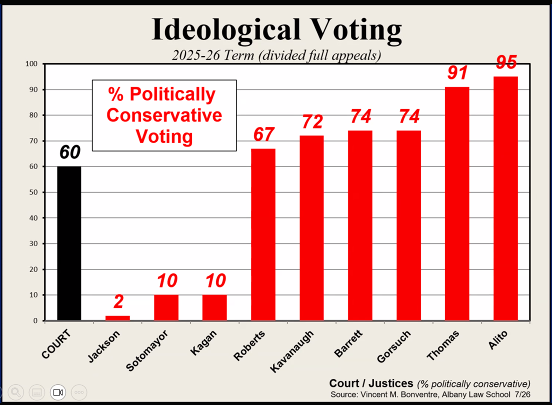
“If we’re going say that Thomas and Alito are ideologically blind, we can’t then dismiss the fact that Jackson and Sotomayor are voting the same kind of way, an extremely ideological way on these issues,” he said.
Bonventre also concluded that the court is not two-sided but three-sided with Chief Justice John Roberts and Justices Amy Coney Barrett and Brett Kavanaugh in the middle, often acting as swing votes.
“Justice Amy Coney Barrett is … bright as can be and won’t be as reactionary as liberals think she will be,” he said.
The Intersection of Race and Elections
With the midterm elections approaching next month, Bonventre paid attention to the cases that dealt with voting rights and Congressional districts. In Abbott (Texas) v League of United Latin American Citizens and Louisiana v Callais, the court ruled 6-3 that the state could not consider the race of the voters when drawing Congressional lines.
“The court, speaking through Alito, said, ‘no, you can’t consider race at all, even to remedy past discrimination.’ And he said, ‘I’m not changing the meaning of the Voting Rights Act’,” Bonventre said, adding “Just about everybody that ever studied the Voting Rights Act certainly thought that the Voting Rights Act meant that there could be majority minority districts in order to remedy past discrimination, but that can’t be done anymore, according to the 6-3 court.”
In Allen v Milligan, the court found that states cannot consider race in determining whether there has been discrimination, which Bonventre found confusing.
“What’s not confusing is that the trial court said that there was a deliberate dilution of the black vote, and the United States Supreme Court, the majority, said you can still use that gerrymandering, which diluted the black vote.”
In one of the few cases in which the court did not side with the Trump administration, the justices supported a state’s right to provide a grace period for mail-in ballots in Watson v RNC. It was a close 5-4 decision.
Bonventre also remarked on how the court limits the use of race in college admissions, diversity in the workplace and the drawing of Congressional lines yet allows race as a factor in law enforcement. In the case of Noem v Perdomo, the court ruled 6-3 that ICE agents may use race and other ethnic-related factors to justify an investigative stop.
“Maybe [the decision] is wise, maybe that makes sense, but it sure as heck is not consistent with all these other decisions that you absolutely can’t use race, that America and the Constitution are colorblind. It doesn’t fit into that at all,” he said.
Bonventre’s analysis also included cases dealing with the use of executive power, birthright citizenship, abortion rights and transgender rights.
The Continuing Legal Education course, “Another Year of Momentous Decisions and (Re)defining Constitutional Principles,” was sponsored by the Torts, Insurance, & Compensation Law Section, the Trial Lawyers Section and the Committee on Continuing Legal Education of the New York State Bar Association. It is available to watch on demand with attendees earning 2 MCLE credits.