A Trademark Goliath: Registration, Enforcement and the Super Bowl
5.20.2026
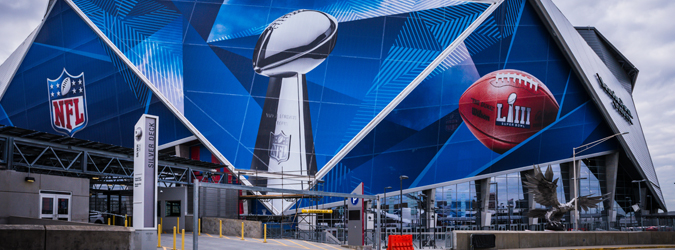

Numbers form the foundation of the National Football League.
Who is the first player to rush for 2,000 yards in a season? O. J. Simpson.
Who holds the career record for passing touchdowns with 649? Tom Brady.
Who set a single season sacks record when he registered 23 in 2025? Myles Garrett.

Yet there is a number with greater significance than statistics among trademark lawyers servicing the intellectual property portfolio of the NFL – 882283. That is the United States Patent and Trademark Office registration number for the wordmark “Super Bowl” in Class 41, which was registered on Dec. 9, 1969. Its services are described on the office’s website as “entertainment services in the nature of football exhibitions.” The NFL last received a renewal on the mark’s registration in 2020.
Trademark lawyers enforcing the NFL’s rights regarding the “Super Bowl” trademark are determined to create an impenetrable fortress around this valuable intellectual property asset. Their efforts focus on promoting rights and confronting violators with cease and desist letters, as one of the obligations regarding trademark ownership is control over how the mark is used and ensuring that it is not diluted or falls into the public domain. Litigation may result, depending on the severity of the infringing actions. Whether it is the NFL with “Super Bowl,” Disney with Mickey Mouse, Mattel with Barbie, DC Comics with Superman, or Hasbro with Monopoly, trademark lawyers must be adamant about enforcing rights and providing advice to rights holder clients.
In 2021, Mitchell Stabbe summarized the NFL’s approach to trademark enforcement along with the peril for violators confronting the league in an article published on the Broadcast Law blog: “Simply put, the NFL views any commercial activity that uses or refers to the ‘Super Bowl’ to draw attention as a violation of its trademark rights. Many of the activities challenged by the league undoubtedly deserve to be penalized. However, the NFL’s rule book defines trademark violations very broadly. If anyone were willing to throw the red flag to challenge the league’s position, a review from the booth might reverse some of those calls, but seeking review of the NFL’s play may be risky and would almost certainly be time-consuming and expensive.”[1]
Imagine a supermarket manager in Peoria, Illinois, creating a display with a sign that says “Super Bowl Snacks on Sale – Chips, Dip, Soda, Beer,” or a bowling alley owner in Sheboygan, Wisconsin, running a promotion titled “Strikes, Spares and Super Bowl Sunday – 50% Discount for Lanes and Shoes from 11 AM to 5 PM.” If the NFL’s in-house lawyers or outside counsel become aware of this use, they may spring into action immediately with a cease and desist demand.
Why would the NFL be concerned about businesses with a limited reach in the Midwest? If the league does not enforce its rights, then other businesses will follow, leading to a potential consequence of dilution regarding the mark’s strength and profitability.
The media must also be aware of rights associated with this football game that attracts worldwide attention. Assuming that the supermarket and bowling alley examples include advertisements in a newspaper, then the newspaper may be vulnerable. Before Super Bowl LX, the Pennsylvania News Media Association published an advisory warning:
“If a trademark is not owned by an advertiser or the advertiser has not gotten permission to use the trademark, the trademark owner can sue for an injunction against future printing. The newspaper is not liable for damages unless it publishes the advertisement knowing that it would cause confusion or deceive purchasers. If the newspaper runs the ad with knowledge of a conflicting claim of trademark ownership, the paper is not only subject to an injunction against future printing but may face liability for damages.”[2]
The first Super Bowl took place on Jan. 15, 1967, in Los Angeles Memorial Coliseum between the Green Bay Packers and Kansas City Chiefs. Led by head coach Vince Lombardi, Green Bay won 35-10 and followed with a 33-14 victory against the Oakland Raiders on Jan. 14, 1968, prompting Raiders tight end Billy Cannon to observe, “The Packers never change. They come at you and beat you. They made mistakes too, but we didn’t capitalize on them.”[3]
Both matchups received the label “AFL-NFL Championship,” “AFL-NFL World Championship” or a similar descriptor with a juxtaposition of the leagues’ initials. Even though America’s sports media used the term “Super Bowl,” it did not get officially implemented by the NFL until the third matchup, which ended in a 16-7 victory for the New York Jets over the Baltimore Colts and holds the distinction of being the last AFL-NFL contest before the leagues merged in 1970 with an expanded NFL being the remaining entity.
Baltimore dominated its opposition during the 1968 season, compiling a 13-1 record, including three games where the other teams failed to score. Losing only to the Cleveland Browns, Baltimore’s beloved Colts avenged their defeat by blanking Cleveland in the AFL championship game 34-0 after beating the Minnesota Vikings 24-14 in the initial playoff game.
Jets quarterback Joe Namath famously guaranteed a victory for his team a few days before Super Bowl III in Miami’s Orange Bowl. It did not seem plausible to insiders. However, the 25-year-old quarterback delivered on his promise. Larry Fox of New York City’s Daily News wrote, “Namath was the guy they said would rattle; he was the guy they said needed humility; he was the guy who threw interceptions. But, when they got on the field this overcast afternoon, he was the man directing the only kind of disciplined attack that can beat a team like the Colts – and he did it without throwing a single interception.”[4]
The Super Bowl ascended to the status of an American institution in the 1970s, reflected by Hollywood storytellers using it as a foundation in episodes of the sitcoms “All in the Family” and “The Mary Tyler Moore Show” as well as the movies “Black Sunday” and “Heaven Can Wait.” Further, the 1979 film “North Dallas Forty” revolves around the fictional North Dallas Bulls, but the term “Super Bowl” appears in dialogue and in the coach’s pyramid of success atop words including integrity, reliability and sincerity.
Sixty years after the Packers and Chiefs inaugurated this cultural cornerstone, its appeal is stronger than ever, which means that the NFL will continue to be vigilant in protecting the “Super Bowl” trademark with the aggressiveness of Dick Butkus, the focus of Lynn Swann and the effectiveness of Joe Montana.
David Krell is the author of “Have Yourself a Merry Legal Christmas: Laws and Justice in Holiday Movies and Television Shows.” This article appears in a forthcoming issue of the Entertainment, Arts and Sports Law Journal, the publication of the Entertainment, Arts and Sports Law Section. For more information, please visit nysba.org/easl.
Endnotes:
[1] Mitchell Stabbe, Stay a Lot More Than Six Feet From the NFL’s Trademarks! 2021 Update on Super Bowl Advertising and Promotions, Broadcast Law Blog, January 25, 2021, https://www.broadcastlawblog.com/2021/01/articles/stay-a-lot-more-than-six-feet-from-the-nfls-trademarks-2021-update-on-super-bowl-advertising-and-promotions/ (last accessed March 5, 2026).
[2] Legal Hotline: ‘Super Bowl’ Rules, Pennsylvania News Media Association, January 27, 2026, https://panewsmedia.org/legal-hotline-super-bowl-rules/ (last accessed March 5, 2026).
[3] George Ross, You Can’t Make Mistakes, Oakland Tribune, January 15, 1968, 41.
[4] Larry Fox, No Impossible Dream: Jets 16, Colts 7, Daily News (New York), January 13, 1969, 60.