AI and the Courts: New Frontiers in Legal Writing and Research for New York Judges and Litigators
8.12.2026
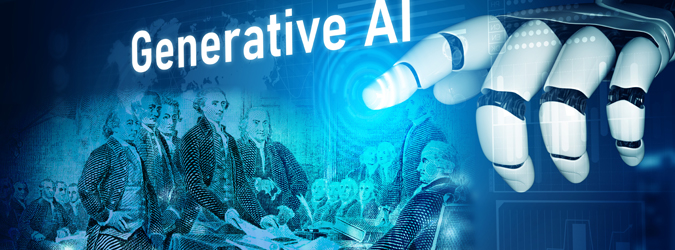
When America’s Founding Fathers drafted the Constitution, today’s technology was inconceivable. One example is artificial intelligence machines that decide, predict, and recommend.[1]
Generative AI is what online legal research was decades ago: a favorite target of critics, but a tool that could revolutionize legal work.[2] ChatGPT’s November 2022 debut transformed legal operations. Generative AI has since become “as ubiquitous to [the legal field’s] infrastructure as a typewriter or calculator was in the 1970s.”[3] It is now everywhere.

Generative AI tools use large language models to analyze enormous datasets and create human-like text in response to an instruction or prompt.[4] Their customizability and scalability make them suitable across industries. But their incorporation into standard operating procedures has produced mixed reactions. Advocates praise efficiency gains; critics blame them for layoffs.[5] Junior attorneys fear that automation will eliminate basic tasks that have traditionally marked their professional development.[6]
The polarization following generative AI’s widespread adoption strengthens the case for regulation. In March 2026, the White House urged Congress to adopt a national framework to avoid “a patchwork of conflicting state laws” and emphasized the federal government’s role in setting uniform AI policy.[7]
Even a national framework cannot answer every sector-specific or adjudicative question, and generative AI might evolve faster than legislation.
Existing regulators with subject-matter expertise would still need to address sector-specific issues.[8] Courts would also retain an adjudicative role. On the narrower question – whether training AI models on copyrighted works is fair use – the White House opposed congressional interference with the judiciary’s resolution of the issue[9] and supported allowing the Courts to resolve it.[10] State courts are likewise well-positioned to address AI issues arising in litigation and court administration.
State courts can regulate generative AI, and several have. But questions remain about how courts will enforce existing ethical duties.[11] The New York State Unified Court System has sought to create a uniform statewide floor through its Interim Policy on the Use of Artificial Intelligence[12] and 22 N.Y.C.R.R. Part 161: Use of Artificial Intelligence Technology. Both policies largely reflect judges’ and attorneys’ existing ethical obligations.[13]
This article explains how generative AI can help judges and litigators with legal research and writing; how to identify possible AI use in opinions and court papers; the controversies surrounding its integration into court operations; the UCS’s current policies; and best practices for ethical, responsible use.
Assistance With Fundamental Tasks
Generative AI is becoming an essential part of modern legal workflows.[14] New York’s UCS agrees; its Advisory Committee on Artificial Intelligence and the Courts noted in its December 2025 report that generative AI can “improve the administration of justice” by enhancing judges’ and litigators’ ability “to operate effectively and efficiently.”[15] Practitioners should take advantage of what generative AI offers, especially for legal research and writing.[16]
Legal Research
Generative AI can help with legal research. Judges and litigators can ask it questions about the law or direct it to collect cases on a legal issue in a specified jurisdiction, making relevant authority easier to find. Researchers may instead identify cases independently and ask a tool to compare them or organize their notes.[17]
A Northwestern University survey conducted in December 2025 found that more than 60% of the 112 responding federal judges reported using at least one AI tool in their judicial work.[18] Respondents reported using AI most often for legal research (30%) and document review (15.5%).[19] They reported similar use by others in chambers: 39.8% for legal research and 16.7% for document review.[20]
The numbers reflecting AI use have only increased in the past months.
Generative AI’s usefulness to legal researchers has led Lexis and Westlaw to add AI-enhanced search functions to their platforms (Lexis+ with Protégé and Westlaw with CoCounsel and other AI products).[21] AI can point to the law. But AI is not the law. It is best used for discrete tasks, including generating Boolean searches (terms and connectors) and identifying claims, defenses, and leading cases.
Legal Writing
Generative AI can also speed legal writing. It can help brainstorm, communicate with clients, and format citations – whether Bluebook-style or under the Official New York Law Reports Style Manual (the Tanbook).[22] It can also perform substantive tasks, including drafting legal documents.[23] It can organize an argument using IRAC (Issue, Rule, Application, Conclusion) and follow a prescribed format. Generative AI tools can be configured to follow professional standards and jurisdictional rules.[24]
Beyond prewriting and drafting, generative AI tools can refine documents. They can revise word choice, evaluate tone, improve clarity and flow at the sentence level, and suggest organizational changes that eliminate redundancy. These editing capabilities can accelerate new litigators’ development by coaching them on language and organization while serving as Socratic partners.[25] They can also free experienced litigators and judges for higher-level work that cannot yet be automated.
Identifying (and Editing) AI Use
Existing ethical duties require human judgment. It is therefore important to assess whether a legal document was produced with meaningful human oversight. How can one tell whether a judicial opinion or court paper was written with a human in the loop?[26]
One way is pattern recognition. Generative AI seeks to mimic human prose but often overuses certain devices, distinguishing its output from genuine human writing. Possible signs, or red flags, include:
- Bookending a neutral example with em dashes (—) instead of using a personal anecdote or parenthetical aside. Em dashes are useful in legal writing, but AI often overuses them.
- Relying on contrasts and parallel phrasing, for example, “I thought it was X. It wasn’t.” It might also overuse “It’s not only X, but also Y.”
- Appearing “too perfect.” Legal writers should strive for perfection, but human writing often contains homophone errors, typos, and other mistakes that AI-generated text might lack.
- Exploiting cliché transitions, like “Here’s why that matters” or “In conclusion.”
- Using unusually uniform sentence lengths.
These red flags are not proof. Content matters more than style or structure. Generative AI’s greatest weaknesses are its inability to authenticate information, reason reliably, and exercise judgment. When reviewing AI-generated content, look for:
- Legitimate case citations without engagement with the facts or procedural posture.
- Invented authorities: fabricated cases or defective citations to real cases, including impossible pinpoint pages, nonexistent quotations, or incorrect courts or years.
- Hollow reasoning: polished prose that lacks analytical friction. It might summarize both sides superficially, describe the holding generically or inaccurately, and reach conclusions without applying the facts or addressing counterarguments.
- Inconsistency: broken cross-references, conclusions that do not follow from preceding paragraphs, inconsistent dates, incorrect pronouns, or mismatched party names.
- Jurisdictional slippage: ignoring controlling Appellate Division authority or treating federal or another state’s standard of review as New York law.
Generative AI is no panacea for fatigued legal writers. Its limitations require writers to take ownership of AI-generated drafts and, according to legal-writing expert Brian Garner, turn them into “polished prose” that reflects “their own voice and standards.”[27] In a world where generative AI can do the grunt work, editorial skill will distinguish good legal writers.[28] Legal writers must treat AI-generated content as “draft text, not finished work.”[29] They demonstrate judgment and value by “bring[ing] structure, refin[ing] tone, and align[ing] the prose with professional expectations.”[30]
Editors of AI-generated work should be attentive to shallow reasoning, nonexistent authorities, and citations that do not support the propositions for which they are offered. These are not new challenges. Careful judges, law professors, lawyers, and law students always strive in their legal writing to sharpen their reasoning, verify their authorities, and improve the accuracy of their citations. Skepticism, close reading, independent verification, and sound judgment have distinguished good legal writers for generations. They are the habits needed to use AI judiciously.
Anticipating the importance of editing AI, Columbia Law School this fall semester will require its 1L legal writing and research students to edit AI-drafted work, to teach students to master legal AI, rather than to be subservient to it.
But skilled generative-AI users who craft effective prompts and vigilantly edit the output can reduce or eliminate those red flags, effectively disguising their AI use. One can moralize that copying AI is undisclosed plagiarism. Eliminating flags makes AI assistance difficult to detect and, in some cases, impossible to identify from the finished text alone. Detection software is notoriously inaccurate, producing false positives and false negatives. Its reliability also varies with the model, the genre, and the extent of human editing.
The best available evidence of AI use is process evidence. That evidence includes chambers policies, clerk emails, draft histories, Microsoft Word metadata, and prompt logs. If that process evidence is absent or inaccessible, a cautious conclusion is, “This work has features consistent with unverified AI assistance,” not “This was written by AI.”
Judges and litigators remain responsible for their work product, even when generative AI did most of the boring, routine labor or the user failed to confirm or edit the output. They should therefore learn to use the technology ethically and sensibly. The practical audit is simple:
- Confirm all cited material, including givens, such as legal standards.
- Ensure that the output meets expectations. Are seminal cases cited? Do the motion papers or opinion address the arguments and facts in the record?
- Make sure that the document is internally consistent.
- Revise the output until it sounds like the author’s prior writings. It should not seem like Mr. Hyde is publishing something under Dr. Jekyll’s name.
It is useful to distinguish AI-generated text from genuine human writing. But identifying AI use is not a “gotcha.” Generative AI is a tool; using it for legal research or writing is not inherently unethical. Wrongdoing occurs only when judges or litigators misuse it in violation of their ethical duties.
Controversies Over AI Use
The adoption and use of generative AI remain controversial. Criticism centers on bias, billing, privilege, fabrications, and possible violations of judicial and attorney-conduct standards.
Ethical Considerations
Ethical considerations are a major barrier to generative AI’s integration into the practice of law.
The first ethical consideration is bias. Historical data used to train LLMs can, and often do, reflect longstanding systemic inequities.[31] Generative AI tools can reproduce those biases in their output.
The second consideration is billing.[32] Assume that one attorney uses generative AI to produce in one hour a document that another attorney would need three hours to produce. For an hourly matter, a lawyer generally may bill only the time actually spent – including reasonable time reviewing and revising the output – not the time the task would have taken without AI. Flat or value-based fees might be permissible, but they remain subject to reasonableness and disclosure requirements. Rule 1.5 of the New York Rules of Professional Conduct forbids attorneys from charging or collecting “an excessive or illegal fee.”[33] Rules 1.5(a)(1) and (a)(3) permit consideration of “the time and labor required” and “the fee customarily charged in the locality for similar legal services” when determining whether a fee is excessive.[34]
The third concern is confidentiality and privilege. Entering client information into a public generative AI tool might breach confidentiality even if no court ultimately finds a privilege waiver. The risk depends on the tool’s terms, settings, data practices, and safeguards.[35]
New York courts have begun to address discovery of AI interactions.[36] Under Rule 1.6, attorneys must “take reasonable efforts to prevent the inadvertent or unauthorized disclosure or use of, or unauthorized access to, confidential client information.”[37] In Assini v. Hayward, the court did not announce a blanket attorney-client privilege for AI prompts; it held that the unrepresented party’s prompts, prepared solely in anticipation of litigation, were conditionally protected litigation-preparation materials under CPLR 3101(d).[38] Confidentiality, privilege, and work product are related but distinct.
Fabrications and Hallucinations
Another barrier to generative AI’s integration is its tendency to invent information. This occurs when LLMs cannot substantiate their source material. They are trained to generate content, not to give authoritative answers to factual inquiries. They cannot distinguish a true statement from a false one or a legitimate citation from a fictitious one.[39]
Fabrications take many forms.[40] They include altered evidence, blended jurisdictions, citations to nonexistent cases, misinterpretations of existing law, and references to overruled authority.[41] Hallucinations are common. A 2024 study of public-facing models found legal hallucinations in at least 58% of tested responses overall; for questions asking for a case’s central holding, the rate was at least 63% .[42]
The fear that any one hallucination will profane Lady Justice is overstated. But AI poses a distinctive risk: It can produce plausible, unsupported assertions quickly and at scale.
Judges have long relied on court attorneys, law clerks, and judicial interns and externs for first drafts, and those writers sometimes err. Human assistance does not eliminate the duty to verify; neither does machine assistance.
The possibility of hallucinations is not itself a reason to reject generative AI. It is a reason to limit the tool’s role, ground its work in reliable sources, and authenticate every material proposition. Before Google, Lexis, and Westlaw, attorneys and judges researched and cited more slowly. Greater speed, however, does not excuse lesser care. We should not let the perfect be the enemy of the good; neither should we let convenience become the enemy of accuracy.
An undetected hallucination here and there will not necessarily compromise the administration of justice, but judges and litigators must still prevent these errors. Hallucinations can be insidious; they are hard to detect. Generative AI tools alternate between flattering and gaslighting. Because they aim to please, they can reinforce users’ biases and logical fallacies. The danger is not that AI sometimes sounds wrong; it is that it can sound certain when it is wrong. Those who fail to review AI-generated content meticulously might overlook these errors.
Hallucinations can be especially harmful in criminal cases.[43] When an expert uses generative AI, ordinary evidentiary questions arise concerning disclosure of the methodology, its reliability, the basis of the opinion, and the opposing party’s ability to test or challenge the work. Hearsay and admissibility depend on the purpose for which the output is offered and the governing rules. AI-altered or AI-generated evidence also raises authentication and reliability concerns. These errors could contribute to wrongful convictions and sentences.[44] Who should be responsible: the expert, the advocate, the court, or the technology provider?
Violations of Existing Conduct Standards
The final major barrier to generative AI’s integration is the belief that judges and litigators who use it violate existing ethical and conduct standards.
Under the Rules Governing Judicial Conduct (22 N.Y.C.R.R. Part 100), judges are accountable for all content in their opinions, orders, and other writings. They also may not delegate their decision-making responsibilities to another person or entity.[45]
Because the judicial-conduct rules do not directly address generative AI, uncertainty remains about permissible use. Asking a tool to help with research or drafting does not delegate decision-making. The ethical line is crossed when AI substitutes for the judge’s independent evaluation of the record and the law.[46]
The rules governing attorneys require competence, candor, confidentiality, and nonfrivolous filings.[47] They do not prohibit generative AI. Attorneys may use it if they independently check the output, protect client information, and otherwise satisfy their professional duties. What additional restrictions, if any, should apply?
Policy as Risk Mitigation
We must scrutinize anyone – or anything – claiming to have all the answers. Before incorporating generative AI into UCS standards, we must ask whether it can advance our goals and improve the administration of justice.
The UCS asked its Advisory Committee on Artificial Intelligence and the Courts to answer that question. The committee concluded that ethical, responsible use of generative AI can improve the administration of justice. UCS policies allow judges and litigators to use the technology while mitigating its risks and reinforcing existing professional duties.
Current Policies
Necessity
Courts cannot – and should not – ignore generative AI. Even systems without a framework must confront litigators’ and self-represented litigants’ use of it.[48] The issue is unavoidable.
The difficulty of creating a coherent policy cannot excuse a court system’s failure to adopt one. AI-related errors have already produced sanctions that are remedial, deterrent, or punitive, or all three.[49]
Judicial decisions can be vacated or remanded when an order relies on fictitious authority.[50] It is good that bad decisions can be corrected; it is better to avoid them. Judges who fail to exercise due diligence when reviewing AI-assisted papers and deciding cases risk more than their reputations. They might cause a miscarriage of justice and undermine public confidence in the court system.[51]
Litigators can likewise be sanctioned for citing hallucinated cases or statutes.[52] In Noland v. Land of the Free, L.P., the court warned that counsel must personally read and authenticate authorities and imposed $10,000 in sanctions after fabricated quotations and authorities appeared in appellate briefs.[53] Remedies in AI-misuse cases have included monetary sanctions, disciplinary referrals, striking or rejecting papers, and other corrective (and punitive) orders.[54] Courts commonly consider contrition, prompt correction, repetition after warning, and the effect on the proceeding.[55]
Operating without a coherent generative AI policy increases uncertainty. As incidents accumulate, inconsistent case-by-case responses might produce uneven treatment and perceived unfairness.[56] Clear, statewide rules are preferable.
Policy Cohesion, or Lack Thereof
The principal drawback of state-court regulation is fragmentation. States can and will adopt different policies, and courts within the same state might also differ.
Existing generative AI policies vary. A few courts prohibit attorneys and unrepresented litigants from using it.[57] Some permit use but require disclosure and certification of AI-generated content and sanction noncompliance.[58] Others require only that filers take responsibility for AI-generated content.[59]
New York is at the vanguard of judiciary-led generative AI regulation because it has adopted a statewide minimum standard. Chief Administrative Judge Joseph A. Zayas convened the Advisory Committee on Artificial Intelligence and the Courts and charged it with studying AI’s effect on UCS operations and recommending a broadly applicable, forward-looking policy.[60] The committee’s December 2025 report contains nine appendices, including two addressing the Interim Policy and the then-forthcoming Part 161.[61]
AI Policy for Judges
In October 2025, the UCS published its Interim Policy on the Use of Artificial Intelligence. It applies to judges and staff, to all work on UCS-owned devices, and to UCS work performed on personal devices.[62] It was designed to evolve with legislation, operational needs, and technological advances.[63]
Required Training
The Interim Policy encourages responsible use by requiring judges and staff to complete formal training before using generative AI. The required courses are “Artificial Intelligence Foundations,” “Introduction to Generative AI,” and “AI and Sensitive Info Don’t Mix.”[64] Three optional modules cover Microsoft 365 Copilot Chat, access to and use of the tool, and effective prompt writing.[65]
Restriction on Use to DoTCR-Approved Tools
The Interim Policy also requires judges and staff to use only generative AI tools approved by the UCS’s Division of Technology and Court Research (DoTCR).[66] The UCS imposed this restriction because of judges’ ethical duties under the Rules Governing Judicial Conduct, Part 100, Rules 100.2(A) and 100.3(B)(11).[67] Rule 100.2(A) provides that judges must promotes public confidence in the judiciary’s integrity and impartiality.[68] Rule 100.3(B)(11) requires judges not to disclose or use nonpublic information learned in a judicial capacity.”[69]
The Interim Policy bars users from entering confidential information into generative AI programs that do not operate on private models.[70] Once information is entered into a public-model tool, it might no longer remain under UCS control.[71] The UCS broadly defines “confidential information” to include addresses, birth dates, docket numbers, party names, publicly filed documents that might later be sealed, and UCS intellectual property.[72]
The May 2026 appendix to the Interim Policy lists approved products and their availability.[73] It identifies Microsoft Azure AI Services and Microsoft 365 Copilot Chat as currently available; Microsoft 365 Copilot as approved but currently unavailable and requiring a paid license; and GitHub Copilot and Trados Studio for specified users or functions.[74] ChatGPT was removed from the approved list, and DoTCR blocked it on UCS-owned devices.[75]
Enterprise-protected Microsoft tools do not use organizational prompts and responses to train foundation models.[76] But prompts and responses are logged and retained for audit and eDiscovery, and user-uploaded files may be stored in OneDrive.[77] The Advisory Committee’s statement that Copilot Chat carries virtually no risk that information will be leaked to the public addresses public leakage, not exclusive access by the individual user.[78]
DoTCR-approved tools offer stronger contractual, security, and governance protections than public consumer tools.[79] Tenant controls and guardrails can reduce confidentiality risks, but they do not eliminate the duty to comply with access, retention, and data-classification rules.[80] Organizations can also tailor tools through administrative settings, default instructions, and compliance measures.[81]
The UCS’s preferred tool, Microsoft 365 Copilot Chat, is hosted within its Microsoft 365 tenant.[82] Signed-in work accounts receive enterprise data protection, denoted in the UCS interface by a green shield.[83]
Access is limited to users with institutional credentials who have completed the required training. Prompts and responses are processed within the Microsoft 365 service boundary. Ordinary users cannot see one another’s conversations, although authorized administrators and compliance personnel may have access under applicable policies.[84]
This setup allows judges to access Microsoft 365 Copilot Chat from personal devices through their UCS accounts.[85] Microsoft states that enterprise prompts and responses are logged, retained, and available for audit and eDiscovery. OCA may therefore retrieve them for authorized compliance, disciplinary, litigation, or records purposes. Judges should treat prompts as institutional records, not private notes.
Suggested Improvements
Judges need state-of-the-art generative AI tools designed for judicial work.[86] The UCS should consider authorizing and encouraging judges to use premier generative AI tools and AI-enhanced legal-research platforms.
Judicial work requires tools capable of handling its complexity. Microsoft 365 Copilot Chat is useful for general drafting, editing, summarization, and brainstorming. But it is not an authoritative legal-research system. Its principal advantage is enterprise protection, not specialized legal authority. For complex legal questions, judges need tools grounded in current primary law and linked to verifiable sources.
The UCS is considering whether to license Microsoft 365 Copilot, a product distinct from Copilot Chat.[87] Although the UCS already has a Microsoft 365 tenant and DoTCR has approved the product, the May 2026 appendix lists it as unavailable. Copilot integrates with Calendar, Excel, Outlook, PowerPoint, Teams, Word, SharePoint, OneDrive files, and other Microsoft 365 applications New York judges use. That integration would provide significant workflow benefits and accelerate judicial productivity.
The UCS should also invest in AI-enhanced versions of Lexis and Westlaw. The Interim Policy requires judges to confirm all AI-generated content from Copilot Chat through independent research using non-AI sources. AI-enhanced legal-research tools remain fallible and require verification. But they can accelerate the identification of material issues and relevant authorities and examine Copilot Chat’s output, which is based on current public-web information.
New York judges cannot fall behind everyone else when it comes to legal research:
* The entire federal judiciary has had Westlaw with CoCounsel since April 2025.[88]
* Judges from forty-seven states have Westlaw CoCounsel.[89] New York is not in that group.
* 200 U.S. law schools and more than 120,000 law students get Thomson Reuters Westlaw CoCounsel Legal and Deep Research.[90]
* Lexis has also been providing law schools with AI since December 2023.[91]
* Judges with academic affiliations (typically adjunct professors) have free access for academic work, but that access does not authorize use for nonacademic work. In any event, the product is not listed in the May 2026 appendix to the Interim Policy. Judges may not use it for court work even if they paid for it themselves.
The UCS is reviewing AI-enhanced Lexis and Westlaw for compliance with the Interim Policy.[92] In evaluating Westlaw Advantage, CoCounsel, Lexis+ with Protégé, or similar products, the UCS should compare source coverage, citation transparency, accuracy, confidentiality, workflow integration, and government pricing.[93]
Intersection With Judicial Ethics
The Interim Policy was designed with judges’ existing duties under Part 100, the Rules Governing Judicial Conduct. Part 100 and the principle that generative AI must never displace the judgment and discretion required of judges guided the policy’s development.[94]
Appendix 9 of the Advisory Committee’s December 2025 report seeks to “to merge the Interim Policy on AI with the basic principles of judicial ethics so that courts have a unified framework for governing AI use in judicial work.”[95] It explains the policy’s relationship to Part 100 and recommends practices for incorporating generative AI effectively and efficiently into judicial work.
The committee intended Appendix 9 to provide general considerations and recommendations, not to enact guidelines.[96] It lacks authority to promulgate ethical standards. UCS leadership may promulgate statewide court rules; the Appellate Divisions’ Attorney Grievance Committees oversee attorney conduct; the New York State Commission on Judicial Conduct enforces judicial-conduct standards; the Advisory Committee on Judicial Ethics issues advisory opinions; and courts may develop governing principles through decisions and orders.[97] It nevertheless offered suggestions for “balancing the inevitability and benefits of the use of AI with the need to uphold the highest ethical standards when using it.”[98] The result was Appendix 9, “Ethical Considerations and Recommendations for the Use of Artificial Intelligence by Judges and Judicial Staff.”
Rule 100.1 requires judges to uphold the judiciary’s independence and integrity.[99] Rule 100.2 requires them “to avoid impropriety and the appearance of impropriety in all activities.”[100] Rule 100.2(A) further requires judges to “act at all times in a manner that promotes public confidence in the integrity and impartiality of the judiciary.”[101]
These rules shape judges’ use of generative AI. A judge may not delegate decision-making to a tool and must guard against biases in an LLM that could compromise judicial independence or impartiality. Judges must use generative AI without outsourcing their duties or undermining the judiciary’s image.
Concerns that judges might outsource decision-making are longstanding. Delegating drafting to court attorneys/law clerks or to law-student interns and externs – and now possibly to generative AI – has been extensively discussed in legal literature.[102] Judges must approve every aspect of an opinion, from its reasoning to each citation and punctuation mark, regardless how many people assisted. A machine’s involvement does not relieve judges of their duty to remain hands-on decision makers and lead authors. A judge may delegate drafting, but never judgment.
Other Part 100 rules provide guidance on using generative AI without violating judicial ethics.
Rule 100.3’s command that judges “perform the duties of judicial office impartially and diligently” offers guidance. Rule 100.3(B)(1)’s requirement that judges “be faithful to the law and maintain professional competence in it” can accommodate an evolving understanding of professional competence. Read with Appendix 9 and the Interim Policy, it supports acquiring enough knowledge to evaluate and supervise AI use.
Judges with the requisite competence should know how to use generative AI without jeopardizing confidentiality and also how to evaluate its output for accuracy and objectivity.[103] The UCS’s training requirement and restriction to DoTCR-approved tools make sense in this regard.
Rules 100.3(B)(6)(b) and 100.3(B)(6)(c) mark important limits. The former conditionally allows judges to obtain advice from a disinterested legal expert, described as a person, after notice to the parties and an opportunity to respond.[104] The latter permits consultation with court personnel whose function is to aid judges in carrying out adjudicative responsibilities.[105]
Neither exception naturally classifies an AI tool as a person or as court personnel.[106] Appendix 9 instead warns judges not to introduce AI output into decision-making if it constitutes improper external information or an ex parte communication, and not to use generative AI for independent factual investigation or to supplement the record. AI may assist with research and drafting, but the judge must validate its output and decide the case independently.
Part 100 does not prohibit judges from using generative AI. Judges who follow its rules need not fear inadvertently outsourcing decision-making to a machine. Doubting judges may still prohibit staff from using the technology.[107]
AI Policy for Litigators
The UCS’s policy for litigators appears in 22 N.Y.C.R.R. Part 161: Use of Artificial Intelligence Technology. Announced in March 2026, it took effect on June 1, 2026. Part 161 governs the use of AI in preparing papers in civil and criminal cases; its definition of “paper” excludes materials constituting or proffered as evidence.[108]
Rules
Rule 161.1 applies the policy to every UCS court in civil and criminal cases.[109] Attorneys and parties submitting covered papers are thus subject to a statewide baseline.[110]
Rule 161.2 defines two terms. First, it defines “AI” as “a machine-based system that can, for a given set of human-defined objectives, make predictions, recommendations or decisions influencing real or virtual environments [by formulating] options for information or action.”[111] Second, it defines “paper” as an affidavit, affirmation, brief, memorandum, pleading, or “other document prepared by an attorney or party for submission to a court.”[112]
Rule 161.3 states the policy. Attorneys and parties may use generative AI if they comply with the duties and responsibilities that apply to people who submit papers to a court.[113] Those duties include ensuring the accuracy of every paper, “regardless of whether [generative] AI tools were used” to prepare it.[114] The machine may be new; the duty of accuracy is not.
Rule 161.4 permits individual judges, in their discretion, to implement a Part rule governing AI use in preparing papers. If judges decide that a rule is appropriate, Rule 161.4 encourages adopting the model rule found in Appendix A.[115] The model rule repeats Rule 161.3’s duties and requires users to appreciate capabilities and limitations and independently ensure that a paper contains no fabricated or fictitious cases, statutes, or other material.
Implementation
Part 161 sets a statewide baseline for New York attorneys and parties. Courts may adopt Part rules, and Rule 161.4 encourages them to use the model rule. Litigators should therefore check both Part 161 and the presiding judge’s current Part rules.
Several judges have adopted Part-specific rules:
- In Brooklyn:
* Justice Aaron D. Maslow, Kings County Supreme Court, requires every motion to state whether generative AI was used.[116] If so, counsel must identify the tool, the documents containing AI-generated material, and the affected portions.[117] Counsel must also certify that the material was reviewed for accuracy.[118] Justice Maslow’s rules further require attorneys to alert the court to hallucinations in an opponent’s submissions.[119]
* Justice Sharon Bourne-Clarke, Kings County Supreme Court, requires attorneys to disclose generative AI use and certify that AI-generated arguments and authorities have been independently verified.[120]
- In Manhattan:
* Justice Kathy J. King, New York County Supreme Court, requires attorneys to disclose generative AI use and identify the tool and AI-drafted portion of each document.[121] She also requires certification that the AI-generated content was reviewed.[122]
* Justice Kathleen Waterman-Marshall, New York County Supreme Court, requires attorneys to state whether generative AI was used in any court filing and, if so, to certify that they reviewed the AI-generated content.[123]
- In Queens:
* Justice Mojgan C. Lancman, Queens County Supreme Court, requires attorneys to disclose generative AI use, identify the tool, and certify that AI-drafted content was checked for accuracy.[124] She also states that noncompliance might result in sanctions.[125]
- In Staten Island:
* Justice Catherine M. DiDomenico, Richmond County Supreme Court, requires attorneys to affirm that they have confirmed the accuracy of any AI-generated content and citations in their court filings.[126]
Part-specific rules offer benefits: judges establish uniform standards in their courtrooms, and litigators learn those preferences in advance and can better serve clients by complying.
But Part-specific rules can create confusion, not clarity.[127] A patchwork of overlapping requirements can undermine consistency. For example, a certification that satisfies Justice DiDomenico might not satisfy Justice Maslow.
I have not amended my Part rules to address generative AI.[128] I agree with Part 161’s underlying logic. Rule 130-1.1(c) defines frivolous conduct to include false material factual statements, and Rule 130-1.1-a(b) makes a signature a certification, after reasonable inquiry, that the paper and its contentions are not frivolous.[129] Together with Part 161 and the Rules of Professional Conduct, those provisions make a separate blanket disclosure requirement unnecessary.
Limitations
Arguably, Part 161’s most important feature is its limited scope. It applies only to “attorneys and parties,” not judges. Unlike the Interim Policy, it requires neither formal training nor the use of DoTCR-approved tools. It governs papers prepared for submission to a court and expressly excludes evidentiary materials, which are subject to separate considerations and requirements.[130]
Part 161’s limited scope raises questions. It defines AI broadly but does not separately define “AI tool,” leaving uncertainty about which integrated technologies fall within its scope. This uncertainty extends to AI-enhanced search functions on established legal-research platforms and unavoidable AI-generated summaries embedded in public search engines.[131] It matters because technology is evolving faster than regulatory nomenclature.
Another possible ambiguity in Part 161 concerns pro se litigants’ use of AI in their court submissions. Should unrepresented nonlawyers be accountable for AI’s poor lawyering?
An August 2026 Canadian study has found tangible benefits in AI, not only for pro se litigants, but also for judges. The study shows that judges believe that pro se arguments are not much better than before but that their filings are now clearer and better organized, closing what one judge called the “format gap.”[132] In New York, pro se litigants must also audit their AI work, as the Appellate Division, Second Department, held in May 2026 in Julien v. Arthur. The Court sanctioned the unrepresented litigant $250 for citing one nonexistent case.[133]
Clarification might come soon. Meanwhile, Part 161’s ambiguity gives it breadth and flexibility. By permitting responsible use, it allows litigators to reap generative AI’s benefits. That breadth and flexibility are strengths in a field often marked by fragmented and restrictive policies.
Intersection with Attorney Ethics
Part 161 has two key takeaways: State-court litigators may use generative AI, and they need not disclose its use when submitting papers. That nondisclosure policy should not be confused with Bluebook Rule 18.3, which governs citation when a writer relies on or quotes AI output.[134] It does not impose a general disclosure requirement for AI-assisted drafting.
Part 161 omits disclosure and separate certification because existing duties already require accuracy. Rule of Professional Conduct 3.3(a)(1) prohibits attorneys from making a false statement of fact or law and from failing to correct a prior material misstatement.[135] Rule 130-1.1(c) defines false material factual assertions as frivolous conduct, and Rule 130-1.1-a(b) makes a signature a certification, after reasonable inquiry, that the paper and its contentions are not frivolous.[136] Existing rules therefore support Part 161’s decision not to require an additional blanket disclosure or certification.[137]
A disclosure regime would also require standards and consequences for nondisclosure. Courts, the Appellate Division’s Attorney Grievance Committees, the New York State Commission on Judicial Conduct, and the Advisory Committee on Judicial Ethics would need to address whether accidental and willful nondisclosure warrant different treatment.[138] Attorneys might not even know they used AI as vendors increasingly integrate it into ordinary software.[139] Should unknowing and deliberate nondisclosure be treated alike?
One recent case shows that sanctions might await those who do not fully audit their AI product. In July 2026, the Supreme Court of Connecticut sanctioned an attorney for seven hallucinated citations in two separate cases, ordering him to complete extra ethics and AI-focused CLE courses, donate to the Connecticut Bar Institute $1,000 (plus another $1,000 from his firm), file a compliance report within six months, follow reciprocal disciplinary rules in any other state in which he is licensed, and post the Court’s decision online.[140] The Court also shamed the attorney by naming him 23 times.
But sanctions do not automatically follow every AI-related error. In one Eastern District of New York case, the court declined to impose sua sponte monetary sanctions despite hallucinations in AI-generated filings because the record did not establish bad faith or ill intent, and the court considered counsel’s personal circumstances.[141] The decision might cause judges to think twice before publicly calling out and humiliating lawyers for AI errors when correction and education can adequately protect the process. Should mercy be exceptional, or should proportionality and prompt correction guide the response? An August 2026 New York County Supreme Court case assumed without deciding that a lawyer submitted a brief with one quotation fabricated by AI, but the court nonetheless declined, in its discretion, to impose any sanction.[142]
Disclosure requirements also raise the question whether attorneys should disclose other technologies. Where should the line be drawn? Must they disclose Grammarly or Word’s spell-checker, or certify information obtained from Wikipedia?
Attorneys’ ethical duties require technological competence. Part 1200 Rule 1.1(a) defines competent representation as requiring “the legal knowledge, skill, thoroughness and preparation reasonably necessary for the representation.”[143] Part 161 signals the UCS’s willingness to treat generative AI as a technology attorneys must understand well enough to use competently. It permits use without disclosure or separate certification but warns that inadequate diligence endangers clients’ cases, attorneys’ jobs, and their reputations.
Best Practices
Responsible use is a sound principle but too vague to be actionable. It does not explain how judges and litigators can practice law effectively while using AI responsibly.[144] How can they maintain quality control while taking advantage of the technology?[145]
Best practices will change as generative AI technology—and our knowledge of it—evolves. But a few common-sense principles should stand the test of time.
Choose a Suitable Tool
First, choose a tool suited to the task. A general-purpose chatbot – even a paid one – does not become an authoritative legal database. Domain-specific tools that provide current primary law, source links, confidentiality controls, and auditability might be better suited to legal work, but price alone does not establish quality.[146]
Customize the Tool
Second, judges and litigators should customize their tools. Retrieval-augmented generation (RAG) retrieves relevant documents and supplies them to the model to help ground its response instead of relying only on the model’s internal parameters.[147] RAG can reduce unsupported answers, but empirical testing has found that legal-research products using RAG still produce erroneous or unsupported responses.[148]
Users can also customize tools to consider specified factors before answering and to respond in a particular format or tone. This customization can improve relevance and presentation, but it cannot ensure accuracy. Information security and privacy depend primarily on the platform’s terms, architecture, and administrative settings – not on the prompt alone.
Devise an Effective Prompt
Third, write good prompts. Asking a generative AI tool a question resembles making a wish to a genie: specificity produces better, safer results. Start with essential context, including the kind of document required, and provide the legally determinative facts.[149] Avoid irrelevant information that can distract the model or consume its finite context; include important contrary facts and authority instead.[150] Specify the desired product and any citation or formatting requirements.
The ABA recommends giving a tool a series of simple tasks, not one multifaceted assignment.[151] For example, first ask it to generate Lexis or Westlaw searches for an issue under New York law, then separately request federal-law searches.[152] A model has a finite context window. A muddled or overloaded exchange can degrade later output.[153]
The ABA also recommends assigning the tool a persona or role. For example: “You are a plaintiff in a New York State court. The issue is whether a negligent-supervision claim against a school is likely to survive summary judgment when the student’s injury occurred during recess. Outline your case, basing your answer on New York case law and statutes. Hyperlink all cited sources.” This helps the tool frame and narrow the task.[154]
Users can evaluate prompts by examining the responses.[155] Output that misses the crux, hallucinates, or lacks organization suggests an ineffective prompt. But fluency is not proof of accuracy. Only output that is independently authenticated, well organized, appropriately qualified, and supported by legitimate sources should be treated as a successful result.
Challenge AI-Generated Content
Fourth, establish procedures to challenge AI-generated content. This is critical because most generative AI tools are prone to hallucinations and require “oversight via human intelligence.”[156]
An easy challenge is follow-up prompting – sometimes called iterative prompting – in which the user asks the model to critique, test, or refine its response.[157] Useful questions, or statements, include:
- “Any situations in which your advice might fail?”
- “Identify missing perspectives in your previous response.”
- “What assumptions did you make in answering the previous prompt?”
- “What is the strongest aspect of your argument?”
- “Where might a judge push back against your argument?”
Users can also give follow-up feedback to improve a response. For example: “Your tone was too definitive and one-sided. Acknowledge the lack of consensus on this subject.” Be critical. Play devil’s advocate. Machines require no courtesy.
Audit AI-Generated Content
Finally, establish procedures to validate AI-generated content. A “cite and substance” review – familiar to academic and law-journal editors – checks that authorities are real, applicable, controlling, current, and correctly cited; that quotations are exact; and that majority and dissenting opinions are properly identified. Require the tool to hyperlink primary and secondary authorities. Soon enough, law journal editors will be in much demand.
Technology can also help through retrieval, grounding, and retrieval-augmented generation. These techniques can anchor responses to retrievable sources, but they can miss controlling authority, and a model can misstate the sources it retrieves. They help verification; they do not replace it.
Responsible Use Is Self-Preservation
Under UCS policy, judges and staff remain accountable for AI-assisted work. Under Part 161 and existing professional duties, attorneys and parties remain responsible for the papers they submit. Using a suitable product, writing effective prompts, and challenging and verifying output are acts of self-preservation as well as responsible practice. These measures help protect practitioners’ livelihoods and reputations. They promote accurate, persuasive, and truthful work.
Conclusion
The UCS’s generative AI policy strikes a comparatively sound balance. It disagrees with anti-AI rules but tells us that blaming generative AI models will not excuse false statements of fact or law.[158] That balance is difficult but essential. A categorical ban is nearly impossible to enforce and would deprive the judiciary of a valuable tool as the technology evolves. Unrestricted use, however, risks producing low-quality work. The UCS approach answers initial questions, builds on existing duties, and leaves room for revision.
Generative AI’s importance will continue to grow.[159] UCS policies can help New York courts, judges, and litigators remain technologically current. AI will not replace judges or lawyers. Used well, it can enhance their work, improve efficiency, and help them meet modern demands. The future of law will not belong to AI. It will belong to the judges and lawyers who learn to use it well.
Hon. Gerald Lebovits is a Manhattan Supreme Court Justice and an adjunct professor at Columbia, Fordham, and NYU law schools. He wrote the New York State Bar Association Journal’s Legal Writer column for 20 years.
Endnotes:
[1] 15 U.S.C. § 9401(3). The United States Code defines artificial intelligence as “a machine-based system that can, for a given set of human-defined objectives, make predictions, recommendations or decisions influencing real or virtual environments.” Id. https://nysba.org/managing-partners-underscore-that-training-and-oversight-are-critical-in-todays-ai-environment.
[2] Cynthia Feathers, Beyond the Mirage: Beware of Generative AI and Hallucinations, NYSBA.org (June 26, 2026), https://nysba.org/beyond-the-mirage-beware-of-generative-ai-and-hallucinations.
[3] David Alexander, Managing Partners Underscore That Training and Oversight Are Critical in Today’s AI Environment, NYSBA.org (Apr. 28, 2026),
[4] Examples of generative AI tools for lawyers include BriefCatch, ChatGPT, Claude, Clearbrief, GitHub Copilot, Google Gemini, Harvey, Legora, Microsoft 365 Copilot, Microsoft 365 Copilot Chat, Midjourney, and Spellbook.
[5] Sophie Caldwell, “AI Is Now the Leading Reason Companies Give for Cutting Jobs,” Says New Report – What That Means for Workers, CNBC.com (June 5, 2026), https://www.cnbc.com/2026/06/05/ai-is-now-the-leading-reason-companies-give-for-cutting-jobs-says-new-report-what-that-means-for-workers.html. A recent Challenger, Gray & Christmas report attributed almost 40 percent of the job cuts announced in May 2026 primarily to AI. See id.
[6] Maritza Dominguez Braswell, Legal Training in the Age of AI: A Leadership Imperative, ThomsonReuters.com (Apr. 30, 2025), https://www.thomsonreuters.com/en-us/posts/ai-in-courts/legal-training-ai-leadership.
[7] The White House, President Donald J. Trump Unveils National AI Legislative Framework (Mar. 20, 2026), https://www.whitehouse.gov/releases/2026/03/president-donald-j-trump-unveils-national-ai-legislative-framework/.
[8] White House Legislative Recommendations, National Policy Framework for Artificial Intelligence 3 (Mar. 2026), https://www.whitehouse.gov/wp-content/uploads/2026/03/03.20.26-National-Policy-Framework-for-Artificial-Intelligence-Legislative-Recommendations.pdf.
[9] Id. at 4.
[10] Id.
[11] See Brian Lee, New York Judges Get Fresh Guidance on AI-Generated Errors in Court Papers, Law.com (June 22, 2026), https://www.law.com/newyorklawjournal/2026/06/22/new-york-court-rule-puts-teeth-in-enforcement-of-lawyers-duty-to-verify-ai-assertions.
[12] N.Y. State Unified Ct. Sys., Interim Policy on the Use of Artificial Intelligence 1 (Oct. 2025; amended May 2026) (“Interim Policy”), https://www.nycourts.gov/LegacyPDFS/a.i.-policy.pdf.
[13] Lee, supra 11.
[14] Clio, AI Legal Writing: How Lawyers Can Work Faster Without Sacrificing Accuracy, AmericanBar.org (Sept. 15, 2025), https://www.americanbar.org/groups/law_practice/resources/law-technology-today/2025/how-lawyers-can-work-faster-without-sacrificing-accuracy.
[15] N.Y. State Unified Ct. Sys. Advisory Comm. on Artificial Intelligence & the Courts, Annual Report to the Chief Judge and the Chief Administrative Judge of the State of New York 13 (Dec. 2025) (“Advisory Comm. on AI”).
[16] Id.
[17] Patria Frias-Colón, Karl Pflanz & Christine Sisario, Artificial Intelligence in Chambers: Using Copilot Chat Within UCS Policy, PowerPoint Presentation (June 24, 2026). The presenters advocated using generative AI for low-risk tasks, such as comparing and summarizing documents.
[18] Anika Jaitley, Daniel W. Linna Jr., Hon. Xavier Rodriguez, V.S. Subrahmanian & Siyu Tao, Artificial Intelligence in Federal Courts: A Random-Sample Survey of Judges, 27 Sedona Conf. J. __ (2026 preprint), https://www.thesedonaconference.org/sites/default/files/publications/Artificial_Intelligence_in_Federal_Courts_preprint_0.pdf (“Northwestern Study”); see also Shanice Harris, Federal Judges Report Broad Adoption of AI Tools, Northwestern Engineering (Mar. 31, 2026), https://fcei.northwestern.edu/news/articles/2026/03/federal-judges-report-broad-adoption-of-ai-tools/index.html.
[19] Northwestern Study, supra note 18, at 20.
[20] Id.; see also Thomson Reuters Institute, 2026 AI in Professional Services Report (2026), https://www.thomsonreuters.com/en/reports/2026-ai-in-professional-services-report (reporting that organization-wide AI use nearly doubled to 40 percent in 2026).
[21] Advisory Comm. on AI, supra note 15, at 5–6 (describing UCS pilots and evaluations of AI tools).
[22] See N.Y. State Law Reporting Bureau, Official New York Law Reports Style Manual (2022), https://www.nycourts.gov/reporter/style-manual/2022/2022-SM.shtml. Generative AI can format Tanbook citations effectively. For more on the Tanbook, see Thomas J.K. Smith & Gerald Lebovits, The Case for Official New York Tanbook Citations, N.Y.L.J., July 31, 2025, p. 3, col. 1, https://www.nycourts.gov/reporter/files/tanbook-article.pdf.
[23] Frias-Colón, Pflanz & Sisario, supra note 17.
[24] Clio, supra note 14.
[25] Id.; Dominguez Braswell, supra note 6.
[26] Nat’l Ctr. for State Courts AI Policy, A Legal Practitioner’s Guide to AI & Hallucinations, NCSC.org (Feb. 16, 2026), https://www.ncsc.org/resources-courts/legal-practitioners-guide-ai-hallucinations.
[27] Brian A. Garner, email to author via LawProse.org digest (July 21, 2026, 12:36 PM EDT) (on file with author).
[28] Id.
[29] Id.
[30] Id.
[31] Advisory Comm. on AI, supra note 15, at 12.
[32] ABA Standing Comm. on Ethics & Prof’l Responsibility, Formal Op. 512, Generative Artificial Intelligence Tools 11–13 (July 29, 2024), https://www.americanbar.org/content/dam/aba/administrative/professional_responsibility/ethics-opinions/aba-formal-opinion-512.pdf. See also Katsiaryna Zinavenka, AI and the Transformation of Legal Performance Models, NYSBA.org (forthcoming 2026) (on file with author).
[33] N.Y. Rules of Prof’l Conduct, Rule 1.5(a), 22 N.Y.C.R.R. § 1200.0.
[34] Id.
[35] See, e.g., Evan Glassman, Joseph M. Sanderson & Meghan L. Newcomer, New York Commercial Judges Embrace the Promises – and Confront the Perils – of Generative AI in Litigation, Law.com (June 15, 2026), https://www.law.com/newyorklawjournal/2026/06/15/new-york-commercial-judges-embrace-the-promisesand-confront-the-perilsof-generative-ai-in-litigation.
[36] Id.
[37] N.Y. Rules of Prof’l Conduct, Rule 1.6(c), 22 N.Y.C.R.R. § 1200.0. See also Ralph Carter, James M. Wicks, Timothy S. Driscoll, Katy Cole, Cathy Fetgatter & Angela Shannon, The Future Is Now: Practical Considerations and Developments at the Intersection of Litigation and Generative AI, PowerPoint Presentation, slide 17 (Jan. 14, 2026) (on file with author) (“The Future Is Now PowerPoint”).
[38] See Assini v. Hayward, 2026 N.Y. Slip Op. 26086, at *3–4 (Sup. Ct., Nassau Cnty. June 4, 2026), https://www.nycourts.gov/reporter/current/3dseries/2026/2026_26086.shtml (quashing a subpoena and finding conditional litigation-preparation protection under CPLR 3101(d) for the pro se litigant’s AI prompts prepared solely in anticipation of litigation).
[39] Advisory Comm. on AI, supra note 15, at 14.
[40] Interim Policy, supra note 12, at 2.
[41] Feathers, supra note 2; Nat’l Ctr. for State Courts AI Policy, supra note 26.
[42] Matthew Dahl, Varun Magesh, Mirac Suzgun & Daniel E. Ho, Large Legal Fictions: Profiling Legal Hallucinations in Large Language Models, 16 J. Legal Analysis 64, 64, 82–83 (2024), https://academic.oup.com/jla/article/16/1/64/7699227.
[43] Advisory Comm. on AI, supra note 15, at 13.
[44] Id.
[45] See Frias-Colón, Pflanz & Sisario, supra note 17. New York’s judicial-conduct rules appear in 22 N.Y.C.R.R. Part 100.
[46] Interim Policy, supra note 12, at 3.
[47] See N.Y. Rules of Prof’l Conduct, Rules 1.1, 1.6, 3.1 & 3.3, 22 N.Y.C.R.R. § 1200.0; 22 N.Y.C.R.R. §§ 130-1.1(c), 130-1.1-a(b).
[48] See Grace Marion, AI Hallucinations Prompt Mississippi Judge to Boot All Lawyers from Case for “Blindly Relying on Technology,” Mississippi Free Press (June 10, 2026), https://www.mississippifreepress.org/ai-hallucinations-prompt-mississippi-judge-to-boot-all-lawyers-from-case-for-blindly-relying-on-technology.
[49] See Damien Charlotin, AI Hallucination Cases, DamienCharlotin.com, https://www.damiencharlotin.com/hallucinations (last accessed July 25, 2026) (collecting reported AI-related litigation incidents; database entries are not necessarily distinct published decisions).
[50] See Shahid v. Esaam, 376 Ga. App. 145 (2025) (vacating and remanding after the trial court’s order relied on nonexistent authority and imposing a $2,500 penalty against counsel).
[51] Feathers, supra note 2.
[52] See, e.g., Mata v. Avianca, Inc., 678 F. Supp. 3d 443, 448, 461–66 (S.D.N.Y. 2023).
[53] Noland v. Land of the Free, L.P., 114 Cal. App. 5th 426, 432–46 (2025), https://courts.ca.gov/opinion/published-extended-post/2025-09-12/b331918.
[54] See Lorenzo Rovini, Avoiding Sanctions in the Gen AI Era: Practical Guardrails for Lawyers, NYSBA.org (Apr. 21, 2026), https://nysba.org/avoiding-sanctions-in-the-gen-ai-era-practical-guardrails-for-lawyers; Advisory Comm. on AI, supra note 15, at 74–75.
[55] Rovini, supra note 54 (noting that prompt correction, transparency, and meaningful remedial steps tend to mitigate consequences, whereas minimization or repetition after warning tends to aggravate them).
[56] See Advisory Comm. on AI, supra note 15, at 7–9 (discussing practitioner difficulty with inconsistent rules and the advantages of a uniform statewide policy).
[57] The Northern District of Ohio has adopted a hard-line approach to generative AI. See Christopher A. Boyko, Court’s Standing Order on the Use of Generative AI, OHND.USCourts.gov (Dec. 19, 2023), https://www.ohnd.uscourts.gov/sites/ohnd/files/Boyko.StandingOrder.GenerativeAI.pdf.
[58] See, e.g., Leslie E. Kobayashi, Disclosure and Certification Requirements – Generative Artificial Intelligence, HID.USCourts.gov (Sept. 28, 2023), https://www.hid.uscourts.gov/cms/assets/95f11dcf-7411-42d2-9ac2-92b2424519f6/AI%20Guidelines%20LEK.pdf; Jason A. Robertson, Order, OKBar.org (Oct. 22, 2025), https://www.okbar.org/wp-content/uploads/2025/10/Mattox-Order.pdf. Many other courts have similar policies.
[59] The Illinois Supreme Court has adopted a comparatively lenient policy on generative AI usage. See Illinois Supreme Court Announces Policy on Artificial Intelligence, IllinoisCourts.gov (Jan. 1, 2025), https://ilcourtsaudio.blob.core.windows.net/antilles-resources/resources/e43964ab-8874-4b7a-be4e-63af019cb6f7/Illinois%20Supreme%20Court%20AI%20Policy.pdf.
[60] The Advisory Committee on Artificial Intelligence and the Courts has more than 40 members from across New York State. Justice Angela G. Iannacci; Stuart Levi, Esq., of Skadden, Arps, Slate, Meagher & Flom LLP; and New York University School of Law Professor Jason Schultz co-chair it. See Advisory Comm. on AI, supra note 15, at Appx. 2.
[61] Michael S. Chu, First Department and AI: Takeaways from the Advisory Committee on AI and the Courts’ Inaugural Annual Report, PowerPoint Presentation, at slide 6 (June 14, 2026) (overviewing the Report’s organization).
[62] Interim Policy, supra note 12, at 1.
[63] Frias-Colón, Pflanz & Sisario, supra note 17.
[64] Angela G. Iannacci, email to author (May 7, 2026, 4:06 PM EDT) (on file with author); see also Advisory Comm. on AI, supra note 15, at 13.
[65] Id.; see also Advisory Comm. on AI, supra note 15, at 13.
[66] Interim Policy, supra note 12, at 5.
[67] Chu, supra note 61, at slide 26.
[68] Judicial Conduct, 22 N.Y.C.R.R. Part 100.
[69] Id.
[70] Interim Policy, supra note 12, at 3–5.
[71] Id. at 3.
[72] Chu, supra note 61, at slide 32.
[73] Interim Policy, supra note 12.
[74] Id.
[75] Id.
[76] Microsoft, Enterprise Data Protection in Microsoft 365 Copilot and Microsoft 365 Copilot Chat, Microsoft Learn (last updated June 2026), https://learn.microsoft.com/en-us/microsoft-365/copilot/enterprise-data-protection. Enterprise products are designed for organizational use and typically provide stronger security, centralized administration, user permissions, audit logs, compliance controls, software integration, and contractual restrictions on data use.
[77] Microsoft, Frequently Asked Questions About Microsoft 365 Copilot Chat, Microsoft Learn (last accessed July 25, 2026), https://learn.microsoft.com/en-us/copilot/faq; Microsoft, Microsoft 365 Copilot Data Protection Architecture, Microsoft Learn (last updated Mar. 20, 2026), https://learn.microsoft.com/en-us/microsoft-365/copilot/microsoft-365-copilot-architecture-data-protection-auditing.
[78] Advisory Comm. on AI, supra note 15, at 5–6.
[79] Interim Policy, supra note 12, at 3.
[80] See N.Y.C. Bar Ass’n Comm. on Prof’l Ethics, Formal Op. 2024-5, Ethical Obligations of Lawyers and Law Firms Relating to the Use of Generative Artificial Intelligence in the Practice of Law 2–3 (Aug. 2024), 20221329_GenerativeAILawPractice.pdf; Advisory Comm. on AI, supra note 15, at 58. In cloud computing, a tenant is an organization’s segregated environment within a shared software system.
[81] See Interim Policy, supra note 12, at 3.
[82] Id.
[83] Iannacci email, supra note 64.
[84] Microsoft, Privacy and Protections for Microsoft 365 Copilot Chat, Microsoft Learn (last updated Mar. 3, 2026), https://learn.microsoft.com/en-us/copilot/privacy-and-protections; Microsoft, Frequently Asked Questions About Microsoft 365 Copilot Chat, supra note 77.
[85] Angela G. Iannacci, email to author (July 13, 2026, 1:16 PM EDT) (on file with author) (citing UCS internal Copilot Chat SharePoint site); Microsoft, Frequently Asked Questions About Microsoft 365 Copilot Chat, supra note 77.
[86] See N.Y. State Off. of Gen. Servs., Award 23260 – Books, Serials, Databases, and Library Resource Management Products, Online.OGS.NY.gov (Sept. 9, 2025), https://online.ogs.ny.gov/purchase/spg/pdfdocs/2007023260PL_RELX.xlsx.
[87] Interim Policy, supra note 12.
[88] Jeff McCoy, Westlaw Precision with CoCounsel, Practical Law, and CoCounsel to Be Provided to US Federal Courts as the Essential Information Provider for the Federal Judiciary, Thomson Reuters (Apr. 9, 2025), https://www.thomsonreuters.com/en/press-releases/2025/april/westlaw-precision-with-cocounsel-practical-law-and-cocounsel-to-be-provided-to-us-federal-courts-as-the-essential-information-provider-for-the-federal-judiciary.
[89] Thomson Reuters, Is CoCounsel Legal a Tool for Judges? (Apr. 3, 2026), https://legal.thomsonreuters.com/blog/is-cocounsel-legal-a-tool-for-judges/ (reporting that courts in 94 percent of U.S. states have adopted CoCounsel).
[90] Thomson Reuters, Thomson Reuters Brings Agentic AI to Over 200 Law Schools (Jan. 22, 2026), https://www.thomsonreuters.com/en/press-releases/2026/january/thomson-reuters-brings-agentic-ai-to-over-200-law-schools (reporting access for more than 200 U.S. law schools and more than 120,000 law students).
[91] Lexis+ AI Expands to U.S. Law Schools | 2023 | LexisNexis Newsroom (Dec 2023).
[92] Iannacci email, supra note 85.
[93] See Thomson Reuters, Westlaw Plans and Pricing, https://legal.thomsonreuters.com/en/c/westlaw/plans-and-pricing (last accessed July 25, 2026). Retail pricing and product descriptions do not establish government pricing, comparative accuracy, or fitness for UCS use.
[94] Advisory Comm. on AI, supra note 15, at 147–54.
[95] Id. at 148.
[96] Id. at 24.
[97] Id.
[98] Id.at 22-23.
[99] 22 N.Y.C.R.R. Part 100.
[100] Id.
[101] Id.
[102] See, e.g., Douglas E. Abrams, Judges and Their Editors, 74 J. Mᴏ. Bar 194, 194 (2018); Gerald Lebovits, Alifya V. Curtin & Lisa Solomon, Ethical Judicial Opinion Writing, 21 Georgetown J. Legal Ethics 237, 304–05 (2008).
[103] 22 N.Y.C.R.R. Part 100. See Rule 100.3(B)(4), which directs judges “to perform their judicial duties without bias or prejudice against or in favor of any person,” and Rule 100.3(B)(11), which states that judges must not disclose or use nonpublic information learned as a jiudge. Id.
[104] 22 N.Y.C.R.R. 100.3(B)(6)(b); Advisory Comm. on AI, supra note 15, at 148–49.
[105] 22 N.Y.C.R.R. 100.3(B)(6)(c).
[106] See Advisory Comm. on AI, supra note 15, at 147–49 (requiring decisions based on the record, applicable law, and independent judicial analysis; warning against improper external information, ex parte communications, and independent factual investigation through AI).
[107] Chu, supra note 61, at slide 30.
[108] Use of Artificial Intelligence Technology, 22 N.Y.C.R.R. Part 161, especially Rules 161.1–161.2, https://www.nycourts.gov/rules/part-161-use-artificial-intelligence-technology.
[109] Rule 161.1.
[110] Id.
[111] Rule 161.2(a).
[112] Rule 161.2(b).
[113] Rule 161.3.
[114] Id.
[115] Rule 161.4 & Appx. A.
[116] See Part Rules § C15, https://www.nycourts.gov/courts/kings-county-supreme-court-civil-term/hon-aaron-d-maslow (last accessed July 27, 2026).
[117] Id.
[118] Id.
[119] Id.
[120] See Part Rules “Use of Artificial Intelligence (AI),” https://www.nycourts.gov/courts/kings-county-supreme-court-civil-term/hon-sharon-bourne-clarke (last accessed July 27, 2026).
[121] See Part Rules § VII, https://www.nycourts.gov/legacypdfs/courts/1jd/supctmanh/Rules/part6-rules.pdf (last accessed July 27, 2026).
[122] Id.
[123] See Part Rules “Use of Artificial Intelligence (‘AI’) in Filings,” https://www.nycourts.gov/legacypdfs/courts/1jd/supctmanh/Rules/part31rules.pdf (last accessed July 27, 2026).
[124] See Part Rules “Use of Generative Artificial Intelligence,” https://www.nycourts.gov/LegacyPDFS/COURTS/11jd/supreme/civilterm/partrules/part20.pdf (last accessed July 27, 2026).
[125] Id.
[126] See Part Rules “Use of Artificial Intelligence (‘AI’),” https://www.nycourts.gov/LegacyPDFS/courts/13jd/rules/DiDomenico/Part%2011%20Rules.pdf (last accessed July 27, 2026).
[127] See Chu, supra note 61, at slide 21. In his PowerPoint, Chu recommends that UCS courts “use the Model Rule” instead of “creat[ing] new part rules prohibiting AI or requiring its disclosure when [counsel] submit[] papers.” Id.
[128] See Part Rules, https://www.nycourts.gov/legacypdfs/courts/1jd/supctmanh/Rules/part7-rules.pdf (last accessed July 24, 2026).
[129] 22 N.Y.C.R.R §§ 130-1.1(c), 130-1.1-a(b), https://www.nycourts.gov/rules/part-130-costs-and-sanctions.
[130] Id. § 161.2(b); see also Chu, supra note 61, at slide 48.
[131] For example, Google displays an AI-generated answer before its other search results, and users cannot disable the feature. Does a Google search constitute prohibited use of public AI? Does the answer depend on whether the query includes confidential information? See Michael S. Chu, email to author (June 17, 2026, 3:14 PM EDT) (on file with author).
[132] Canadian Lawyer, GenAI is Changing How Self-Represented Parties Engage With Canada’s Courts, (Aug. 5, 2026), https://www.canadianlawyermag.com/news/general/genai-is-changing-how-self-represented-parties-engage-with-canadas-courts/394464.
[133] Julien v. Arthur, 2026 N.Y. Slip. Op. 03308 (App. Div., Second Dep’t, May 27, 2026).
[134] See The Bluebook: A Uniform System of Citation, Rule 18.3 (22d ed. 2025). Rule 18.3 addresses how to cite AI-generated content or AI-enhanced search results when cited; it does not require a general disclosure that AI assisted in drafting a document.
[135] Conduct Before a Tribunal, 22 N.Y.C.R.R. Part 1200, Rule 3.3(a)(1).
[136] 22 N.Y.C.R.R. §§ 130-1.1(c), 130-1.1-a(b), supra note 129; Chu, supra note 61, at slide 14.
[137] Rovini, supra note 54. The author notes that “attorneys have always been required to confirm that the authorities and assertions in their filings are accurate before presenting them to a tribunal.” Id.
[138] See The Future Is Now PowerPoint, supra note 37, at slide 27.
[139] See Advisory Comm. on AI, supra note 15, at 48.
[140] Tov Realty, LLC v. Suarez, 355 Conn. 902, 907-08 (2026).
[141] Debra Cassens Weiss, Confronted with AI Hallucinations in Filings, One Court Shows “Justifiable Kindness,” While Another Gets Tough, ABAJournal.com (Aug. 19, 2025), https://www.abajournal.com/web/article/court-rejects-monetary-sanctions-for-ai-generated-fake-cases-citing-lawyers-tragic-personal-circumstances. See also The Future Is Now PowerPoint, supra note 37, at slide 27.
[142] See Brown v. Real Estate Capital Am. LLC, 2026 N.Y. Slip Op. 51211(U) (Sup. Ct., N.Y. Cnty. Aug. 7, 2026) (G. Lebovits, J.).
[143] Competence, 22 N.Y.C.R.R. Part 1200, Rule 1.1(a).
[144] Alexander, supra note 3.
[145] Zinavenka, supra note 32.
[146] See Dahl et al., supra note 42; Varun Magesh, Faiz Surani, Matthew Dahl, Mirac Suzgun, Christopher D. Manning & Daniel E. Ho, Hallucination-Free? Assessing the Reliability of Leading AI Legal Research Tools, 22 J. Empirical Legal Stud. 216, 216–42 (2025), https://doi.org/10.1111/jels.12413.
[147] James Ju, Retrieval-Augmented Generation in Legal Tech, Thomson Reuters (Dec. 4, 2024), https://legal.thomsonreuters.com/blog/retrieval-augmented-generation-in-legal-tech.
[148] Magesh et al., supra note 42 (finding erroneous or unsupported responses in 17 to 33 percent of tested answers from leading AI legal-research tools).
[149] Introduction to Writing Effective AI Legal Prompts, Thomson Reuters (Jan. 16, 2024), https://legal.thomsonreuters.com/blog/writing-effective-legal-ai-prompts.
[150] Id.
[151] Am. B. Ass’n, Legal ChatGPT: Tips, Prompts, and Use Cases (Mar. 21, 2025), https://www.americanbar.org/groups/law_practice/resources/law-technology-today/2025/legal-chatgpt-tips-prompts-and-use-cases.
[152] In this example, the prompt should also request Boolean searches, natural-language searches, and terms of art.
[153] A context window is the finite amount of information a model can process at one time, including system instructions, the current exchange, and uploaded or retrieved text. It is not a separate model and does not necessarily include an entire chat or every uploaded document.
[154] Am. B. Ass’n, supra note 151; Introduction to Writing Effective AI Legal Prompts, supra note 147.
[155] Am. B. Ass’n, supra note 151.
[156] Feathers, supra note 2.
[157] Follow-up, or iterative, prompting asks a model to critique, test, or revise a response within the current exchange. It does not retrain the underlying model or change its learned parameters.
[158] Glassman, Sanderson & Newcomer, supra note 35.
[159] Dominguez Braswell, supra note 6 (citing 2025 Generative AI in Professional Services Report, Thomson Reuters (2025), https://www.thomsonreuters.com/en/reports/2025-generative-ai-in-professional-services-report). Ninety-five percent of respondents said that generative AI will “be a central part of their daily workflow within the next five years.” Id.