Cultivating New York’s Future Citizens: Advancing a Tradition of Democratic Education
7.13.2026
 Across the history of democratic thought, one theme endures: A just society requires educated, engaged citizens.[1] Aristotle argued that the purpose of law is not only to regulate but to cultivate virtue and shape citizens capable of intelligently participating in public life.[2]
In the early American republic, Thomas Jefferson warned that without widespread civic education a people could not remain free.[3] Education equips individuals with the skills necessary to engage in reasoned debate, challenge abuses of power and preserve liberty.[4] Jefferson articulated a complementary vision of civic formation, one grounded in the Enlightenment belief that self-government requires an educated public.[5] He repeatedly argued that a republic’s survival depends on its citizens’ capacity to understand their rights, scrutinize their government and participate meaningfully in public life.[6]

Jefferson viewed public institutions not simply as sources of law but as sites of democratic learning.[7] Courts, legislatures and schools expose citizens to the workings of government and model the principles of fairness, equality and deliberation that sustain republican life.[8] He saw civic education as a practical safeguard against tyranny, ensuring that each generation could defend the republic anew.[9]
Working from the premise that all institutions can play a part in educating the future citizenry, the legal profession has long provided programs for students to engage, question and learn about the justice system in the United States. One such program, Justice for All: Courts and the Community, was spearheaded by former Chief Judge Robert A. Katzmann of the U.S. Court of Appeals during his tenure (2013-2020).[10] In this program, students participate in a one-week summer session at a federal courthouse in Manhattan or Brooklyn. High school students can also arrange to meet a federal judge and participate in an essay contest. Justice for All offers resources and support for teaching about the law in classrooms. Its stated mission is “to help increase points of contact between the courts and the communities we serve, to facilitate mutual understanding, and help to ensure that the courts are accessible and effective public institutions.”[11]
The Scales of Justice Academy is another example of courts working in partnership with the community to educate future community leaders. This program, specifically for female students, was founded in 2009 by New York State Supreme Court Justice La Tia W. Martin to encourage girls to pursue careers in the law. In addition to classroom-based learning, students have the opportunity for mentorship and visits to local, state and national courthouses and other civic sites of interest.[12]
Inspired by the Scales of Justice Academy, in 2025, under the leadership of Presiding Justice Gerald J. Whalen, the Appellate Division, Fourth Department, embarked on a suite of youth-focused community initiatives for both high school and middle school students. The court has developed a model designed to develop the next generation of engaged citizenry. These initiatives serve as a community-based learning model that can be replicated throughout the New York State court system.
While there is much that students can learn in the classroom and through other educational activities, community-based learning can offer insight and experiences beyond the classroom. Community-based learning “connects academic learning with real-life application and community engagement” where young people can “learn and problem solve in the context of their lives and communities.”[13] The court system is one area where students can acquire a more thorough understanding of how our government and the law function.
The New York Youth Law Academy: A Week of Civic Formation
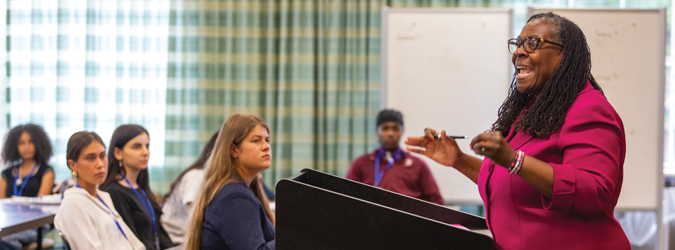
The cornerstone of the initiatives in the Fourth Department is the New York Youth Law Academy, a weeklong, intensive program that was held in July 2025 at the University of Rochester for approximately 40 high school students. (The 2026 program is scheduled for this week.) Its inaugural year was publicly recognized through local news coverage and community partnerships.[14]
The academy’s first session emphasized civic reasoning, exposure to legal institutions and democratic participation. Students learned the “Issue, Rule, Application, Conclusion” foundation of legal writing, explored the civil and criminal systems, received public speaking and media literacy training and heard from public officials, legal practitioners and judges. These seminars fostered deep discussions, promoted strong critical thinking about society and the law, and allowed for exploration of varying viewpoints regarding the responsibilities and shaping of society.
Vital to the project of an engaged, informed citizenry, the media plays an important role in safeguarding democracy. To this end, students met with Karen Edwards, an evening news anchor at 13WHAM in Rochester, who spoke about her role as a professional broadcaster. Edwards discussed how facts are gathered, how a crime story is developed, and how it is presented to an audience. Students were able to explore how media and the legal system intersect by learning how legal stories are covered by the media.
The Youth Law Academy also sought to help students understand historical contexts and included a visit to the Civil Rights Museum on Wheels, a replica of the bus in which Rosa Parks refused to give up her seat. This experience provided students with a real-time understanding of how legal segregation functioned every day. The week concluded with a graduation ceremony in the Susan B. Anthony Courtroom at the Hall of Justice in Rochester. These experiences reinforced the link between law, justice and civic identity.
The Fourth Department staff has also coached mock trial teams since 2023 at Vertus High School and East High School, with both teams participating in the New York State Bar Association’s statewide competition.[15] Each school works with a team of Fourth Department court attorneys to draft opening and closing statements and direct and cross-examination questions, to learn and apply the rules of evidence and to develop legal reasoning skills.
Finally, many students have taken advantage of the Fourth Department’s “Day at the Court” program where local students come to court as a complement to their classroom civics instruction.
The Fourth Department’s community-based learning model embodies Jefferson’s steadfast belief in civic engagement. By offering students direct encounters with legal institutions, observing oral arguments, learning rules of evidence, analyzing legal questions and engaging with judges and attorneys, the Fourth Department invites young people into the democratic process itself. This is not abstract civics but active civics: Students learn how the law functions, why it matters, and how they might one day contribute to its ongoing development.[16]
Students said that the academy helped them gain confidence with their research and public speaking skills and piqued their interest in the legal profession.
In addition to extending an understanding of law and citizenship beyond the classroom, the program helped students who may not have the opportunity to visit college campuses to do so. Students participated in a campus tour and met with various members of the administration. These experiences also attract students from diverse and underrepresented backgrounds, which serves as a pipeline program to ensure that talented individuals, regardless of their socioeconomic status, are exposed to careers in law, academia, journalism and politics.
Through structured experiences like the New York Youth Law Academy, students not only learn about the law but come to see themselves within it, a crucial step toward ensuring that tomorrow’s citizenry is prepared to serve as full participants in society.
Beyond the Academy: A Multi-Layered Civic Pipeline
The Fourth Department’s broader youth initiatives also expand access to civic and legal learning to even younger students.
In the spring of 2025, the Fourth Department, in partnership with Rochester’s Andrew Langston Middle School, created the first Middle School Legal Academy. The Fourth Department formed this unique program with the goal of introducing younger students to the court system and helping them learn fundamental civic concepts.[17]
Students participated in monthly colloquia with local lawyers and judges who shared their career paths, discussed the type of law they practiced and answered students’ questions. After the speakers finished, students then transitioned to formal instruction, where they, like the high school students at the legal academy, learned the basics of legal writing and oral advocacy, including completing an “Issue, Rule, Application, Conclusion” analysis for assigned issues. The program culminated with each student arguing before an Appellate Division justice at the Fourth Department. A graduation ceremony followed where Appellate Division judges and local politicians spoke to the students on how their interest and participation in the law are important components of a fair and just society.
The Fourth Department’s newest civic programming for youth, along with programs like the Scales of Justice Academy and Justice for All, create a continuum of civic formation that brings classical democratic theory into alignment with the needs of today’s youth.
By investing in civic formation, the court can help strengthen public understanding of the judiciary, increase access to the legal profession and encourage students to see themselves as future participants in democratic life. This model can be a “transformative force in education and social development.”[18]
These programs exemplify this transformation, reimagining the courthouse from a distant symbol of authority into a living civic classroom. In doing so, they enable young people to see themselves not as observers of the legal system but as potential leaders of that system, an essential ingredient of civic virtue in a pluralistic democracy. In an era where public trust in institutions is fragile,[19] programs that invite young people into the courthouse, literally and figuratively, serve as a powerful antidote to the increasing skepticism of established institutions. Programs linking classroom-based instruction with “real world” practices can be a vital part of ensuring that the next generation is prepared not merely to inherit New York’s governmental institutions but to actively participate in them.
Mary Ann C. Krisa is a principal appellate court attorney at the Appellate Division, Fourth Department, in Rochester, and an attorney/educator with experience in law, public administration, and higher education. She has taught “Introduction to Lawyering” at Albany Law School and constitutional law at SUNY Brockport. Krisa is dedicated to advancing civic literacy, cross-cultural understanding and public engagement through law and education.
Brittany A. Jones is the principal law clerk to Justice E. Jeannette Ogden, Appellate Division, Fourth Department. Prior to her current position, she was a litigator at Mental Hygiene Legal Service. Jones has served as an adjunct lecturer at Daemen University. She is a past president of the Minority Bar Association of Western New York and a state director of the Women’s Bar Association of the State of New York.
Endnotes:
[1] Amy Gutmann, Democratic Education (1999).
[2] Aristotle, Politics, bk III, Part 13.
[3] 79. A Bill for the More General Diffusion of Knowledge, 18 June 1779, reprinted in 2 The Papers of Thomas Jefferson 526, 526-35 (Julian P. Boyd ed., 1950), https://founders.archives.gov/documents/Jefferson/01-02-02-0132-0004-0079.
[4] Rockfish Gap Report of the Virginia Commissioners, Aug. 4, 1818, reprinted in 13 The Papers of Thomas Jefferson: Retirement Series 209, 209-24 (J. Jefferson Looney ed., 2016), https://founders.archives.gov/documents/Jefferson/03-13-02-0197-0006.
[5] 79. A Bill for the More General Diffusion of Knowledge (June 18, 1779), reprinted in 2 The Papers of Thomas Jefferson 526, 526-35 (Julian P. Boyd ed., 1950), https://founders.archives.gov/documents/Jefferson/01-02-02-0132-0004-0079.
[6] Rockfish Gap Report of the University of Virginia Commissioners (4 August 1818), reprinted in 13 The Papers of Thomas Jefferson: Retirement Series 209, 209-24 (J. Jefferson Looney ed., 2016), https://founders.archives.gov/docuents/Jefferson /03-13-02-0197-0006.
[7] See History of the Library of Congress, Libr. of Cong. (last visited Jan. 20, 2026), https://www.loc.gov/about/history-of-the-library/; The Role of Education, Thomas Jefferson’s Monticello (last visited Jan. 20, 2026), https://www.monticello.org/the-art-of-citizenship/the-role-of-education/ (noting Jefferson’s belief that “only educated citizens could make the American experiment in self-government succeed” and his advocacy for broad public education as essential to an informed citizenry).
[8] Charles R. Kesler, Education and Politics: Lessons from the American Founding, 1991 U. Chi. Legal Forum 101, 105 (1991) (discussing the role of education and political institutions in cultivating republican citizenship).
[9] Letter from Thomas Jefferson to William Charles Jarvis (Sept. 28, 1820), in 16 The Papers of Thomas Jefferson: Retirement Series 287, 287-89 (J. Jefferson Looney et al. eds., 2019), https://founders.archives.gov/documents/Jefferson/03-16-02-0234 (noting that the proper “remedy” for uninformed citizens is to “inform their discretion by education”).
[10] Announcement: United States Court of Appeals for the Second Circuit (death notice), U.S. Courts (June 9, 2021), https://ww3.ca2.uscourts.gov/docs/Katzmann.pdf.
[11] Mission, About Us, Justice for All, U.S. Courts, https://justiceforall.ca2.uscourts.gov/about-us/.
[12] About Us, Scales of Justice Academy, https://scalesofjusticeacademy.org/about/.
[13] Atelia Melaville, Amy C. Berg, and Martin J. Blank, Community-Based Learning: Engaging Students for Success and Citizenship, Partnerships/Community 40 (2006), https://digitalcommons.unomaha.edu/slcepartnerships/40.
[14] Reagan Hillman, NY Youth Law Academy’s Inaugural Graduation, RochesterFirst.com (July 18, 2025), https://www.rochesterfirst.com/news/local-news/ny-youth-law-academys-inaugural-graduation/.
[15] For more information on NYSBA’s Mock Trial Program, please visit nysba.org/nys-mock-trial.
[16] Claire Willeck, Active Civics: How Civics Education Shapes Political Engagement (Ph.D. dissertation, Princeton University 2023).
[17] Press Release: Appellate Division, Fourth Department, Appellate Division, Fourth Department Collaborates with Andrew Langston Middle School in Spring 2025 (June 16, 2025), https://ad4.nycourts.gov/press/notices/685063e28ece9a5eb04f8f4f.
[18] Asuma Mariita Nchaga, Exploring Community-Based Learning: Opportunities and Challenges. 4 Rsch Output J. Arts & Mgmt. 1, 46-52 (2025), https://doi.org/10.59298/ROJAM/2025/414652.
[19] Public Trust in Government: 1958‑2025, Pew Research Ctr. (Dec. 4, 2025), https://www.pewresearch.org/politics/2025/12/04/public‑trust‑in‑government‑1958‑2025/ (showing that only 17% of Americans trust the federal government to do what is right “just about always” or “most of the time”).
Copy Direct Link
Source Copy Link