Hidden in Plain Sight: How To Identify Victims of Human Trafficking
10.23.2026
A woman under the age of 18 is in adult court testifying in a case involving the assault and robbery of a man who hired her for sex. When she takes the stand, her behavior changes. She looks at the gallery and is overcome with fear. An observant court officer recognizes a man in the gallery and alerts the judge who also remembers the man from another recent trafficking case.
“Look for the power dynamics in the courtroom. Who are your eyes and ears when you are looking forward – the court officers. They can see what you cannot,” said attorney and trafficking expert Jane Anderson.
This case is one example where the accused may also be a victim in a larger criminal conspiracy. Third Judicial District Administrative Judge E. Danielle Jose-Decker and Albany County Supreme Court Justice Sherri Brooks-Morton say cases like this are the reason they joined forces to offer a program educating the bench and the bar on how to recognize human trafficking.
“This program reflects a simple reality. We have an obligation to see each case before us clearly,” said Judge Jose-Decker.
“People and relationships are complicated. There may be a history of fear or coercion that is changing their story. Behavior does not tell us the whole story,” added Justice Brooks-Morton.
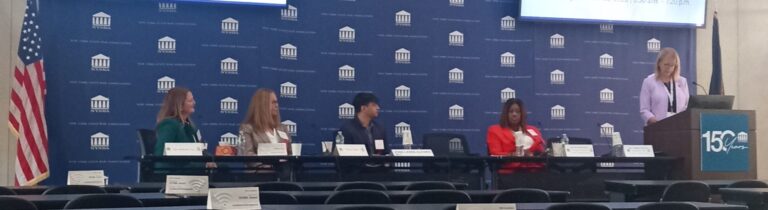
In recognition of October as Domestic Violence Awareness Month, the program, “Hidden in Plain Sight: the Intersection of Domestic Violence and Human Trafficking,” was sponsored by the New York State Bar Association’s Women in Law Section in partnership with Third Judicial District Gender Fairness Committee, the Office of Prevention of Domestic Violence, the Capital District Women’s Bar Association, Equinox, the Family Violence Litigation Clinic of Albany Law School and the Albany County Coalition Against Domestic Abuse.
The four-hour training session for attorneys included information on how to identify clients who may be victims of human trafficking, how to understand the intersection of domestic violence and trafficking and how to connect with local and regional victim service providers. The full program was offered in person and online and will be available for members on demand.
The first segment of the program was led by Jane Anderson, a retired Dade County, Florida, prosecutor who was a pioneer in prosecuting the area’s first human trafficking cases using RICO statutes intended for organized crime syndicates. Now, Anderson travels across the country with AEquitas, training attorneys and law enforcement on what to look for in suspected human trafficking cases.
She was joined by Jose Lewis Alfaro, a trafficking survivor who testified against his abuser and now speaks about his experience as a victim; and Theresa Nietzel a retired detective with the Erie County Sheriff’s Department with decades of experience investigating both sex trafficking and labor trafficking in Western New York. The three panelists shared sobering statistics and real-life cases with the attorneys to illustrate the complexities of trafficking cases and the attention needed to identify victim versus criminal.
According to a recent survey of survivors by the National Survivor Network, 60% of human trafficking victims were arrested for crimes not related to prostitution or drugs. Over half of those surveyed reported that each arrest took place while they were being trafficked by their abusers.
“Victims are often arrested for theft, shoplifting, or fraud such as passing bad checks,” Nietzel said.
She described one of her trafficking victims who was identified by a probation officer who noticed that each time the young female parolee was arrested for theft or fraud, the same man was waiting in a car for her. In addition to court officers and probation, corrections employees can be resources to identify trafficking victims. Nietzel says educating them to listen for certain words like “daddy” during calls or visits with female inmates can be a key indicator of trafficking.
Nietzel also encourages attorneys to partner with local police and school district officials to track children who stop attending school. She credits an English as a Second Language teacher in Chautauqua County for recognizing immigrant children who would stop attending school 30 days after arriving in the district. Nietzel’s investigation found that a trafficker was posing as a family member to bring unaccompanied minors into the country to work as farm labor. Once the immigration case closed, the children stopped attending school.
“The children were in the fields working. They came here to work and send money home to their families or were paying off the debt incurred for bringing them to the U.S.,” she said.
Lured From Home by the Promise of Love
“If a child runs away four or more times, they are 80% more likely to be victims of trafficking,” said Neitzel, who detailed the type of people who are most vulnerable to be victimized by traffickers.
- Adolescents aging out of foster care.
- Teens who feel rejected or socially outcast.
- Single mothers with young children.
- Unhoused, living in poverty.
- Immigrants and native people.
- Recent parolees.
Trafficking survivor Jose Lewis Alfaro shared his story of leaving a home where his father beat his mother and his siblings. As a gay teen, he was also ostracized from his family and was lured into a relationship with a man who then abused him further.
“He made me feel loved and respected. When, in reality, he was planning my abuse. My teenage mind was looking for safety,” he said.
Alfaro’s abuser went on to abuse other young men before being arrested and charged with trafficking years later. Alfaro bravely testified against his abuser in both criminal and civil court, winning a conviction and million-dollar judgment. He now speaks nationally on the topic of human trafficking.
From the courtroom to the jailhouse and the classroom, adults from all parts of the community can look out for vulnerable people at risk of abuse. The panelists agree that it takes all of us to identify and work together to be successful in rooting out human trafficking.
The full program, “Hidden in Plain Sight: the Intersection of Domestic Violence and Human Trafficking,” will be available for members to view on demand. The attendees earn 4.5 MCLE credits in professional practice during the program.
List of resource organizations:
- New York Safe Harbor Act
- AEquitas Resources
- Third Judicial District Gender Fairness Committee
- Equinox, Inc.
- Albany County Coalition Against Domestic Abuse
- Office of Prevention of Domestic Violence
- National Human Trafficking Hotline 1 (888) 373-7888
- NY Child Abuse and Maltreatment Register 1 (800) 342-3720
Copy Direct Link
Source Copy Link