Land Use Law: Understanding Battery Energy Storage Systems
7.6.2026
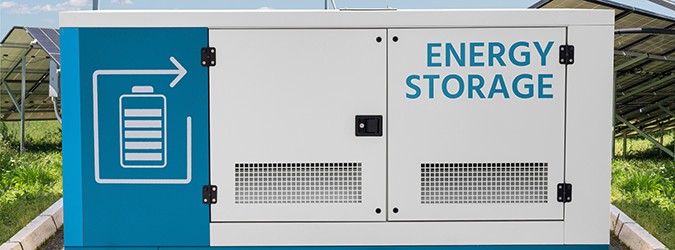
Attorneys representing municipalities and energy companies across New York are grappling with understanding the regulatory landscape and the future of battery energy storage operations.
The topic of battery energy storage systems was one of several discussed in the recent “Land Use 2026” Continuing Legal Education course presented by the New York State Bar Association.
Dan Spitzer of Hodgson Russ in Buffalo explained how this new technology can help New York’s communities provide backup power when they need it most.
The conventional power grid, in service since the turn of the last century, distributes energy immediately after it’s generated. It calculates the cost of energy based on supply and demand with the cost rising during peak usage. This is why power companies ask consumers to delay using appliances during peak usage time periods.
Solar power will peak at midday but generate no power at night while wind power will increase after dark. Batteries can then be charged when demand is low and the stored energy can be saved for when demand is high.
“Energy storage lets us change those rules, and take electrons that we produce when they’re cheap, and store them for when it’s expensive,” Spitzer says. “It allows us to change both the economics and the need for both transmission and for generation of power.”
Battery Storage Can Replace Gas Powered Plant
Gas powered plants on barges in New York City and in lower-income neighborhoods across the state provide extra power during peak usage. Spitzer says the New York State Independent Services Operator has ordered these plants to remain in operation for more years than planned to meet the state’s energy needs.
“These plants are all in areas that have some of the heaviest pollution. The use of energy storage can replace these plants and reduce the negative impacts [of the gas plants] on disadvantaged communities,” he said. “There is a projected deficit of megawatts in New York in 2028. Energy storage can really change that equation by taking an existing generation at night, moving it to the day. It can address a lot of resource issues by getting greater efficiency out of our existing generating resources.”
Regulation of Battery Energy Storage Systems
Spitzer acknowledged that many communities have moratoriums in place concerning battery storage. Some of the moratoriums are being challenged in the courts.
“We are seeing a shift in capital investment in energy storage in communities. It can work in industrial areas and in land classified as a brownfield. They are smaller than a solar array with many less than 10,000 square feet in size,” he said
Backup Power in Emergencies
Many public service agencies such as law enforcement and hospitals are turning to battery storage as a source of backup power in emergencies, Spitzer said.
“As battery costs continue to plummet, I think we are going to see more of this. If you are a municipal facility and concerned about what happens if the power goes out, this may be an option,” he said.
The Land Use 2026 program included an update on recent caselaw and statutory changes to the State Superfund and Brownfield Cleanup Programs. The program was coordinated by the land use committee members of the Real Property, Environmental and Energy Law and State and Local Government Law Sections of the Association and drew nearly 200 attorneys in attendance.