Looking Back in Search of a More Equitable Future
4.14.2026
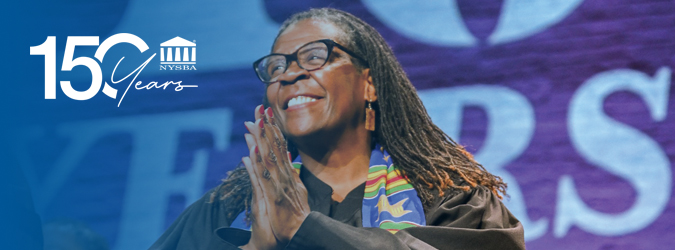
Over the course of writing this article, I had the honor of participating in a Sankofa ceremony commemorating a Black man who was lynched in the Adirondacks in 1932. His name is lost to history.[1] Rooted in cultural traditions from the Akan people of Ghana, Sankofa ceremonies emphasize the importance of reconnecting with the past to inform our future. The New York State Bar Association’s 150th anniversary provides an opportunity to engage in similar reflection.

This reflective spirit encouraged me to engage with NYSBA’s early history. When NYSBA was in its nascent stages, its first president, Judge John K. Porter, envisioned the association to be “an undertaking by practical men … to be of practical benefit to the profession and to the community at large.”[2] Our society, in many ways, would be unrecognizable to NYSBA’s founding members and, inevitably, much of what is beneficial to contemporary society differs dramatically from 1870s America. Yet this objective is as relevant today as it was 150 years ago. The driving aspiration to be beneficial to communities and the profession has, I venture, equipped NYSBA with an elasticity that enables us to celebrate its sesquicentennial. To honor that past, I would like to reflect on some ways that the association has been practically beneficial and how it can continue in that spirit.
One example of how NYSBA has been of practical benefit to the legal profession and community has been by diversifying its membership. At its inception, NYSBA was literally an “undertaking by practical men.” Women could not practice law in New York until 1886, after then NYSBA President and Gov. David B. Hill signed legislation lifting the proscription on women being admitted to the New York bar.[3] The New York State Bar Association did not admit its first female member, Kate Crennell, until 1901.[4] NYSBA would not have a female president for another 86 years, when Maryann Saccomando Freedman was elected in 1987. Today, we can see how far we as a profession have come: The number of women in the legal profession and NYSBA has significantly increased, with women now practicing law in every sector, leading the legal profession, and serving as leaders in our courts (including myself). To my delight, NYSBA’s leadership is mostly women: President Kathleen Sweet, President-Elect Taa Grays, and Treasurer Susan Harper.
One hundred and fifty years since NYSBA’s founding, its membership more generally reflects the rich diversity of New York State. While the association gained its first female member in 1901, its first Black member, Thomas B. Dyett, did not join until 1927. It would be another 66 years before NYSBA elected its first Black president, Archibald R. Murray. Today, NYSBA’s membership includes people from all backgrounds, experiences and identities. The association also has multiple sections that focus on diversity, civil rights and equity within the profession. Many foster the next generation of diverse legal professionals through scholarship opportunities and/or mentorship programs, embodying the spirit of being of practical benefit to our profession and communities. That NYSBA’s membership is more diverse and inclusive than it was 150 years ago is a powerful practical benefit that has and will continue to have widespread ripple effects. Undoubtedly, including as many voices as possible enriches our profession and, by extension, society.
NYSBA’s history is replete with other examples of practically benefiting society and the legal profession. Some themes emerge. One is providing a forum to engage with pressing legal and social issues. The association “reflects society. Society often disagrees with itself.”[5] Thus, an important feature of NYSBA has been to encourage members of the legal community to grapple with and inform the public about these issues. NYSBA does this by providing educational programs that analyze our laws and encourage forward thinking. NYSBA also offers a forum for robust debates on prominent legal and societal issues. To this latter point, I recommend perusing section reports issued by the association’s sections; they are teeming with future-oriented and solutions-focused analyses of pressing issues.
Another theme is supporting causes that help our society progress. The association has historically supported causes that promote access to justice, such as right to defense in criminal cases (predating Gideon v. Wainwright) and access to legal services.[6] Recently, NYSBA supported the Equal Rights Amendment to New York State’s Constitution, exemplifying its continued commitment to be practically beneficial.
Further, NYSBA supports access to justice for all, regardless of background, income or circumstance. The association has long advocated for increased access to quality legal services for low-income people across New York and a reputable legal profession to furnish these services. The association has also been an ardent supporter for pro bono work, including partnering with the Unified Court System for an annual celebration of Pro Bono Week in October. Steadfast support for access to justice through affordable legal services and information is, as the Deputy Chief Administrative Judge for Justice Initiatives, particularly dear to my heart.
Reviewing NYSBA’s history through a Sankofa-inspired lens that encourages connecting the past to the future illuminates a wonderful blueprint for the future, showing that reflection provides direction. As we move from the past 150 years to the next, our challenge will be to carry forward the lessons from our past to craft a legal profession that is ever more equitable and more attuned to the needs of society. The New York State Bar Association has indeed laid a foundation to do just that.
Deputy Chief Administrative Judge Edwina G. Richardson leads the New York State Unified Court System’s Office for Justice Initiatives, which is tasked with promoting meaningful access to justice in all New York state courts regardless of income.
Endnotes:
[1] I am deeply grateful to Beck Zucker, my special counsel, for his help with researching and drafting this article.
[2] Quoted in Deborah S. Gardner and Christine G. McKay, Of Practical Benefit: New York State Bar Association 1876-2001, cover and 10-11 (2003); Henry M. Greenberg, The Birth of the New York State Bar Assoc., NY St BJ 8, 14 (94-June 2022). https://nysba.org/the-birth-of-the-new-york-state-bar-association.
[3] Greenberg, supra note 2, at 8, 13 n 114 (noting that Kate Stoneman, the first women admitted to practice law in New York State, helped draft this legislation. Gov. Hill was president of NYSBA while he occupied the role of lieutenant governor of New York. When Gov. Grover Cleveland was elected to the U.S. presidency, Hill became governor.
[4] Id. at 8, 13 n 115 (2022); Gardner & McKay, supra note 2, at 37.
[5] Gardner & McKay, supra note 2 at foreword.
[6] Id. at 50-51, 72; 372 U.S. 335 (1963).