Managing Partners Underscore That Training and Oversight Are Critical in Today’s AI Environment
4.28.2026
Law firms are no longer merely thinking about incorporating artificial intelligence into their daily workflows. It has become as ubiquitous to a firm’s infrastructure as a typewriter or calculator was in the 1970’s. However, AI’s impact is far more significant as is the accompanying level of concern for its misuse through overreliance.

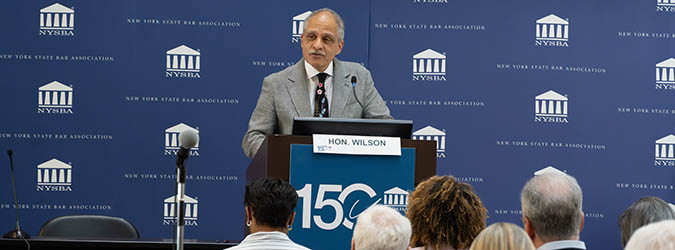
That was the consensus among three managing partners who spoke at a New York State Bar Association Law Practice Management Roundtable last week.
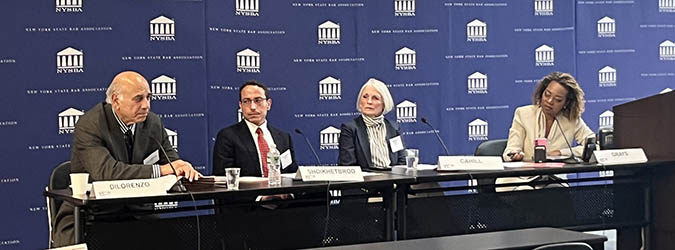
The panelists were:
- Connie Cahill, managing partner at Barclay Damon.
- Louis P. DiLorenzo, managing partner of the Westchester Office and co-managing partner of the New York City Office at Bond, Schoeneck & King, PLLC.
- Allen A. Shoikhetbrod, managing partner at Tully Rinckey PLLC.
New York State Bar Association President-Elect Taa Grays moderated the hour-long discussion while Craig Brown, principal at Bridgeline Solutions, introduced the speakers.
The propensity for attorneys to put unwarranted trust in or to become too dependent on AI’s outputs are among the biggest challenges facing senior partners today. Training and vigilant oversight have therefore become points of emphasis in law firms’ policy manuals.
Cahill reinforced that notion by saying that the training of young associates today is more important than it ever has been.
“We adopted a policy this year because we are most concerned about associates and making sure that they are getting the training they need. So right now, our policy requires that any junior associate, anyone in their first, second, or third year with us has to do the work first without using AI,” Cahill said. “They have to turn in the draft, they have to turn in the outline, they have to turn in whatever their work product was on their own, and only then can they go to AI.”
Shoikhetbrod agreed with her assessment, but with the caveat that senior partners must understand that most associates have been exposed to AI before they accept their first job.
“I think it’s tough, because with the new generation of attorneys coming in, they have already been relying on AI. They have been using consumer-facing technology, like ChatGPT and Copilot. So, it is going to be challenging to take it away from them,” he said.
However, Shoikhetbrod pointed out that identifying a job candidate’s ability to analyze an issue without the benefit of AI is part of the firm’s hiring process.
He said his firm provides job candidates with a hypothetical fact pattern on a real-world situation that might arise in his office. The candidates have 24 hours to turn in their responses.
“The point is for them to spot issues and for us to see if they can spot issues. We also get them to certify that they are not using generative AI. And then once they are hired, they are placed in a mentorship program for about six to 12 months with a senior attorney that meets with them every day, goes over work product with them, and provides them feedback.”
DiLorenzo said his firm has a policy that prohibits new lawyers from using AI tools and that their training also focuses on developing young associates’ general lawyering skills.
He drew on one of his father’s favorite phrases to illustrate a point that AI software is only a tool and the ability to use the software is not synonymous with being a good attorney.
“My father had a good saying, ‘it’s not the hammer, it’s the carpenter.’ These are tools, right? We still have to be good lawyers. This (AI) is a tool that can be especially useful and enhance our practice tremendously, but we can’t change the focus from teaching them to be lawyers first,” he said. “We’re trying to make sure they learn how to spot issues, draft pleadings, and draft other documents so that they can then use the (AI) tool to make the product better.”
Each panelist said that AI has improved their firm’s efficiency and that, contrary to many workforce forecasts, it has not led to massive layoffs.
“We had two people in our accounting group that did one function and we bought an AI tool. Those two people now have new jobs. It takes one person a quarter of the time to do what used to take those two people full time. Certainly, I think there is a lot that is going to happen away from the practice of law, but in the business of law, AI is going to save us money,” Cahill said.
President-Elect Grays jumped on the point about job displacement.
“I want to highlight that the tool did not replace people. It allowed them to do something more, right? It allowed them to do different jobs, because that is always a concern, that people are fearful that they are going to lose their jobs, but it opened an opportunity for them,” Grays said.
“It opened an opportunity, and we are trying to do the same thing with our legal assistants, but we have been very clear. We think, probably like a lot of firms, that finding good legal assistants is like searching for gold, and so we have no intention of reducing the number of legal assistants, we just think that they’ll be doing higher level things,” Cahill added.