Member Spotlight: Elizabeth Cooper
6.18.2025
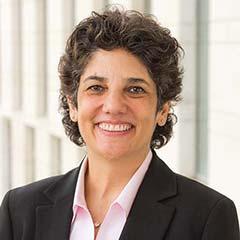
Elizabeth Cooper is a professor of law and faculty director of the Feerick Center for Social Justice at Fordham University School of Law, and a former member of the LGBTQ+ Law Section’s Executive Committee.
Who are your heroes in the legal world?
Like many of us, my heroes are those who were tenacious enough, and smart enough, and wise enough to challenge barriers to full equity and equality for all – Thurgood Marshall, Ruth Bader Ginsberg, Tom Stoddard & Abby Rubenfeld (early leaders at Lambda Legal). One of my personal heroes is the wonderful judge for whom I clerked, Anne E. Thompson, of the U.S. District Court for the District of New Jersey: the first woman and first African American federal judge in the state, appointed by President Jimmy Carter in 1979.
If you didn’t become an attorney, what career path would you have pursued and why?
For many years, I thought I would run for political office, which I considered an extension of being an attorney. Earlier, I thought about attending rabbinical school as I felt a deep connection to my Jewish identity and enjoyed parsing ancient texts, but ultimately I felt a stronger pull to doing social justice advocacy. I now know one can do that as a rabbi, but I did not have that vision then. Still, I think I chose the right path for me.
If you could dine with any lawyers – real or fictional – from any time in history, who would it be and what would you discuss?
There are so many! I would love to gather people from different eras and listen in on their conversation. For example, could you imagine Thomas Jefferson, James Madison (we’ll make him a lawyer for this hypothetical), Ruth Bader Ginsberg, as well as current Justices Sonia Sotomayor, Elena Kagan, and Ketanji Brown Jackson, gathered in a room discussing the issues of the day?
What is your favorite television show?
The television show that has affected me more than any other, and that I would highly recommend, is “A French Village.” It is long (many episodes for each of its seven seasons), as it takes the viewer through the experiences of residents of a fictional town in France from just prior to the Nazi occupation through the end of the war. Some collaborated with the Nazis; some joined the Resistance; some made small compromises at first that often led to larger compromises. It is deeply compelling and raises questions many of us are starting to consider in these challenging times.
How did you decide on your practice area?
One of the things I love about my job is that I get to learn about many different areas of law. I teach the Legislative Advocacy Clinic at Fordham Law School, where we partner with community-based and legal advocacy organizations to help develop and advocate for their legislative priorities – largely in Albany, but also in New York City. I so appreciate that I get to work with students to achieve social justice in areas as diverse as consumer rights, the rights of intersex individuals, decriminalization of sex work, taxpayer rights, and trans rights. I am looking forward to developing our projects for the fall semester!
What is the best life lesson that you have learned?
I will share two that I continue to try to learn. First, it is really important to work hard, but it is equally important to be good to oneself in the process. Almost everyone says harsh things to themselves they wouldn’t say to others; share the kindness you extend to others with yourself. Second, remember to spend time doing things you love with the people you love. Life is short and it is all the more meaningful when we get to spend it with the people who matter to us.
Lawyers should join the New York State Bar Association because . . .
I first got involved with NYSBA when I was asked to be the reporter for the Association’s Report of the Special Committee to Study Issues Affecting Same-Sex Couples in 2004. After the House of Delegates could not find its way to endorse marriage equality, I began encouraging my LGBTQ+ colleagues to join NYSBA or to come out if they already were members, hoping that this would make a difference. Five years later, Hunter Carter and I served as reporters for NYSBA’s second publication on the subject: Report and Recommendation on Marriage Rights for Same-Sex Couples in 2009, which the Association endorsed – and then used to lobby for marriage equality. I am heartened that in recent years NYSBA has made it a priority to increase the racial, sexual, and gender diversity of its membership. NYSBA is at its best when it reflects the full diversity of attorneys across the state.
As an attorney, what does Pride mean to you?
I had just finished my 1L year when the Supreme Court handed down the devastating Bowers v. Hardwick (1986) decision, upholding Georgia’s sodomy laws. And I recall the later, wonderful decisions of Romer v. Evans (1996), Lawrence v. Texas (2003), U.S. v. Windsor (2013), and Obergefell v. Hodges (2015). Justice didn’t come quickly enough, but these later cases reflected the culmination of brilliant legal work, terrific community organizing, smart legislative advocacy, and dogged work with the media. I know our communities now are experiencing direct threats to safety and well-being in ways we haven’t experienced in decades. I believe that our ongoing collaboration—within our communities and with our allies, in the courthouses and in the streets, will continue to allow the arc of the moral universe to bend toward justice.
What advice would you give to the next generation of law students who are interested in promoting LGBTQ+ rights?
Do it! Get internships and externships with organizations you admire, pursue part-time jobs in law offices that represent LGBTQ+ individuals, volunteer with organizations that provide direct services, write law review articles and blog posts. Remember that the needs of our communities are diverse, implicating issues of poverty and homelessness, as well as more traditional civil rights. There are so many ways to make a difference, including getting involved with NYSBA and its LGBTQ+ Law Section!