Profiles in Leadership: Past President David M. Schraver
3.4.2025
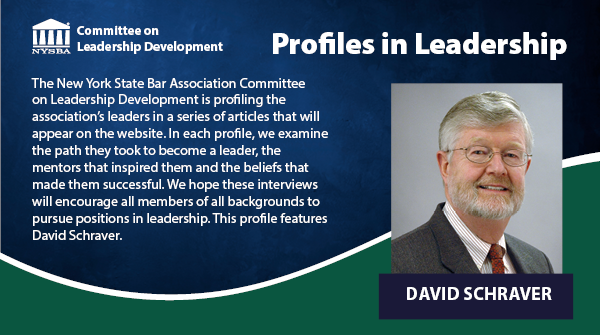
What made you become involved and stay with the New York State Bar Association?
I joined the New York State Bar Association, as well as my local bar association and the ABA, when I was first admitted to the bar. I have always felt that being a member of the bar association is part of being a lawyer and giving back to the profession. I stayed with the association because people in my firm I admired were actively involved with it and because I found meaning and value in the first committees I joined and the friendships I made as a young lawyer.
Describe your journey to becoming a New York State Bar Association leader.
Early in my career at then Nixon, Hargrave, Devans & Doyle; G. Robert (Bob) Witmer, Jr. became a friend and mentor and later my law partner at Nixon (now Nixon Peabody) for many years. Bob was active in the association from the time I knew him, and he served as president in 1994-95. When I was president of the Monroe County Bar Association in the late 1990s, I became a delegate to the House of Delegates and often accompanied Bob to meetings where he introduced me to other association leaders, some of whom were past presidents and others who later were elected president and asked me to take on various leadership roles.
How do you describe your leadership style?
I would say my leadership style is defined by service and collegiality. I try to understand the needs of the organization and identify able people who can work together to help meet those needs.
Can you describe a leadership challenge you overcame while at the New York State Bar Association?
During my term as president, a leadership challenge was presented in connection with the need to hire a new executive director. As a result, I spent considerable time and energy managing the transition with the support of my president-elect Glenn Lau-Kee, immediate past president Seymour James, my executive committee, and staff leaders. I helped lead a search for a new executive director and hired an experienced bar executive who led the staff through a transition period.
What mark of leadership do you wish to leave as a legacy at the New York State Bar Association?
During my term as president, we focused significant attention on the future of legal education and the future of the profession. While we could not have foreseen the challenges presented by the COVID-19 pandemic, I hope that some of our focus helped to prepare the association to inform the discussion of legal education and anticipate changes in the legal profession that have occurred over the past 10 years. Following my term as president, I have served on the board of The New York Bar Foundation, and I hope part of my legacy will be helping the New York State Bar Association and the Foundation to continue to work together through changing times to serve the profession and the public. I also co-chaired with Margaret J. (Peggy) Finerty the Task Force on Mass Shootings and Assault Weapons, which produced a report that included recommendations to reduce the incidence of mass shootings in the United States. The report was approved by the House of Delegates on Nov. 7, 2020, and many of its recommendations have been enacted into law by the New York State Legislature and presented to the ABA House of Delegates.