The Federal Arbitration Act at 100 and the New York Connection
4.15.2026
 In 2025 and 2026, we celebrate the centenary of the Federal Arbitration Act and the birth of the American Arbitration Association. These tandem events are no coincidence. These twin celebrations present the rare opportunity to examine the relationship and recognize the central contribution of visionary and strategic New York lawyers to today’s vastly expanded world of alternative dispute resolution that was built on the foundation they established.
The Federal Arbitration Act is a simple and straightforward (and some suggest too limited) statutory structure designed to address prior judicial hostility to arbitration. Before the act, there were unique defenses that rendered pre-dispute arbitration provisions unenforceable; no court would stay its hand to permit arbitration, and none would direct the parties who had contracted for arbitration to proceed. Instead, under the common law rule, pre-dispute arbitration agreements were revocable, and in equity, they were unenforceable. That meant that parties could not contract in advance to arbitrate. Instead, parties already in dispute had to agree to submit the dispute to arbitration. The Federal Arbitration Act specifically addressed these common law impediments to contracting for private resolutions.
The central remedy to the judicially created disabilities imposed on arbitration by common law is found in Section 2 of the federal law: “A written provision … to settle by arbitration a controversy thereafter arising out of such contract … shall be valid, irrevocable, and enforceable, save upon such grounds as exist at law or in equity for the revocation of any contract.” Other provisions provide for a stay of any court case pending arbitration (Section 3), for an order to compel arbitration (Section 4), and for limits on the vacating or modification of any arbitral award (Section 10).[1] The goal was to make contracts to arbitrate ordinary contracts enforceable to the same extent as all other contracts, and not subject to unique impediments.
Out of these provisions, a large domestic economy of alternative dispute resolution has grown and thrived. It would be 45 years before international arbitration was similarly legitimized by the wide adoption of the New York Convention that is also now imbedded in Title 9 of the U.S. Code (Sections 201-208).[2] Although that eponymous treaty will be celebrated in due course, today we are celebrating the Federal Arbitration Act and the role New York played in achieving a business solution for increasing and supporting the vibrant commerce that was and is central to the energy and success of our city, state and country.
How did we end up with the Federal Arbitration Act? It really started with the 1920 New York Arbitration Law, more commonly called the New York Arbitration Act.[3] The drafters of that act had from the outset a strategic goal of creating a national law. They wanted to position New York as the leading U.S. jurisdiction for commercial arbitration. The movers were the New York Chamber of Commerce and the American Bar Association Committee on Commerce, Trade and Commercial Law. The leading lawyers were Julius Henry Cohen, then general counsel to the chamber, Charles Bernheimer, a merchant and chamber leader, and W.H.H. Piatt, chair of the ABA committee. They had a plan. First, they would obtain enactment of a statute in New York, then obtain a federal law to govern interstate and foreign commerce and admiralty, and third, they would pursue an international treaty.4 To foster trade and increase commerce, they wanted merchants to have a clear path to the resolution of inevitable commercial disputes and a reliable way to reduce the delay and expense inherent in commercial litigation by overcoming judicial hostility to arbitration.
These New Yorkers were part of a wider effort to promote procedural reforms and minimize legal complexity that included Roscoe Pound and William Howard Taft.5 Within that wider movement, the 1920 New York Arbitration Act did in fact become the model for the Federal Arbitration Act, and a comparison of the two acts shows that the key provisions match: making arbitration clauses specifically enforceable and providing for stays and limiting grounds to vacate or modify awards are all shared features.
However, in Congress, our New Yorkers got pushback from organized labor. The entire scheme of labor governance, including strike limits and labor arbitration, predated commercial arbitration’s statutory recognition. Labor leader Andrew Furuseth objected that the bill might be used against workers, and Piatt told the Senate Judiciary Committee that he would eliminate “all labor disputes” from the bill. The language ultimately adopted is reflected in Section 1 of the federal law: “nothing herein contained shall apply to contracts of employment of seamen, railroad employees, or any other class of workers engaged in foreign or interstate commerce.”
Today, employment disputes are routinely resolved in arbitration and, together with consumer disputes that were never even discussed in formulating the legislation, have become a kind of arbitration Achilles heel, often rubbed raw. The U.S. is unusual among advanced economies in permitting (and expanding) consumer arbitration.6 But our focus here is the act itself and its original focus on business-to-business arbitration.
The act has been reinterpreted and reenvisioned many times over its long life. It was first conceived that the source of the congressional authority relied upon to enact the Federal Arbitration Law was the power to govern procedure in the federal courts.7 But if that interpretation persisted, the dictates of Erie RR v. Thompkins8 and the outcome-determinative test of Guaranty Trust Co. of New York v. York9 would have defeated federal application in diversity cases and would never have carried preemption into the state courts. The courts found instead that it was the power to regulate commerce and maritime activity that was the foundation of the Federal Arbitration Act, and its scope and preemptive effect dramatically expanded.10 Although the clear purpose of the act was to equalize a contract to arbitrate, the law evolved to favor arbitration and to favor inclusion of issues within the scope of arbitral authority.11
Only recently has the Supreme Court retraced its path. In Morgan v. Sundance, Justice Elena Kagan noted that the much-cited “policy favoring arbitration” is not a policy in favor of arbitration as a dispute-resolution method, but rather a commitment to end judicial hostility toward arbitration agreements and to place them on the same footing as other contracts.12
Returning our focus to the business-to-business origins of the Federal Arbitration Act, its enactment has had the precise effect its inventors intended. On those original terms, the act has been an unequivocal success. Merchant-to-merchant commercial arbitration clauses are now routinely enforced by federal and state courts, and awards are predictably confirmed absent narrow statutory grounds to vacate. The basic mechanism Cohen and Bernheimer sought – judicial enforcement of written arbitration agreements and awards – has proved durable for a century.13 Even though many friends of arbitration would like to reform the tendency toward more discovery and longer proceedings, the federal law has created an alternative, accessible route to resolution that is in fact less expensive and more expeditious than litigation. The strategy of a few energetic New Yorkers has had an enormous national and international impact.
Why does the AAA anniversary rhyme? Because without the American Arbitration Association, the Federal Arbitration Act would not have been operationalized. The American Arbitration Association was in fact created out of the merger of the key New York proto-arbitration organizations through an arbitration. When Moses Grossman and other lawyers created the Arbitration Society of America in 1922 to promote arbitration of “all disputes and differences,” Bernheimer and his allies perceived it as competing with their chamber-based vision and formed a rival provider, the Arbitration Foundation, in 1925. The foundation included the New York merchant-bar coalition behind the Federal Arbitration Act, while the Arbitration Society reflected a broader judicial-professional push; their rivalry threatened to fracture the very pro-arbitration front Cohen and Bernheimer had built.14 The two groups began an arbitration that resulted in a negotiated merger and, on Jan. 29, 1926, the creation of the American Arbitration Association with Frances Kellor as co-founder and chief administrator. Frances Kellor used her progressive philosophy to envision and then create a professionally run arbitration system.
Today, thanks to New York visionaries, activists and pragmatists, we inherit an arbitration economy that did not exist in the 1920s. Although there is no single authoritative source, the Bureau of Labor Statistics can provide some help on the growth of the neutral category, and American Arbitration Association data suggests the growth of its filings, and federal court data on the slowing rate of filings might be visualized as in the graph below.15
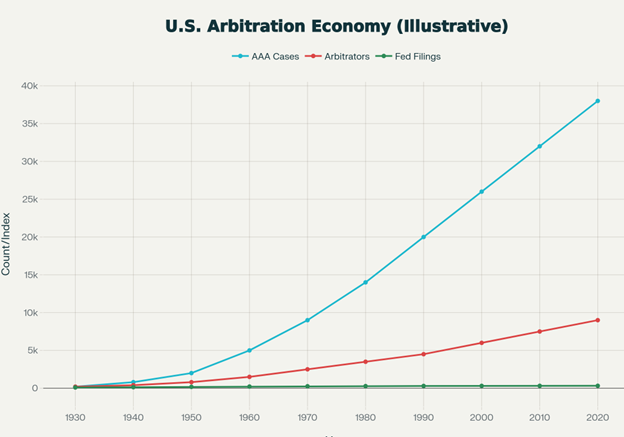
As New Yorkers with an interest in our history and in arbitration work, we have a lot to celebrate. Everyone would hope that their vision and energy could have the positive impact that our arbitral ancestors had with their efforts to create the Federal Arbitration Act and the American Arbitration Association.
This article appears in NY Dispute Resolution Lawyer, a publication of the Dispute Resolution Section. For more information, please visit nysba.org/drs.
Laura A. Kaster is one of the co-editors in chief of NY Dispute Resolution Lawyer, a former chair of the NYSBA Dispute Resolution Section, a fellow of the College of Commercial Arbitrators and the Chartered Institute of Arbitrators, and on the Tech List of the World’s Leading Technology Neutrals of the Silicon Valley Arbitration and Mediation Center. She is a full-time neutral.
Endnotes
[1] 9 U.S.C. § 10 (1970) provides:
“In either of the following cases the United States court in and for the district wherein the award was made may make an order vacating the award upon application of any party to the arbitration- (a) Where the award was procured by corruption, fraud, or undue means. (b) Where there was evident partiality or corruption in the arbitrators, or either of them (c) Where the arbitrators were guilty of misconduct in refusing to postpone the hearing, upon sufficient cause shown, or in refusing to hear evidence pertinent and material to the controversy; or of any other misbehavior by which the rights of any party have been prejudiced. (d) Where the arbitrators exceeded their powers, or so imperfectly executed them that a mutual, final, and definite award upon the subject matter submitted was not made. (e) Where an award is vacated and the time within which the agreement required the award to be made has not expired the court may, in its discretion, direct a rehearing by the arbitrators.”
[2] The New York Convention was adopted and opened for signature on June 10, 1958, and entered in force in the U.S. on Dec. 29, 1970. https://www.newyorkconvention.org/resources.
[3] Now codified in CPLR Article 75.
4 A. Kessler, Arbitration and Americanization: The Paternalism of Progressive Procedural Reform, 124 Yale Law Rev. 2940, 2943-44 (2015).
5 Hiro N. Aragaki, The Federal Arbitration Act as Procedural Reform, 89 N.Y.U. L. REV. 1939 (2014). Taft believed that international peace would be obtainable through arbitrating international disputes. Roscoe Pound’s 1906 ABA speech, The Causes of Popular Dissatisfaction With the Administration of Justice, argued that courts were too slow, technical and formalistic, turning litigation into a “game” that failed to meet social needs. He urged procedural reform, the 1976 Pound Conference named in his honor supplied both the intellectual foundation and institutional catalyst for the modern use of arbitration and ADR in the United States.
6 Many other jurisdictions either invalidate such clauses or subject them to strong consumer protection controls. Hiro N. Aragaki, The Federal Arbitration Act in Comparative Perspective: Is the U.S. an Outlier? in The Federal Arbitration Act: Successes, Failures, and a Roadmap for Reform (Richard A. Bales & Jill I. Gross, eds, Cambridge Univ. Pr, 2025). Jean R. Sternlight argues that the United States “stands apart” in Is the U.S. Out on a Limb? Comparing the U.S. Approach to Mandatory Consumer and Employment Arbitration to That of the Rest of the World, 56 U. Mia. L. Rev. 831 (2002).
7 Bernhardt v. Polygraphic Co. of America, 350 U.S. 198 (1956), where the court emphasized that the Federal Arbitration Act “is not a matter of substantive law at all but merely a declaration of a rule of procedure” for the federal courts.
8 304 U.S. 64 (1938). See L. Kaster, The Consequences of a Broad Arbitration Act Under the Federal Arbitration Act, 52 B.U. L. Rev. 571 (1972).
9 326 U.S. 99 (1945).
10 Prima Paint Corp. v. Flood & Conklin Manufacturing Co., 388 U.S. 395 (1967).
11 Courts did not describe the federal act as embodying a “policy favoring arbitration” until mid-20th-century federal and New York decisions reread the statute as a strong pro-arbitration mandate, most notably the Second Circuit’s decision in Robert Lawrence Co. v. Devonshire Fabrics, Inc. (Judge Medina), 271 F.2d 402 (2d Cir. 1959), which held that § 2 of the FAA created a substantive federal law “equally applicable in state and federal courts” and directed that doubts be resolved in favor of arbitration. The Supreme Court later amplified this interpretation in Moses H. Cone Memorial Hospital v. Mercury Construction Corp., 460 U.S. 1 (1983), and Southland Corp. v. Keating, 465 U.S. 1 (1984) into the now familiar “liberal federal policy favoring arbitration.”
12 596 U.S. 215, 221-22 (2022).
13 Margaret L. Moses, Statutory Misconstruction: How the Supreme Court Created a Federal Arbitration Law Never Enacted by Congress, 34 Fla. St. U. L. Rev. 99, 103 (2006).
14 G. Friedman, Arbitration – the Wave of the Future? Arbitration Resolution Services, Inc. (Feb. 2, 2016), https://www.arbresolutions.com/arbitration-the-wave-of-the-future/.
15 See, Bureau of Labor Statistics, U.S. Department of Labor, Occupational Outlook Handbook, Arbitrators, Mediators, and Conciliators, at https://www.bls.gov/ooh/legal/arbitrators-mediators-and-conciliators.htm (visited Nov. 12, 2025).