The Mission of Higher Education vs. Public Funding: Caveat Emptor!
4.27.2026
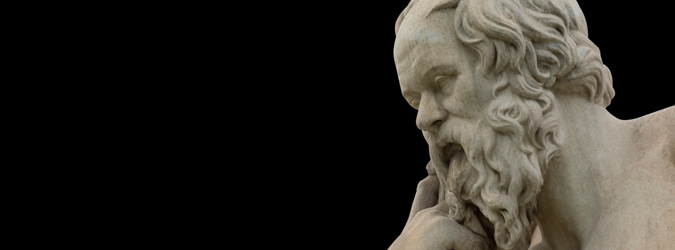
If Socrates were around today pondering this subject, he might ask, at what point does higher learning come at too great a cost – a nettlesome question posed by someone who had to drink a cup of hemlock for constantly poking about.
In medieval times, Galileo paid a high price to continue a scientific search of this planet’s place in the cosmos. To escape the clutches of the Inquisition that threatened his work, liberty and very life, he acquiesced (sort of) to his tormentors’ insistence that the sun circled the centering earth, instead of the other way around. In a likely apocryphal aside, he is said to have whispered wryly: “E pur si muove” (“And still, it [the earth] moves”). Recall, too, foolish Dr. Faustus, whose bargain for knowledge and power cost him his soul. Life, conscience and soul are about the costliest prices anyone can ever pay.

Ask many lawyers what they studied in college and chances are they will say they majored in the liberal arts. It’s easy to see why. The core values of a liberal arts curriculum – to deliver knowledge and wisdom with open-minded and independent inquisitiveness – serve attorneys well throughout their professional careers. They also serve society well, by producing an educated citizenry that helps democracy work. Yet today, the liberal arts are facing challenges never seen before, as a younger generation of students veers more and more toward technology programs that promise high paying jobs after graduation. This leaves liberal arts schools struggling with declining enrollments and trying to pay the bills by reaching out to alumni and private sources for donations and searching for more government funding to keep programs afloat. Yet, private and government funds can come with unwelcome tentacles, and that presents a huge challenge: How to keep liberal arts institutions free of narrow-minded political or partisan entanglements?
Using the Socratic practicum of raising questions and providing no answers, one might ask whether the mixed bag of public, and even private, funding exerts undue influence by the nature of fiscal freight of political and ideological intrigues. To be sure, not all financial assistance is ill-intended, though too often its subsuming motivations are hidden. In a time when external funding often comes with significant pressures, this and other questions directly impact the discussion around the importance of a liberal arts education.
The fact that the classical university model, started in Bologna, Italy, in 1088 A.D., survives in roughly the same pedagogic framework to this day provides a glimmer of hope that the modern version will escape the traps set by the tricky treasure hooks of grants and other funding sources. One thing seems likely not to survive: the so-called “liberal” arts curriculum, as the connotation of the word has lost its etymological equanimity and a penny-pinching loss of perspective has substantially wiped that traditional course of study from the academic curriculum. “Philosophy,” as the pure love of wisdom, often gives way to the more mundane power of the purse and utilitarianism.[1]
That said, part of the overall problem – significant, though surely not all – is whether institutions of higher education and their leadership possess the virtues of courage, vision, objectivity, and intelligence to resist the enticements of overbearing public funding. At the baseline, however, the critical need for public funding remains undeniable in connection with the research grant system that supports important discoveries in medicine, science, and advancement of the humanities. Society unquestionably benefits from the work of dedicated educators who also pursue their primary teaching roles, rendered with moral and intellectual integrity.
Finding and maintaining the right balance on the financial ledgers to support that dual mission does create, however, a dangerous dance with wolves. Grantors often appear disguised as innocent sheep, but underneath are government types, or beneficent philanthropists (“lovers of humanity”), with a few coyly hiding their “vaulting ambition”[2] (a form of philautia – lovers of self).[3] Not satisfied with named buildings and favored programs, some narcissistic donors often seek a voice at the table of the C-suites of academic leadership.
This discourse focuses principally on the academy itself and its need for robust resistance, or at least astute caution, against incursions that diminish intellectual freedom when inappropriate government influence infiltrates for the sake of wired fund transfers and grant contracts – visualized as a Trojan horse that rolls across the academic threshold to the “shocked” ministers of the enclosed academy. Caveat emptor (buyer beware)!
Consider, as one egregious example, an exposé of the University of Chicago in the Wall Street Journal.[4] It recounts the disastrous financial consequences when higher education jumps the shark of its core educational mission and instead outstretches toward the stars of mighty dollars to support hifalutin goals, like elite rankings status and educational celebrity. Socrates’ humility of purpose is missing when motivations push a mission creep that can lead to financial ruin or distress.
Let me turn to a higher plane of consideration and an exhortation that describes the educational mission in “The Idea of a University,” by John Henry Newman. In this book, Newman states that a university:
“aims at raising the intellectual tone of society, at cultivating the public mind, at purifying the national taste, at supplying true principles to popular enthusiasm and fixed aims to popular aspiration, at giving enlargement and sobriety to the ideas of an age, at facilitating the exercise of political power and refining the intercourse of private life.”[5]
I ruefully wonder about how his capacious mission statement could get lost among modern leaders of higher learning in their quest for ever-more robust funding to boost balance sheets along with overblown notions of elite celebrity status – an addiction-like craving at the expense of time devoted to education, per se, in lieu of fundraising as their priority portfolio task.
To be fair, the challenge of the practical modern world must be recognized, right along with idealists who yearn for the soaring aspirations of a John Henry Newman in his “Idea of a University,” or for a Thomas More in his “Utopia.” Bottom line, the big bills must still be paid and reliance on haloed saints just won’t clear the checks.
I also turn attention to some secular sources to fill in the picture. A former Yale Law School dean, Anthony Kronman, in his book, “The Assault on American Excellence,” opens with this blunt warning: “our colleges and universities are not political institutions [and] … their work is not the pursuit of politics by other means.”[6] The educational mission and political objectives are often obscured by funding entanglements that should serve as a caveat emptor – a canary in a coal mine. The allure of money often carries with it the danger of corruption of educational goals – susceptible to conflicts of interest and misaligned purposes.
John Sexton, former president of New York University and also a former dean at its law school, adds his voice to this subject in a book entitled “Standing for Reason – The University in a Dogmatic Age.”[7] Referencing Newman, he designates the university as a “sacred space.” The flipside is that the university should not be converted into something instead called a “safe space” that shuts down open discussion and the robust exchange of ideas that foster the pursuit of knowledge and wisdom in service of a better self and contribution to the civic good.
Keeping the educational mission somewhat sacrosanct within the bounds and controls of the academy itself is key here, though distortions from within by the academy leaders and teachers are another major problem – not always stemming from just financial considerations, but from a form of ideological indoctrination. (That broad subject would better be dealt with elsewhere, as it is beyond the scope of this commentary.)
I proffer one more secular source, to wit, Chief Judge /Justice Benjamin Cardozo, who wrote of a “hoarded treasure,” – a letter in the hand of his friend and predecessor at the Supreme Court, Oliver Wendell Holmes, who privately expressed a “measure of success” of any endeavor as “not place or power or popularity makes the success that one desires, but the trembling hope that one has come near to an ideal.”[8]
References of this kind pinpoint a “trembling hope” for “measuring success” in higher education, too, despite challenges of fiscal intermingling. My bottom-line assessment, therefore, is not a broad criticism as such of the world as it is, but a yearning for discernment, and a means for how to swing the fiscal pendulum back toward the in medio stat virtus[9] principle for the pristine mission ideal and operational reality of higher educational institutions. They are too essential and valuable as a civilizing attribute to society’s welfare to be allowed to be diminished, or worse, fail. So, how then can the success of the higher learning realm be measured under the Holmes-Cardozo gold standard in light of the fiscal resource incursions, especially from government entanglements?
Start with the plain fact that already sky-high tuitions cannot alone pay the freight. So, wherefrom comes the rest of the dollars for the relentless budget-busting demands? Annual operating funds flow, of course, from tuition and robust enrollments, prospects with the onset of artificial intelligence casting some doubts on the investment and value of time and money for meaningful jobs and sustaining careers from college degrees. They also flow from donations and endowments.
And then looms the “Big Nut” of governments providing funds either directly to public education institutions or through grants and specialized contracts of service or consultation to all kinds of educational entities, including private sector research institutions. Even indirect funding of public educational enterprises spreads the equation by ready access and availability for student assistance loans that bump enrollments to garner greater income for the colleges.
Major studies and reforms are needed also to bring about a redirection of massive endowment tax-benefited funds at elite institutions since they otherwise grow exponentially, traducing a mostly vanished imaginatively applied Rule against Perpetuities.[10]
A not-unrelated unease springs from the emergence of another phenomenon – out-of-control spending and pay packages in the athletics departments of many higher educational institutions. Some of them suffer scandalous exposés of non-academic personnel being disproportionately advantaged to the detriment of teaching personnel and the educational program. The rationalization that these programs, in turn, generate funds to support the educational mission is flimsy at best, as the programs are unfairly unequal in their distributive allocation; rather, the capital costs and operational costs likely siphon off far more than they return to the overall budget bucket.
Too many institutions of higher learning seem not satisfied with the classical middle ground attitude of striving principally for excellence of their educational outcomes, laying aside other distractions that diminish curriculum needs for the main purpose (see, e.g., lavish stadia and field houses that rise higher in importance and fiscal allocation over less costly library stalls and shelves with carrels for quiet private study.)[11]
Different governments of various tenures throughout history pursue their own interests to affect open discourse within the academy in service of non-academic ends – a contamination of First Amendment values – using money and other arm-twisting methods of persuasion of a given period or era. Such intrusions are more evident in our own time because we live the “breaking news” cycles in real time.
The academy, and now even the legal profession, can fall victim to the trap of collaboration with governmental powers-that-be because money rules, not high ideals. Compacts, academic regulations and controversial actions or inactions emerge and can even pop up in classrooms, as teachers punish or chill open discourse with questionable practices, unfair grading methods, or direct silencing of student expression. All such stratagems and policies deployed by governmental authorities to influence teaching practices and curricula should be anathema to the purity of purpose of the higher educational atmosphere and mission.[12]
Let me emphasize that I do not urge divestment or total disengagement from government funding or other tributaries of monetary support. The real world expects institutions to work mutually in collaborative common cause, with respect and grace, but with guardrails too, to protect the higher desiderata of the educational enterprise. Taking a page from the jurisprudence realm, realism must act as a counterweight to the idealism of a liberal arts education, and the funding rivers must be kept flowing and open to operate the universities. Educational policy, per se, however, must be formulated and implemented by educators, not manipulated by political leaders or bureaucrats; indeed, rigorous discipline must also be exerted to keep academic bureaucrats and teachers faithful to mission.
In sum, institutions of higher learning ought to be shielded somewhat like Caesar’s wife – kept at a reasonable remove and protected so as to remain true to their only spouse, that is, as independent and free from political and mercenary corrupting influences. Governments, after all, play to the changing flavors of electorates; they and their replacements also have a tendency toward domination and control during their temporary reigns in power. The academy, on the other hand, should remain fixed on its mission North Star, ignoring political winds and whims.
Like Socrates, I raise more questions and provide few answers. He tendered no apologies for his method, nor shall I.[13]
Caveat emptor!
Hon. Joseph W. Bellacosa (ret.) was a judge of the New York Court of Appeals from 1987 to 2000. He is also a dean emeritus and professor at St. John’s University School of Law.
Endnotes:
[1] Compare Hillsdale College, a traditionalist outlier founded in 1841 and located in Michigan, hewing to the classical liberal arts curriculum model while eschewing all governmental funding to preserve its pristine educational mission.
[2] From Shakespeare’s “Macbeth” 1.7.25-28: “Vaulting ambition,/which o’leaps itself,/ And falls on th’other.” (Among many required readings in a classical liberal arts curriculum!)
[3] See, Alan Blinder and Stephanie Saul, Wealthy People Have Always Shaped Universities. This Time Is Different, NY Times, Nov. 25, 2025. at A8.
[4] Sara Randazzo and Heather Gillers, Colleges Face a Financial Reckoning. The University of Chicago Is Exhibit A, Wall Street Journal (Oct. 30, 2025), https://www.wsj.com/us-news/education/colleges-face-a-financial-reckoning-the-university-of-chicago-is-exhibit-a-8918b2b0?mod=article_inlineWSJ.
[5] John Henry Newman was an Oxford Anglican don, later a Catholic cardinal, and recently declared a saint and doctor of his faith in 2019.
[6] Joseph W. Bellacosa, A Call for Higher Education Reform (book review), New York Law Journal (Oct. 11, 2019), https://www.law.com/newyorklawjournal/2019/10/11/a-call-for-higher-education-reform.
[7] Joseph W. Bellacosa, A Call To Bring Sacred Values Into the Fabric of a University (book review), NYLJ (June 26, 2019), https://www.law.com/newyorklawjournal/2019/06/26/a-call-to-bring-sacred-values-into-the-fabric-of-a-university.
[8] Benjamin Nathan Cordozo, Selected Writings of Benjamin Nathan Cardozo, edited by Margaret E. Hall (University of California, 1947), p. 86.
[9] “Virtue is located in the middle” – a principle from St. Thomas Aquinas adapted from a maxim in Aristotle’s “Ethics” (more required reading in a classical curriculum).
[10] The medieval Rule of Perpetuities, wisely operative for the common good to control inordinately perpetual wealth accumulations, somewhat limited generational hoarding of real property and personal assets to something like transfers within two lives in being plus 25 years. It helped to free up the alienation of property – a rule that was whimsically the bane of countless law graduates fearing a complicated question on bar exams in that genre. Would that something like that venerable rule could be shaped to rein in abuses of hoarding such massively accumulating funds, ad infinitum. These bloated mountains of assets seem to operate as offshore tax-free havens with little oversight or social accountability, except for their own aggrandizement.
[11] Shakespeare, “Julius Caesar,” 4.3.23-28: Brutus: Contaminate our fingers with base bribes and sell the mighty space of our large honors. For so much trash as may be grasped thus? I had rather be a dog and bay at the moon, than be such a Roman. (More classical reading requirements of a liberal arts education!)
[12] Joseph W. Bellacosa, Regulation of Hate Speech by the Academy vs the Idea of a University: A Classic Oxymoron? 67. St John’s Law Review, 1 (1993).
[13] A series of Socratic-like questions persist: Who is the “buyer” who must “beware?” (a) The schools? (b) The current taxpayers, whose taxed incomes ultimately provide the funds? or (c) Future generations saddled with the insatiable everyday-growing national debt?
Copy Direct Link
Source Copy Link