To Get to the Truth, Go to the Primary Source, Says New York State Bar Association Media Literacy Panel
10.21.2025
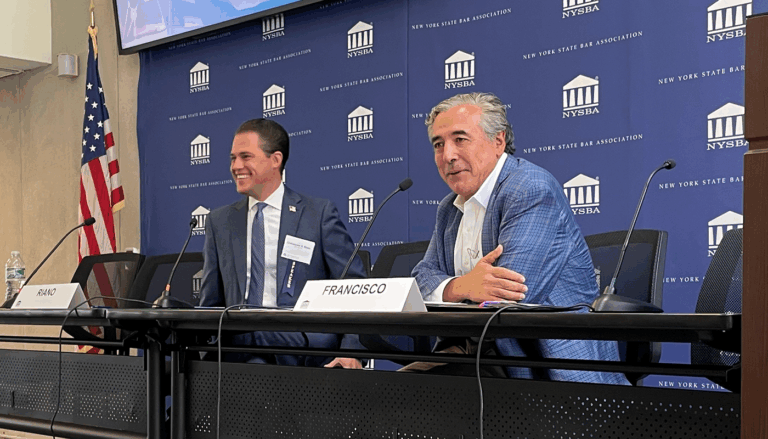
As Americans are bombarded by information, they need tools and resources to sort fact from fiction. To that end, the New York State Bar Association hosted an all-day convocation on the necessity of media literacy, and how the legal profession can help the public understand and participate in civic life in order to protect the rule of law.
“Today’s convocation could not be more necessary in an era where digital manipulation can shape public opinion,” President Kathleen Sweet said in her opening remarks. “Misinformation, disinformation and misrepresentation spread with an unprecedented ease and speed. There’s deceiving social media posts and AI hallucinations. As members of the legal community, we share responsibility to help the public evaluate information, pursue and amplify the truth, think critically, and participate meaningfully in our democracy.”
Chief Judge Rowan Wilson of the New York State Court of Appeals spoke about the importance of education to build up media literacy. “We’ve reached the point where some are using the internet to destroy the truth,” he said. “But we’re not yet at the point where those expressing the truth will always be disbelieved in favor of those who accommodate comfortable lies.”
The convocation kicked off with a panel to examine the state of media literacy.
“In addition to being an advocate, you need to be a role model,” said Howard Schneider, executive director of SUNY Stony Brook University’s Center for News Literacy. “I don’t care who you are. You need to go back to your family and your friends, and you have to stand up for facts. You have to stand up and make sure that you are not inadvertently spreading false and fake information… One of the great underlying principles of media literacy is that we are not victims. We are in control of our information life if we want to be.”
Digging Deeper Into Supreme Court Decisions
Noel Francisco, partner-in-charge of Jones Day in Washington, D.C., and the solicitor general of the United States from 2017 to 2020, spoke with Christopher Riano, a constitutional scholar on media literacy, of counsel at Holland & Knight, and past chair of the LGBTQ+ Law Section. Francisco discussed how media coverage of the U.S. Supreme Court affects the public’s perception of court cases.
For example, Francisco said National Labor Relations Board v. Noel Canning, which he argued in front of the Supreme Court, was framed as a political issue when it was really about the president’s power to appoint officials when the Senate is in recess – when otherwise such appointments would have required a Senate vote. However, sometimes during recess, the Senate meets in one-minute, pro forma sessions.
“It happened to be that President Obama was the first person to challenge that process when he made recess appointments to the National Labor Relations Board during these one-minute sessions,” said Francisco. “He claimed that they were not legitimate sessions and therefore he could make the recess appointments, because the Senate was in fact in recess.”
Francisco represented Noel Canning, a Pepsi bottling company that was regulated by the National Labor Relations Board and decided to challenge the recess appointments.
“At the time, this became this huge political issue – Republican versus Democrat issue,” said Francisco. “All the Republicans lined up for us, all the Democrats lined up against us because it was President Obama who made the appointments. I can guarantee that if in the Bush administration, they had done what President Obama did, the politics would have lined up in the exact opposite direction. I never viewed this case as one having a Democrat-Republican political lens because both parties have been subjected to this process, and Congress said both parties abused this process. It just happened to be the time that this case brought into the courts happened to be a Democrat president and a Republican Congress. So, I think it’s a really good example of where you do need to step back and ask yourself – ‘is this really the partisan issue that people are portraying it to be, or is it something that has a lot more layers?’”
To that end, Francisco also addressed the importance of critical reasoning and evaluating information seen on the internet – even if you agree with it.
Riano recommends that Americans read Supreme Court decisions – including the majority opinions and the dissenting opinions – to get the full context from the primary source.
“My mother gets very energized when she reads about Supreme Court cases in the news because of the world that we’re in,” he said. “We instituted my own media literacy rule, which is: ‘I don’t want to hear about what you’ve read in the news. You have to actually read the Supreme Court opinion, and then you can call me and talk to me about it.’ It saves me a few days, because she takes her time to read it, [and] she then knows what the opinion actually says.”