Understanding the 9/11 Victim Compensation Fund
8.11.2025
Preparing a wrongful death case in Surrogate’s Court might feel like a daunting task for new attorneys. But it doesn’t have to be.
The Trusts and Estates Section of the New York State Bar Association hosted a continuing legal education course that provides a comprehensive overview of wrongful death proceedings in Surrogate’s Court. The full 90-minute program is available here.
The course was taught by Diane Matero, a court attorney-referee in Kings County Surrogate’s Court. Matero discussed the process of filing a claim with the 9/11 Victim Compensation Fund.
The federal government established the fund within days of the Sept. 11 terrorist attacks. The fund has been expanded and reauthorized several times since 2001 and received permanent authorization by President Trump in 2019. The fund is administered by a special master within the U.S. Department of Justice. The fund now covers those who have since been sickened by 9/11 related illness including cancer, respiratory conditions, traumatic injury and mental health conditions. New conditions are certified as a 9/11 related illness each year by the World Trade Center Health Program.
Registering with the Fund and Filing a Claim
The first step in filing a claim is to register with the Victims Compensation Fund. Claimants should register within two years of being diagnosed with a 9/11 related illness although many people who were in the exposure zone after the attacks will register even if they are not sick. If a person dies from a 9/11 illness and had not registered prior to death, a personal representative must register with the fund within two years of the death. The World Trade Center Health Program may certify a health condition as a 9/11 illness after victims have died. In that case, a personal representative must register the victim’s name with the fund within two years of the Victim’s Compensation Fund verifying the cause of death as a 9/11 related illness.
Matero reminded attendees that to be appointed as a personal representative for a deceased victim, the person must file a petition for letters of administration or for probate and letters testamentary in Surrogate’s Court. If the victim has co-fiduciaries, one person must be designated as the lead personal representative with the Victims Compensation Fund.
Once registration is complete, the client can begin filing a claim.
“They can amend that claim in the future to add that second illness,” she said. “If the person dies, the personal representative can amend the claim to add wrongful death action to the claim.”
Matero reminds lawyers that victims filing a claim must understand that they are waiving their right to participate in lawsuits.
“The Victims Compensation Fund is intended as an alternative to litigation. It’s meant to expedite compensation to victims without spending the time and money involved in litigation,” Matero said. “It is only when you file a claim, not when you register, that you are waiving your right to sue.”
Matero outlines three types of awards from the Victims Compensation Fund:
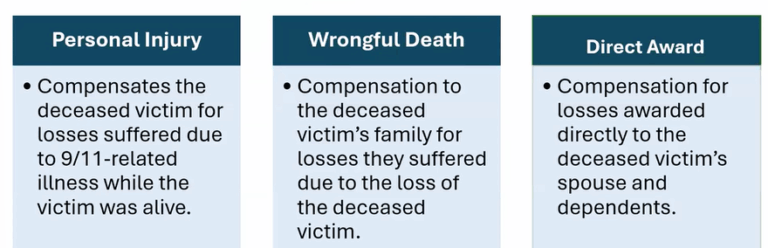
The Victims Compensation Fund will calculate both economic loss and non-economic loss including pain and suffering. The fund will offset compensation from other sources including life insurance, Social Security disability and survivors benefits and workers’ compensation benefits. The registrant will receive an award letter with a breakdown of offsets and attorney fees.
“The Victims Compensation Fund caps attorney fees at 10% of the award. The fund will not reimburse attorneys for obtaining supporting documents, printing, mailing, delivery services or staff expenses. The special master may allow non-routine expenses in excess of the cap,” Matero said.
Finally, Matero encouraged all attorneys to get to know the staff at the Surrogate’s Court in their county. Each court has its own process, and the staff is willing to answer questions.
“Each court may have their own requirement, and you want to check with them first,” she said. “Remember we are the unified court system. We are not the uniform court system.”
The full course is available on demand here.