Chief Judge Wilson Traces the Evolution of ADR and Highlights NYSBA’s Role
4.29.2026
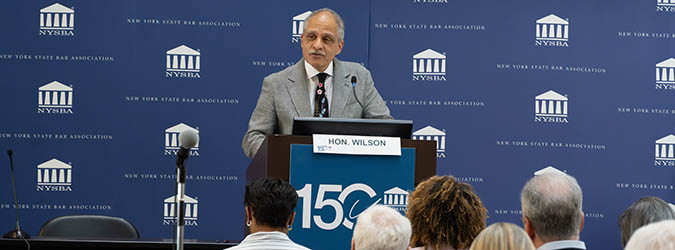 At the New York State Bar Association’s Dispute Resolution Section and Labor and Employment Law Section Spring Meeting on Friday April 24, Chief Judge Rowan Wilson delivered a historical and thoughtful reflection on the development of alternative dispute resolution and its growing importance in modern legal practice.
Judge Wilson situated ADR within a long arc of legal history, noting that while often viewed as a contemporary innovation, its roots stretch back to ancient Athens – public arbitrators (diaitetai) designed to relieve pressure on courts. He then turned to New York’s own jurisprudential evolution, focusing on early 20th-century resistance to arbitration highlighted by the Meacham v. Jamestown, Franklin & Clearfield Railroad Co. decision, where the New York Court of Appeals viewed arbitration agreements as an impermissible attempt to oust judicial authority.
That skepticism, Wilson explained, gave way to a fundamental shift in public policy. With the enactment of the New York Arbitration Act of 1920, the first modern arbitration statute in the country, New York helped legitimize arbitration as an enforceable and practical alternative to litigation. The Court of Appeals’ subsequent decision in Berkovitz v. Arbib & Houlberg, Inc., authored by Judge Benjamin N. Cardozo, upheld that shift, rejecting constitutional challenges and cementing arbitration’s place in the legal system.
Wilson emphasized that these developments did not occur in isolation. New York’s approach quickly influenced other states and the federal government, with the Federal Arbitration Act drawing directly from New York’s model. Together, these changes marked a transition from rigid adjudication toward more flexible, party-driven dispute resolution.
Turning back to the modern era, Judge Wilson framed ADR as a practical necessity in a legal environment defined by limited time, resources, and institutional capacity. Beyond efficiency, he noted, arbitration and mediation offer a means of resolving disputes in ways that preserve relationships and produce more durable outcomes.
Looking ahead, the Chief Judge described the next phase of ADR as one focused on expansion and refinement, broadening its reach while continuing to build trust in its processes. He encouraged practitioners to carry that work forward in partnership with the courts.
In that context, Chief Judge Wilson acknowledged the role of the New York State Bar Association, expressing appreciation for its consistent engagement with the court system and its sections’ contributions to advancing dispute resolution practices, and highlighted the diligent work of President Kathleen Sweet and looked forward to working with President-elect Grays.
Judge Wilson’s remarks positioned ADR not as an adjunct to the legal system, but as a central and evolving component of American jurisprudence, one in which NYSBA has and will continue to play a defining role.